Category | AI And ML
Last Updated On 19/01/2026
Dashboards are everywhere, yet answers still take days. Data teams spend more time cleaning data than analyzing it. This is exactly why generative AI for data analytics is gaining so much attention. It changes analytics from manual work into fast, conversational insight generation.
In analytics workshops and enterprise training sessions, one pattern appears repeatedly: teams already have data and dashboards, but still rely on analysts to manually explain results. Generative AI is gaining traction because it removes this dependency gap.
This blog explains how generative AI for data analytics is reshaping daily analytics work, where it adds real value, and how teams can start using it in practical ways without turning everything upside down.
Traditional analytics relies on rules, predefined queries, and fixed dashboards. You ask a question only if the report already exists. Generative AI for data analytics flips that model.
Instead of rules, AI learns patterns. Instead of static reports, it creates insights on demand. This is why generative AI in data analytics feels very different from traditional BI or even classic machine learning.
Key differences include:
Natural language interaction instead of SQL or formulas
Automated insight generation, not just visualization
Context-aware summaries that explain “why,” not just “what”
Business teams don’t want more charts. They want answers. Generative AI for data analytics meets that need by combining data understanding, language, and reasoning into one workflow. In real analytics environments, the biggest shift users notice is not faster dashboards—but faster understanding. Business users consistently value explanation and context more than visualization depth.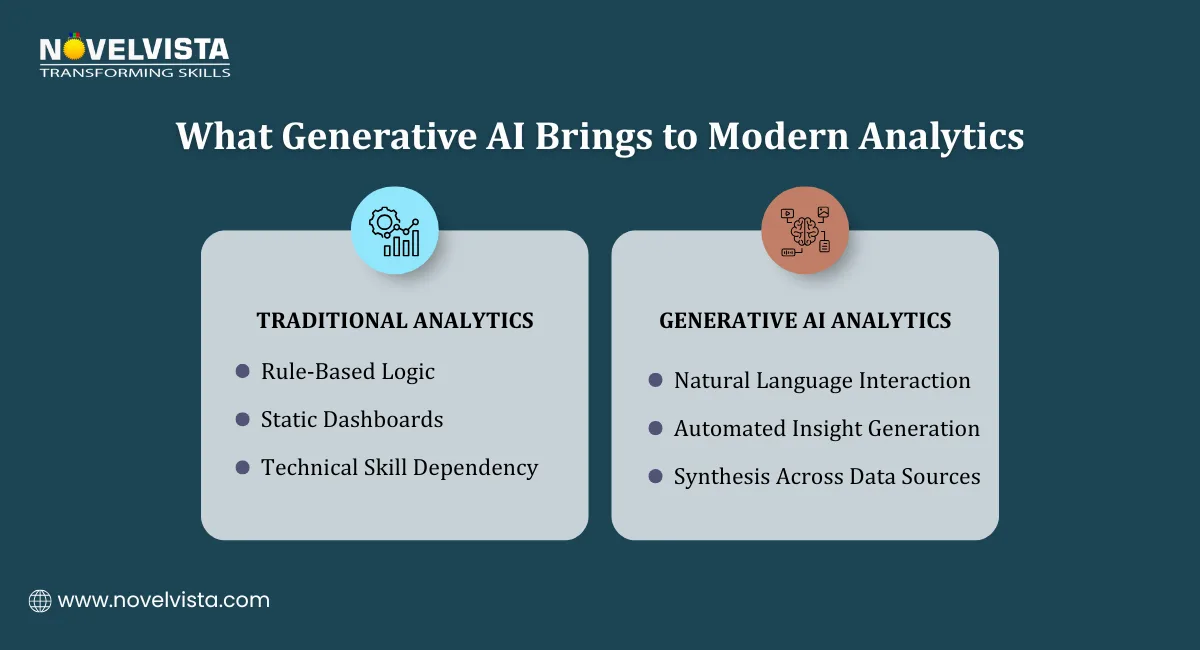
This is where the real value shows up. These generative AI use cases in data analytics are already delivering results across industries.
Data prep has always been the most time-consuming part of analytics.
Generative AI:
Detects missing or inconsistent values
Suggests fixes automatically
Structures raw datasets for analysis
Teams see 50–70% time savings compared to manual data preparation. This alone makes generative AI for data analytics worth exploring.
Instead of writing queries, users simply ask questions like:
“Show Q4 sales trends by region”
“Why did customer churn increase last month?”
The system generates:
Charts
Short explanations
Key takeaways
This is one of the most visible ways generative AI in data analytics helps non-technical users get insights instantly. To maintain trust, experienced teams limit conversational analytics to curated datasets and validated metrics, ensuring that AI-generated answers align with governed data models rather than raw sources.
Real data often comes with privacy risks. Generative AI can create high-quality synthetic datasets that behave like real data.
This enables:
Safe testing and modeling
Compliance-friendly analytics
Use in healthcare and finance
Synthetic data is becoming a core generative AI use cases in the data analytics area for regulated industries.
Traditional analytics tells you what happened. Generative AI goes further.
It can:
Forecast trends
Simulate scenarios like supply chain disruptions
Recommend actions, not just predictions
In practice, analytics teams report the most value when generative AI is used to support decisions, not replace them by offering scenarios and recommendations that analysts can validate before action.
This moves analytics closer to decision-making, which is the real goal of generative AI for data analytics.
Executives don’t want raw outputs. They want summaries.
Generative AI:
Converts analysis into executive-ready narratives
Builds presentation-style reports
Explains insights in simple language
This reduces analyst workload while improving clarity for leadership.
Different industries are already using generative AI in data analytics in focused ways:
Retail: inventory forecasting, demand planning
Finance & marketing: tax analysis, personalization models
These use cases show that value comes from targeted application, not broad experimentation.
Several platforms are accelerating adoption by making AI easy to use, even for non-technical teams.
These tools reduce dependency on great technical skills, making generative AI for data analytics accessible to a wider audience.
Many teams ask how to start without breaking existing analytics setups. The answer is to apply generative AI for data analytics gradually, where it reduces effort first.
A practical way to apply it looks like this:
Start by spotting where time is being lost:
These areas benefit most from generative AI in data analytics early on.
Not every team needs the same tools.
This avoids overengineering while still gaining value.
A simple and safe entry point:
This is one of the easiest ways to learn how to use generative AI in data analytics without changing core systems.
Once trust builds, teams can:
At this stage, generative AI for data analytics moves from support to decision enablement.
Before using sensitive data:
This approach lowers risk while scaling adoption.
AI-generated insights still need human review:
Mature teams treat generative AI outputs as decision support, not decision authority. Human validation remains a core control point, especially for financial, operational, and customer-facing insights. This keeps analytics reliable and trustworthy.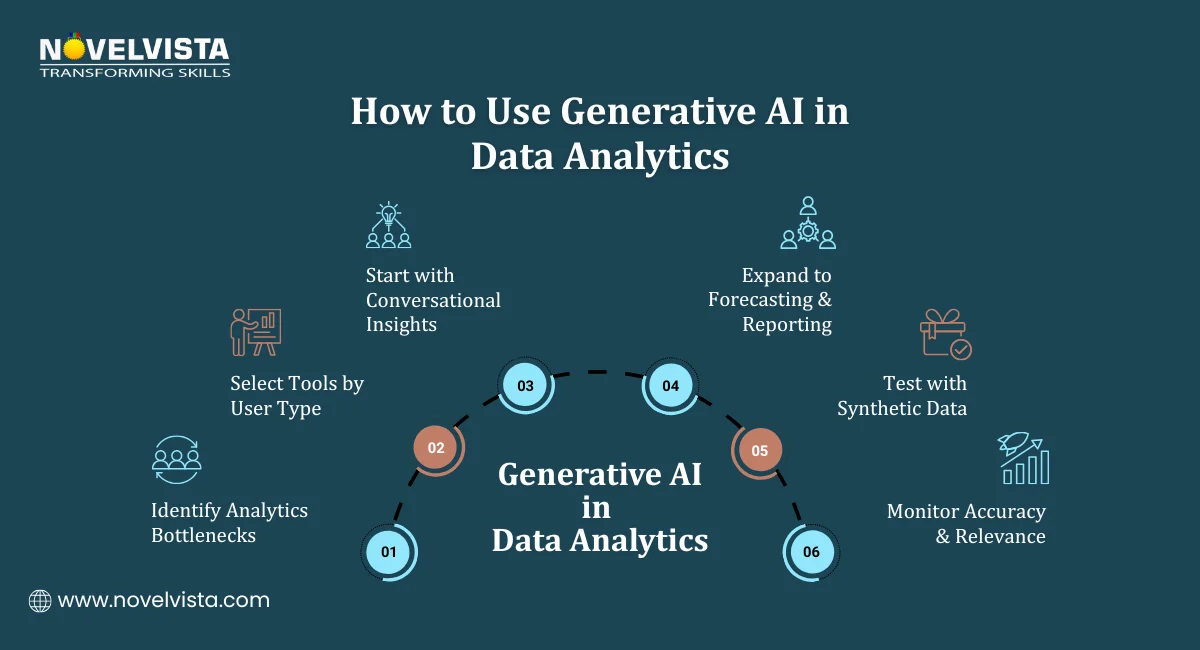
While powerful, generative AI in data analytics comes with real challenges that teams must plan for.
Common issues include:
Data privacy risks: Sensitive data can be exposed if controls are weak.
Bias in outputs: AI reflects the data it learns from, including gaps and skew.
Explainability concerns: Business users may struggle to trust results without clear reasoning.
Integration and cost pressure: Early adoption may require new tools and skills.
Recognizing these challenges early helps teams avoid disappointment later.
Successful teams balance speed with control when applying generative AI for data analytics.
Effective mitigation strategies include:
Use synthetic data and encryption: This protects sensitive information and supports compliance needs.
Run regular bias and quality checks: Review outputs to ensure fairness and accuracy.
Apply explainable AI practices: Use summaries, logic explanations, and traceable outputs.
Track ROI clearly: Measure time saved, faster insights, and reduced manual effort.
Responsible adoption frameworks emphasize governance, transparency, and measurable outcomes. Teams that formalize these controls early see higher trust and sustained adoption of generative AI in analytics.
The role of generative AI in data analytics will expand quickly over the next few years.
Key trends expected by 2026 include:
Automation across the full analytics lifecycle
Wider adoption by non-technical business users
Faster decision cycles driven by conversational insights
Generative AI is becoming a default layer in analytics platforms
As this happens, knowing how to use generative AI in data analytics will become a core skill, not a niche advantage.
Generative AI for data analytics is no longer experimental. It is becoming a foundational part of modern analytics workflows. Organizations using generative AI use cases in data analytics gain faster insights, reduce manual effort, and improve decision clarity.
Across early adopters, the most successful implementations start small, often with reporting and insight summarization before expanding into forecasting and automation.
The teams that succeed are not the ones that rush, but the ones that start practical, govern responsibly, and scale with purpose.
Author Details

Course Related To This blog
Generative AI Professional
Generative AI in Project Management
Generative AI in Risk & Compliance
Generative AI in Marketing
Generative AI in Finance and Banking
Generative AI in Cybersecurity
Generative AI in Business
Confused About Certification?
Get Free Consultation Call
Stay ahead of the curve by tapping into the latest emerging trends and transforming your subscription into a powerful resource. Maximize every feature, unlock exclusive benefits, and ensure you're always one step ahead in your journey to success.