Category | AI And ML
Last Updated On 27/02/2026
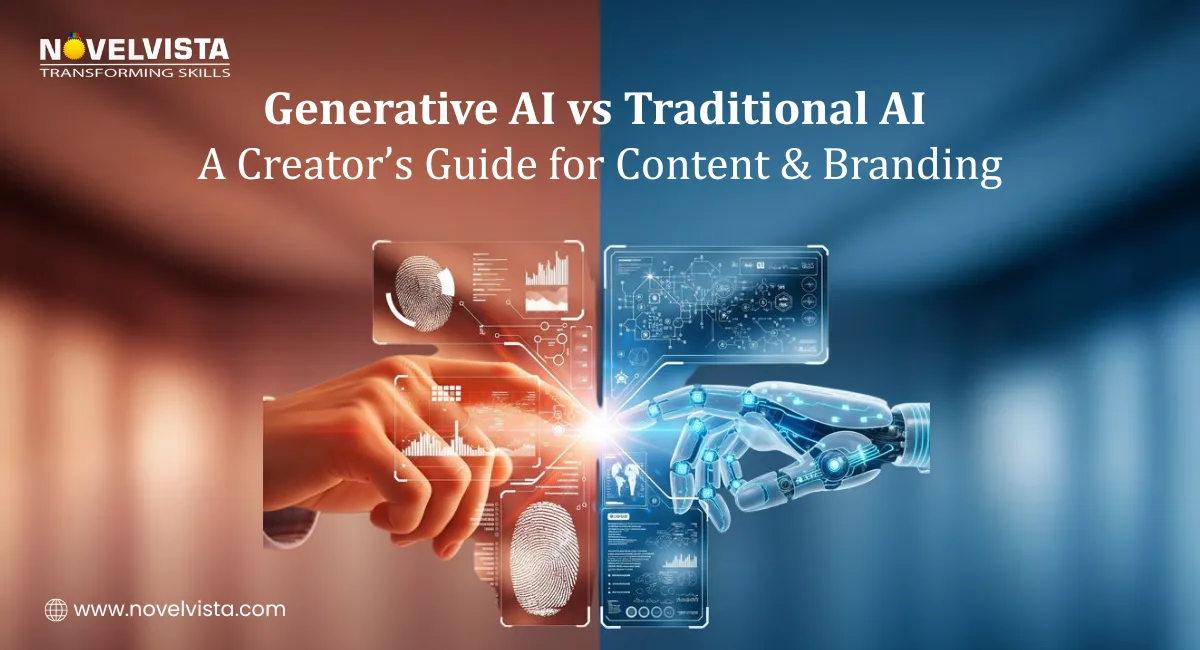
The conversation around Generative AI vs Traditional AI is no longer about future potential. In 2026, it directly affect how creators plan content, how brands grow audiences, and how marketing teams scale without losing originality.
Many creators feel stuck between two extremes. On one side, traditional AI tools offer data, predictions, and insights, but feel limiting for creativity. In creator-focused AI training sessions, many professionals discover they have already been using traditional AI through platform algorithms, analytics dashboards, and fraud detection tools, long before adopting generative AI consciously.
This article explains where each approach fits. You’ll understand the real difference between AI models, how AI for Content Creators 2026 is evolving, the tools creators actually use, and how both forms of AI work better together than apart.
TL;DR – Quick Summary
| Topic | Key Takeaway |
| Traditional AI | Predicts, analyzes, optimizes |
| Generative AI | Creates new content at scale |
| Creator impact | Faster creation, smarter decisions |
| Best approach | Hybrid: analyze + generate |
| 2026 trend | AI as co-creator, not replacement |
Traditional AI has been part of digital systems for years, even before most creators noticed it. It works by analyzing structured, labeled data to make predictions or decisions. Examples include recommendation engines, spam filters, fraud detection, and engagement analytics.
Generative AI works very differently. Instead of just analyzing data, it learns patterns from massive amounts of mostly unstructured content, text, images, video, audio, and uses those patterns to create something new. That could be an article draft, a design, a video script, or even a voice clone.
The simplest way to understand the difference:
Traditional AI answers: What is likely to happen next?
Generative AI answers: What can be created next?
This gap explains the difference between AI algorithms and generative models in everyday creator workflows. One supports decisions. The other supports creation.
Get a comprehensive knowledge of Generative AI in our In-depth blog explaining its application, benefits, and future trends.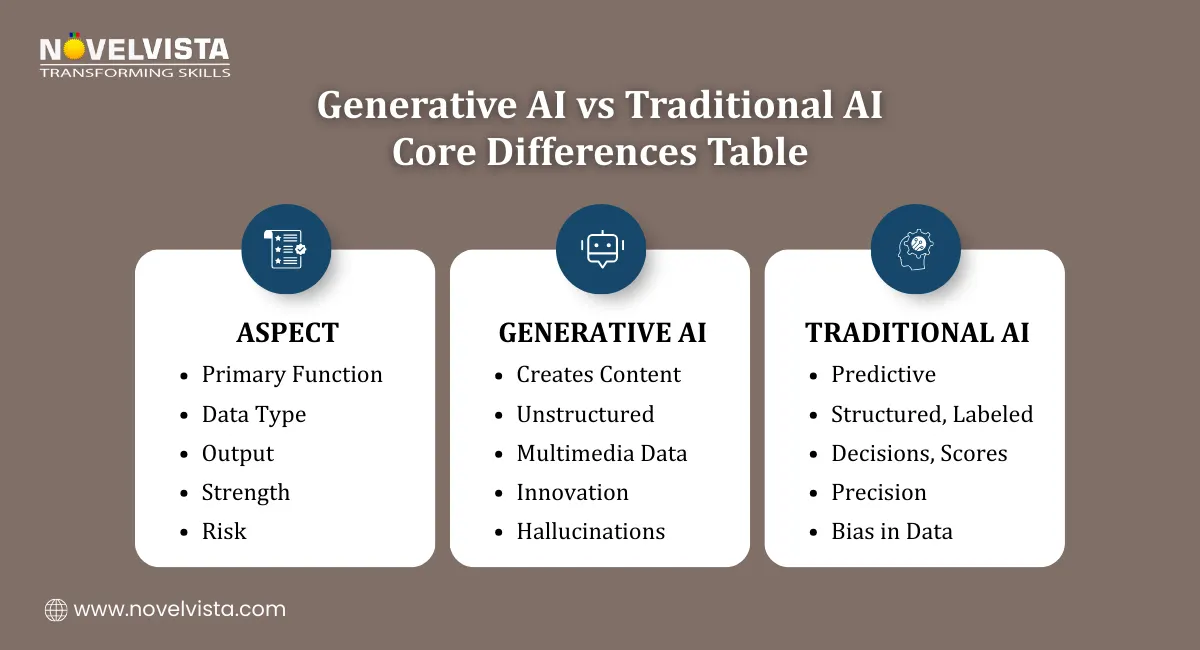
In the generative AI vs traditional AI discussion, traditional AI refers to systems built to analyze structured data and make predictions or decisions. It focuses on accuracy, consistency, and repeatable outcomes.
Traditional AI powers tools like recommendation engines, analytics platforms, fraud detection, and search algorithms. It does not create content; instead, it optimizes decisions by identifying patterns and predicting what is likely to happen next.
When comparing traditional AI vs generative AI, generative AI is designed to create new content. It learns from large, mostly unstructured datasets such as text, images, audio, and video, then generates original outputs.
Generative AI can produce articles, visuals, scripts, designs, and code. Rather than predicting outcomes, it focuses on generating possibilities, making it flexible and creative—but dependent on good prompts and human oversight.
Quick Comparison
| Aspect | Generative AI | Traditional AI |
| Core function | Designed to generate original content by learning patterns and producing new outputs. |
Designed to predict outcomes, classify data, or support decisions based on learned rules. |
| Data type | Trained on large volumes of mostly unstructured data such as text, images, audio, and video. |
Works primarily with structured, labeled datasets that follow predefined formats. |
| Output | Produces creative outputs like text, images, videos, audio, designs, and code. |
Produces analytical outputs such as scores, classifications, recommendations, or automated actions. |
| Strength | Excels at creativity, speed, and handling open-ended or ambiguous tasks. |
Excels at reliability, accuracy, and delivering consistent, predictable results. |
| Risk | Can generate hallucinations or biased content if prompts and context are not well defined. |
Limited in creative capability and struggles with tasks beyond predefined rules or patterns. |
Creators who understand these limits tend to use both more effectively, especially as AI for Content Creators 2026 continues to mature.
The biggest shift by 2026 is mindset. AI is no longer treated as a shortcut or gimmick. It acts more like a co-pilot.
Nearly 90% of synthetic digital content now involves generative systems in some form. At the same time, traditional AI still runs quietly in the background, deciding what content gets shown, when it’s published, and who sees it.
Artificial Intelligence in Content Marketing has become a hybrid system:
Humans define voice, values, and story direction
AI accelerates drafting, variations, and personalization
Analytics engines optimize reach and performance
Key changes creators notice today:
Multi-modal creation (text + image + video together)
Memory-based tools that retain brand voice
Context-aware editing instead of generic rewriting
For AI for Content Creators 2026, success depends less on tool choice and more on how well creators guide the system.
The explosion of AI Content Creation Tools has made advanced capabilities available to non-technical users. The most popular tools focus on ease, speed, and consistency rather than deep configuration.
Commonly used tools include:
ChatGPT 5.1 – Writing, ideation, scripting, repurposing
Jasper Brand Voice 2.0 – Tone consistency across teams
Canva Magic Studio – Visuals, carousels, short videos
Descript Overdub – Podcast and voice editing
Midjourney V7 – Visual storytelling and thumbnails
Video-focused creators rely on:
Runway Gen-3
OpusClip
Synthesia avatars
Workflow support tools include Notion AI and Zapier for automation. Together, these AI Content Creation Tools reduce production time while keeping creators in control.
Among these, many fall into the category of Best AI tools for creators without technical skills, which explains their rapid adoption.
Also Read: Top Generative AI Tools Transforming Industries Globally
While generative tools grab attention, many growth decisions still rely on traditional systems. Traditional AI examples for social media growth focus on optimization rather than creation, and most creators already depend on them, often without realizing it.
Common uses include:
Recommendation engines that decide which posts reach which audience
Predictive models that suggest the best posting time and frequency
Fraud detection systems that flag fake followers or engagement spikes
Sentiment analysis tools that evaluate audience response and tone
These systems form the strategy layer. They analyze patterns, spot trends, and reduce guesswork. Generative tools then build on those insights to personalize content at scale. Used together, they make Artificial Intelligence in Content Marketing both creative and measurable.
A practical shortlist of AI tools professionals are actually using, mapped by role, use case, and real productivity gains (not hype).
Understanding how to use generative AI for personal branding starts with one rule: protect your voice.
The most effective creators do not let AI speak for them. They use it to refine, expand, and experiment.
A practical approach looks like this:
Use ChatGPT or Claude to expand ideas and structure thoughts
Refine tone using prompts that reflect your past content
Generate visuals with Midjourney that match your brand style
Optimize drafts with SEO tools before publishing
AI handles speed and variation. Humans finalize emotion, judgment, and intent. This balance is why creators who learn how to use generative AI for personal branding build trust faster than those who rely on automation alone. In practical creator workshops, the strongest personal brands are consistently those where AI is used as an enhancement tool rather than a direct replacement for the creator’s voice.
Knowing how to integrate AI into a creative workflow means treating AI as a layered system, not a single tool.
A common hybrid workflow used by creators in 2026 looks like this:
Ideation: ChatGPT or Notion AI for trend discovery and outlines
Creation: Generative AI for drafts, visuals, and captions
Production: Descript or Runway for editing and polishing
Optimization: Traditional AI analytics and SurferSEO
Distribution: Automation via Zapier or scheduling platforms
In this setup:
Traditional AI segments, predicts, and analyzes
Generative AI personalizes and creates
In real-world content teams, AI adoption succeeds faster when workflows are redesigned around stages rather than tools, reducing confusion and over-automation. This structure helps creators scale without losing quality, especially as AI for Content Creators 2026 continues to evolve.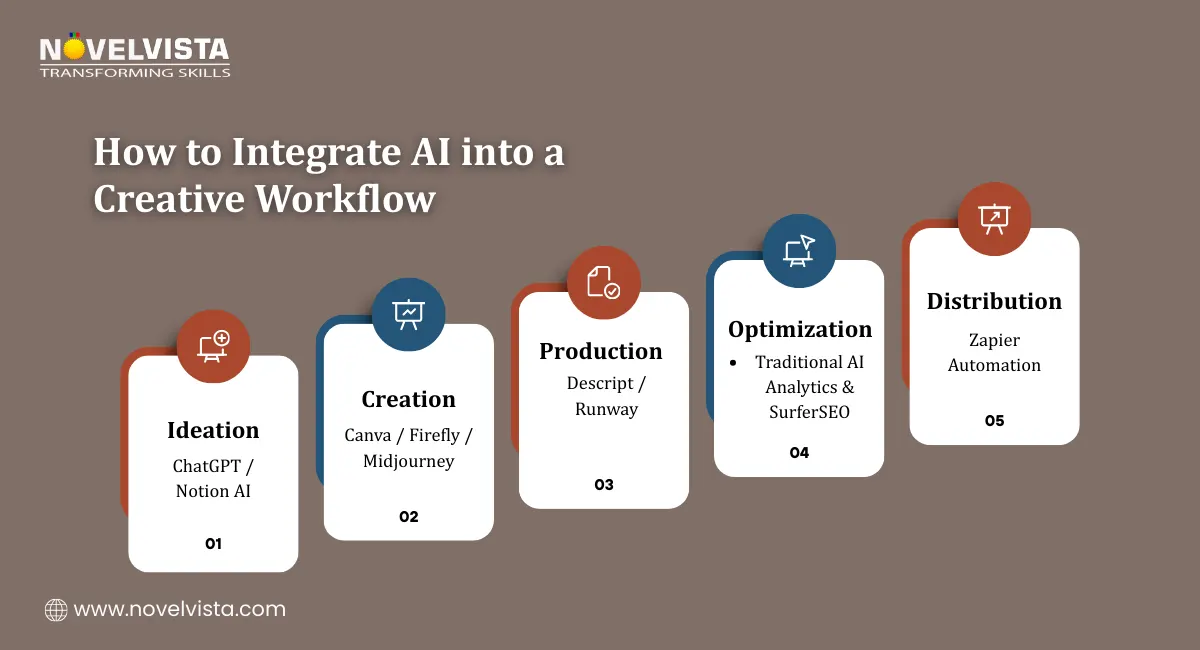
The most successful creators don’t choose sides in the Generative AI vs Traditional AI discussion. They use both intentionally.
Generative AI brings:
Traditional AI brings:
Together, they reduce guesswork while increasing output. This hybrid approach defines modern Artificial Intelligence in Content Marketing, where creativity and analytics work side by side.
Generative AI vs Traditional AI is not a competition. It’s a collaboration.
In 2026, creators win by knowing when to generate, when to analyze, and when human judgment must lead. AI can speed up ideas, polish drafts, and guide decisions, but authenticity still comes from people.
Long-term audience trust continues to depend on authenticity, consistency, and accountability, areas where human oversight remains essential regardless of AI capability.
Creators who master this balance build faster, smarter, and more trusted brands, using AI as support rather than a substitute.
Next Step
If you want to move from experimenting with AI to using it confidently in real marketing work, structured learning makes the difference. NovelVista’s Generative AI for Marketing and Generative AI Professional certification programs focus on practical use cases, real workflows, and responsible adoption. You’ll learn how to combine creativity with data, use AI tools effectively, and apply them to campaigns, branding, and growth strategies without losing originality or control.
Author Details

Course Related To This blog
Generative AI Professional
Agentic AI Certification
Confused About Certification?
Get Free Consultation Call
Stay ahead of the curve by tapping into the latest emerging trends and transforming your subscription into a powerful resource. Maximize every feature, unlock exclusive benefits, and ensure you're always one step ahead in your journey to success.