Category | AI And ML
Last Updated On 22/05/2026
Enterprise teams increasingly face the challenge of selecting the right AI approach for their business problems. But what separates deep learning from traditional machine learning? Understanding this distinction is crucial for effective AI adoption in corporate settings.
This blog explores the core differences between deep learning and machine learning, highlights their practical applications, and offers guidance for L&D and AI teams seeking to deploy these technologies efficiently.
Enterprise teams often use the terms machine learning and deep learning interchangeably, but the two represent distinct approaches to AI. This section introduces the differences, helping organizations choose the right strategy for their business objectives.
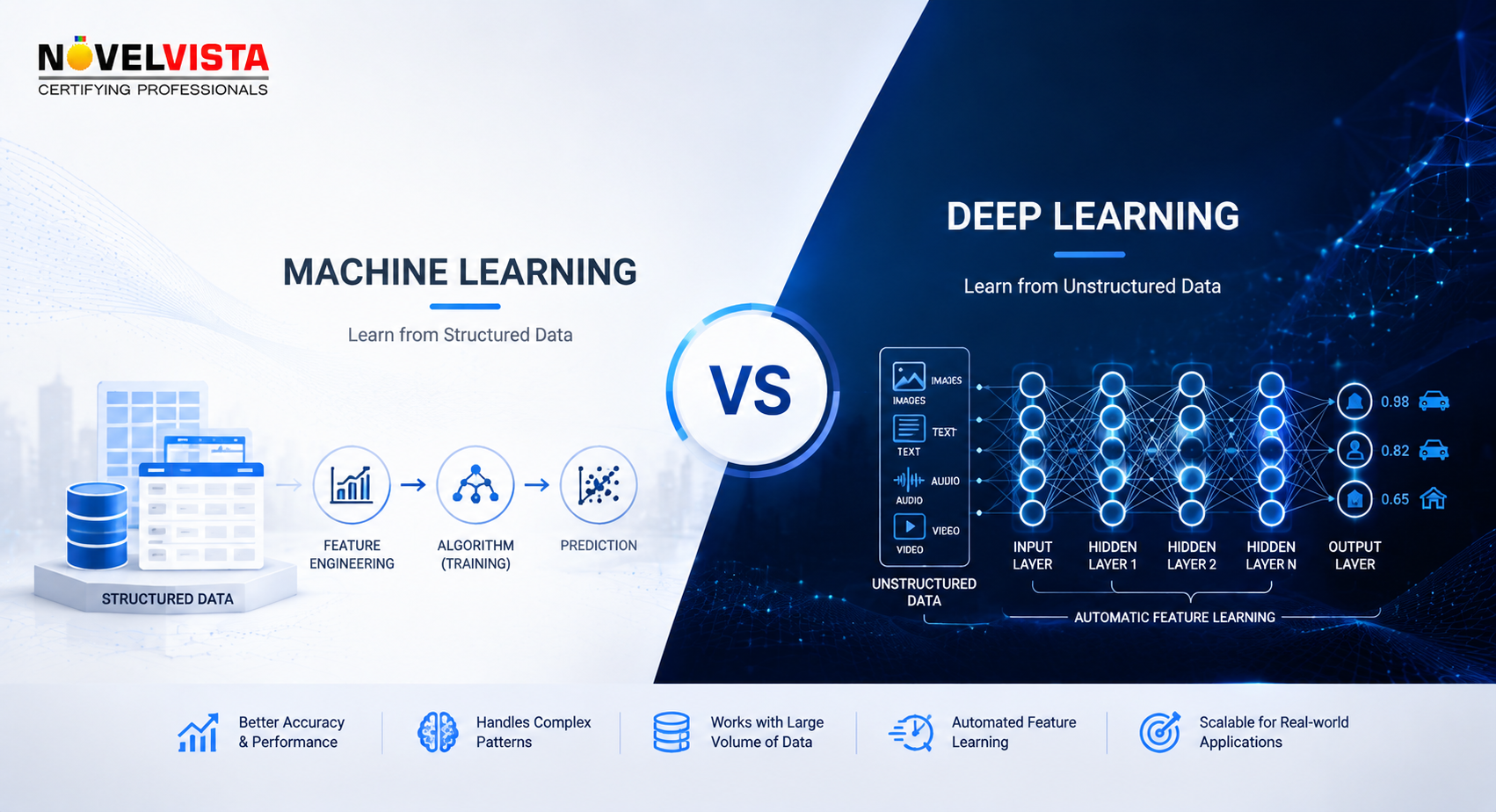
Machine learning (ML) is a subset of AI that enables systems to learn patterns from data without explicit programming. Deep learning (DL), a specialized form of ML, uses multi-layered neural networks to model complex patterns and make high-accuracy predictions.
Understanding this foundational distinction is critical for enterprise adoption and project planning.
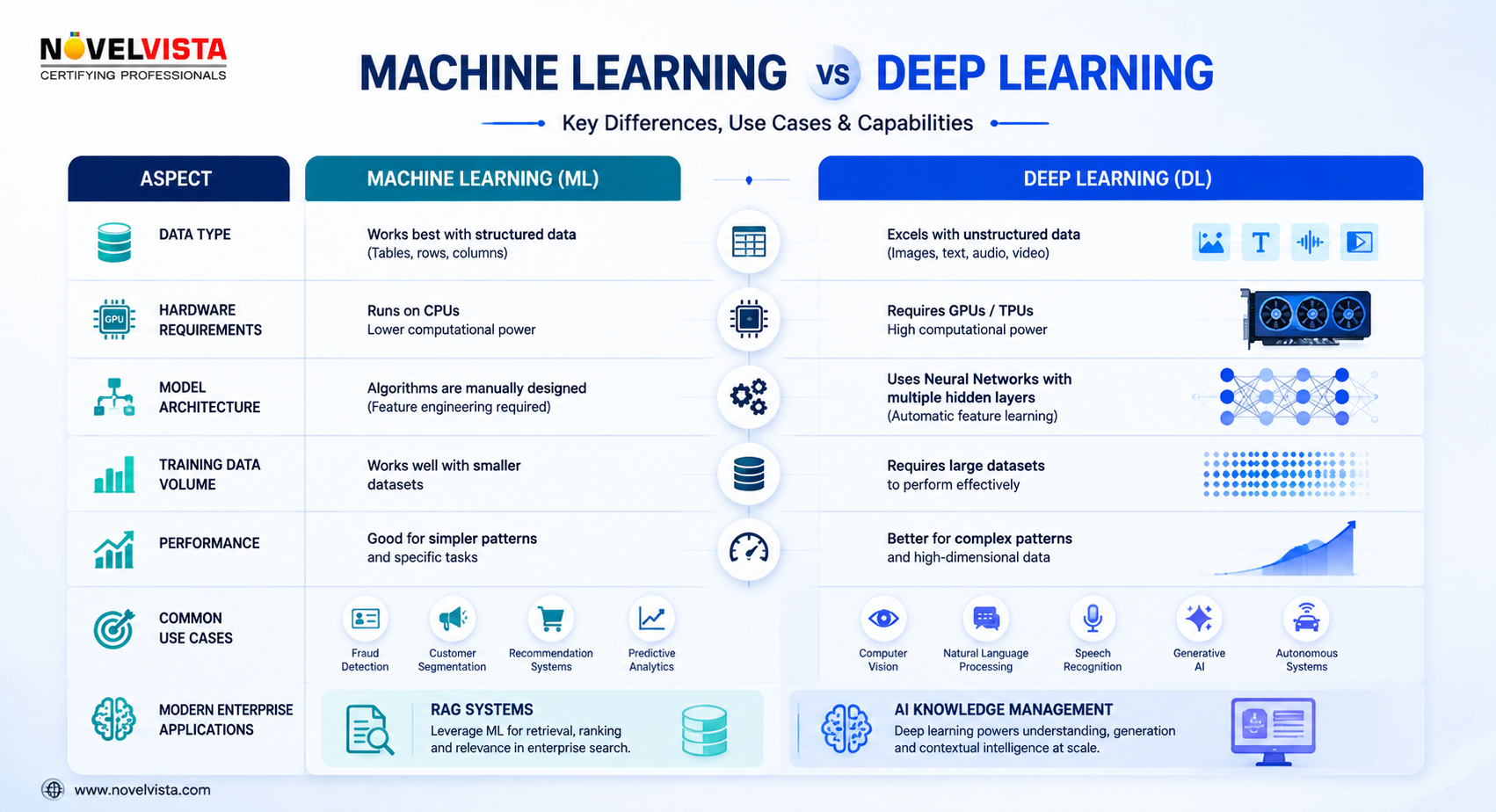
To clarify practical applications, let’s compare ML and DL across multiple dimensions:
| Feature | Machine Learning | Deep Learning |
|---|---|---|
| Data Requirements | Works well with small to medium datasets | Requires large datasets for effective training |
| Feature Engineering | Manual feature selection is often required | Automatic feature extraction via neural networks |
| Computation | Less computationally intensive | Highly computational, often requires GPUs |
| Applications | Fraud detection, customer segmentation | Image recognition, NLP, speech analysis, RAG systems |
This comparison helps enterprise teams decide which AI strategy aligns with their project requirements and data availability.
Practical deployment examples highlight the real value of choosing the right AI approach:
For AI knowledge management training, deep learning models can unlock insights from unstructured corporate data, making them a powerful addition to enterprise AI strategy.
Large Language Models (LLMs) represent a deep learning approach that enterprises can leverage for knowledge-intensive tasks. Key considerations for LLM enterprise deployment include:
Understanding these aspects ensures successful AI adoption without overwhelming internal resources.
Enterprise teams should follow best practices when integrating machine learning or deep learning into business workflows:
Understanding the real difference between deep learning vs machine learning is crucial for enterprise teams aiming to maximize AI ROI. ML provides accessible, computationally lighter solutions, while DL enables sophisticated insights from unstructured data.
For corporate professionals looking to deepen practical skills, NovelVista’s Deep Learning Practitioner course offers a structured path to mastering deep learning techniques, LLM enterprise deployment, and AI-driven business intelligence applications.
Whether you are implementing predictive analytics or RAG systems, this training equips teams to make informed AI decisions and harness enterprise-ready AI models effectively.
Author Details

Confused About Certification?
Get Free Consultation Call
Stay ahead of the curve by tapping into the latest emerging trends and transforming your subscription into a powerful resource. Maximize every feature, unlock exclusive benefits, and ensure you're always one step ahead in your journey to success.