Category | AI And ML
Last Updated On 22/05/2026
This guide explains why machine learning corporate training has become a board-level capability for corporate teams in 2025. It covers the business case for ML literacy, who needs training, how non-technical teams can apply machine learning concepts, what a practical enterprise program should include, common implementation mistakes, measurement metrics, and how training leaders can build a scalable roadmap for workforce readiness.
Machine learning is no longer locked inside data science teams. Sales, HR, finance, operations, risk, procurement, customer support, and leadership teams are now expected to understand how models influence decisions, workflows, productivity, governance, and customer outcomes.
For training leaders, the priority is not turning every employee into a data scientist. The real objective is creating a workforce that can ask better questions, interpret AI-enabled outputs, collaborate with technical teams, and use intelligent tools responsibly.
Machine learning literacy is the ability to understand what machine learning can do, where it can fail, and how it supports better decisions. For modern organizations, machine learning corporate training is becoming as foundational as cloud literacy, cybersecurity awareness, and data literacy.
The urgency is simple: AI tools are moving into daily workflows faster than most teams can adapt. Employees are already using recommendation engines, automated scoring, forecasting dashboards, chatbots, copilots, fraud alerts, and workflow automation. Without a shared literacy base, teams may trust outputs blindly or reject valuable tools because they do not understand them.
A strong AI literacy workplace gives employees a common language. They do not need to build algorithms, but they should know terms such as model, training data, bias, prediction, confidence score, accuracy, false positive, data drift, and human oversight.
This is why machine learning corporate training is now a practical risk-control and productivity lever. It helps teams move from “AI sounds interesting” to “we know where ML can improve business outcomes.”
For training leaders, machine learning corporate training provides a shared baseline before teams experiment with advanced AI tools.
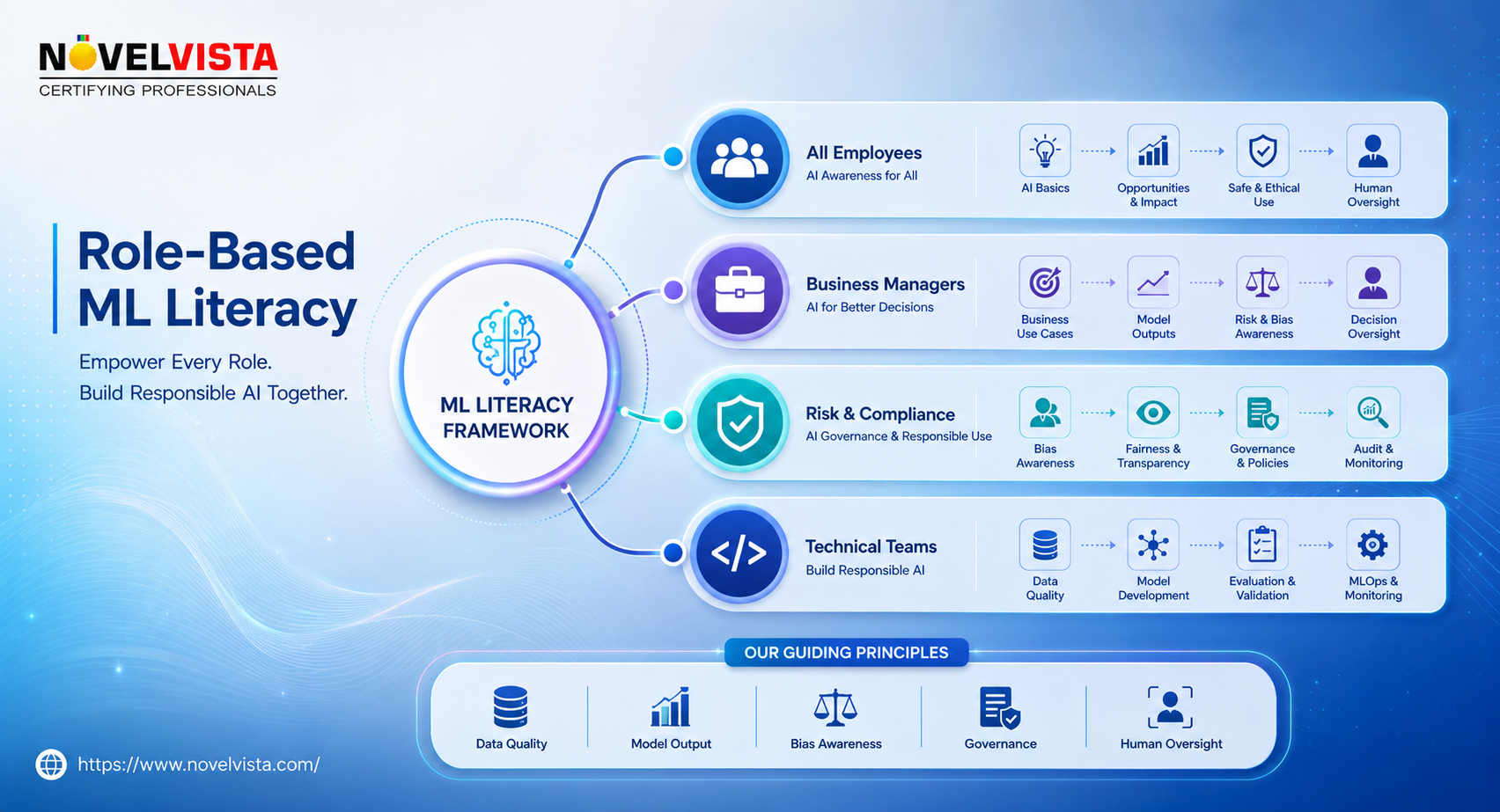
Training leaders are under pressure to justify every learning initiative. The business case for machine learning corporate training is stronger when it is linked to measurable outcomes instead of technology enthusiasm.
Corporate teams need ML literacy because decisions are becoming data-assisted. A credit score, churn prediction, hiring recommendation, demand forecast, customer segmentation model, fraud alert, or quality-control signal can influence revenue, compliance, cost, and reputation.
When employees understand how these systems work, they can:
For HR and L&D leaders, ML upskilling employees is also a retention strategy. People want career-relevant skills, and organizations want teams that can keep pace with changing roles.
For enterprise buyers, machine learning corporate training also creates a common capability benchmark across distributed teams.
In short, machine learning corporate training is not only a technical investment. It is a capability-building initiative for faster decisions, safer AI adoption, and stronger workforce confidence.
One common mistake is assuming that ML belongs only to data scientists, engineers, and analysts. In reality, machine learning for non-technical teams is one of the most valuable training priorities for 2025.
Non-technical employees often sit closest to the business problem. They understand customer friction, process delays, compliance risks, operational bottlenecks, and decision pain points. That context is essential for building useful ML solutions.
| Team | Why ML Literacy Matters | Example Use Case |
|---|---|---|
| HR | Understand bias, employee analytics, and workforce planning | Attrition prediction and skills gap analysis |
| Sales | Interpret lead scoring and customer propensity models | Prioritizing high-value prospects |
| Finance | Evaluate forecasts, anomaly alerts, and risk signals | Fraud detection and cash-flow forecasting |
| Operations | Improve planning, quality, and process visibility | Demand forecasting and predictive maintenance |
| Marketing | Use segmentation, personalization, and campaign analytics responsibly | Customer journey optimization |
| Leadership | Ask better strategic questions and approve AI use cases wisely | AI investment prioritization |
Machine learning corporate training should make cross-functional collaboration easier, especially when business teams must explain requirements to data teams.
Machine learning for non-technical teams should focus on interpretation, business use cases, governance, and decision-making. It should not begin with advanced mathematics or complex coding.
This is where machine learning corporate training becomes commercially useful. It enables different departments to participate in AI transformation without waiting for a small technical team to carry the entire load.
A practical program should simplify machine learning without diluting its business value. Employees need enough understanding to use ML-enabled systems responsibly, not a PhD-level journey through algorithms.
Every machine learning corporate training initiative should cover these core concepts:
These topics create the foundation for an AI literacy workplace where employees can understand opportunities and limitations. This is especially important when business teams use AI tools without direct supervision from data specialists.
Machine learning corporate training should also teach employees when not to use ML, because some decisions need simpler rules, cleaner data, or human review first.
Done well, machine learning corporate training turns scattered curiosity into a shared operating model.
An effective enterprise ML training program starts with roles, not generic content. A CFO, HR manager, product owner, service desk lead, and software engineer do not need the same depth of ML capability.
Training leaders should segment learners into three groups:
The best enterprise ML training program then maps learning depth to business exposure. Employees who influence customer, financial, legal, or people decisions need stronger understanding of risk, bias, and review controls.
| Training Layer | Audience | Learning Outcome |
|---|---|---|
| ML Awareness | All employees | Understand core ML ideas, limitations, and responsible use |
| Business Application | Managers and process owners | Identify use cases and interpret outputs |
| Functional Practice | HR, sales, finance, operations, support | Apply ML concepts to department workflows |
| Governance | Risk, compliance, legal, leadership | Set guardrails, review risks, and audit AI usage |
| Technical Enablement | IT, data, analytics teams | Build, evaluate, and maintain ML solutions |
This layered approach keeps machine learning corporate training relevant. It avoids overwhelming beginners while still giving advanced teams the depth they need.
For business users, the first step is confidence. Machine learning for non-technical teams should help employees understand the “why” before the “how.”
Start with relatable business examples:
Then connect each example to a simple ML idea: pattern recognition, prediction, classification, clustering, anomaly detection, or recommendation.
This approach makes machine learning corporate training approachable. It gives employees enough fluency to participate in AI conversations without pretending everyone must become a programmer.
For L&D leaders, machine learning for non-technical teams should include hands-on exercises such as reading a model output, spotting a biased conclusion, designing a business use case, and deciding when human review is required.
ML upskilling employees works best when it is treated as a capability journey, not a one-time webinar. AI tools change quickly, but foundational literacy remains useful because it helps people reason through new systems.
To build an AI literacy workplace, organizations should combine structured learning with workplace application:
ML upskilling employees also needs psychological safety. Employees should feel comfortable asking basic questions, challenging AI outputs, and reporting concerns without sounding “anti-innovation.”
Machine learning corporate training can help normalize that behavior. A mature AI literacy workplace is not where everyone blindly trusts AI. It is where employees know how to use it with judgment.
Training leaders need a practical rollout model. A 90-day roadmap keeps machine learning corporate training focused, measurable, and aligned with business priorities.
This staged model keeps machine learning corporate training from becoming “innovation theater.” It connects learning to outcomes.
Many companies invest in AI enablement but fail to create durable capability. The issue is rarely lack of enthusiasm. It is usually poor program design.
Avoid these mistakes when planning machine learning corporate training:
The sharper approach is to design machine learning corporate training around business context, risk exposure, and job relevance. That is the sweet spot between hype and hesitation.
Training leaders should measure machine learning corporate training with a mix of learning, behavior, and business metrics.
| Metric Type | What to Track | Why It Matters |
|---|---|---|
| Learning | Assessment scores, concept recall, confidence ratings | Shows whether employees understand core ideas |
| Behavior | Use-case submissions, AI tool adoption, escalation quality | Shows whether training changes workplace behavior |
| Governance | Policy awareness, review adherence, risk reporting | Shows whether AI is used responsibly |
| Business | Time saved, error reduction, faster decisions, improved forecasts | Connects training to enterprise value |
| Talent | Internal mobility, retention, manager feedback | Shows whether learning supports workforce strategy |
For ML upskilling employees, the strongest evidence is not a certificate alone. It is the ability to apply concepts in real decisions: questioning a prediction, identifying data quality issues, improving a workflow, or escalating a high-risk AI output.
This makes machine learning corporate training a performance initiative, not just a learning event.
Before designing modules, leaders should decide how machine learning corporate training will support business priorities such as productivity, customer experience, and risk reduction.
A structured curriculum helps L&D leaders scale machine learning corporate training without losing relevance. The framework below can be adapted for different departments.
| Role Group | Recommended Focus | Training Depth |
|---|---|---|
| All employees | ML basics, AI literacy workplace norms, ethical use | Foundation |
| Business managers | Use-case identification, output interpretation, decision controls | Applied |
| HR and L&D | Skills analytics, bias awareness, workforce planning | Applied |
| Sales and marketing | Lead scoring, segmentation, personalization, customer insights | Applied |
| Risk and compliance | Model risk, audit trails, privacy, human oversight | Advanced awareness |
| IT and data teams | Data preparation, model evaluation, MLOps fundamentals | Technical |
This curriculum supports an enterprise ML training program that is inclusive and practical. It also strengthens collaboration between technical and business functions.
When done right, machine learning for non-technical teams becomes a bridge. It helps business users define better problems and helps technical teams build better solutions.
Many organizations can launch a foundation program in a few weeks, then expand into role-based workshops, applied labs, and governance refreshers over a quarter.
No. Corporate teams across HR, finance, sales, operations, marketing, risk, and leadership benefit from ML literacy because many business decisions are now supported by AI-enabled systems.
Machine learning for non-technical teams focuses on business use cases, interpretation, decision-making, responsible use, and collaboration with technical teams. Data science training usually goes deeper into coding, statistics, model building, and experimentation.
An enterprise ML training program should include ML fundamentals, practical use cases, data quality, bias, explainability, governance, human oversight, and role-based application exercises.
AI literacy workplace training is important because employees are increasingly using AI tools in daily tasks. Without literacy, organizations face risks around poor decisions, weak adoption, privacy gaps, and overreliance on automated outputs.
ML upskilling employees can be measured through assessments, use-case submissions, tool adoption, manager feedback, risk awareness, time savings, and improved decision quality.
Machine learning is becoming part of everyday corporate decision-making. The question is no longer whether teams will encounter ML, but whether they will understand it well enough to use it responsibly and confidently.
For training leaders, machine learning corporate training offers a practical way to close that gap. It helps employees understand how AI-enabled systems work, where they create value, and where human judgment remains essential.
In 2025, machine learning corporate training should sit beside cloud, cybersecurity, and data literacy in the corporate learning portfolio.
The strongest organizations will not limit ML literacy to data teams. They will build shared understanding across functions, invest in machine learning for non-technical teams, and create an enterprise ML training program that grows with business needs.
Ready to Build ML Literacy Across Your Workforce?
Explore NovelVista’s Machine Learning Fundamentals course to help your corporate teams build practical ML awareness, understand real-world business applications, and support responsible AI adoption across the organization.
With the right learning path, machine learning corporate training becomes more than a course. It becomes a workforce strategy for smarter decisions, safer AI adoption, and sustainable business transformation.
Author Details

Confused About Certification?
Get Free Consultation Call
Stay ahead of the curve by tapping into the latest emerging trends and transforming your subscription into a powerful resource. Maximize every feature, unlock exclusive benefits, and ensure you're always one step ahead in your journey to success.