Category | AI And ML
Last Updated On 09/06/2026
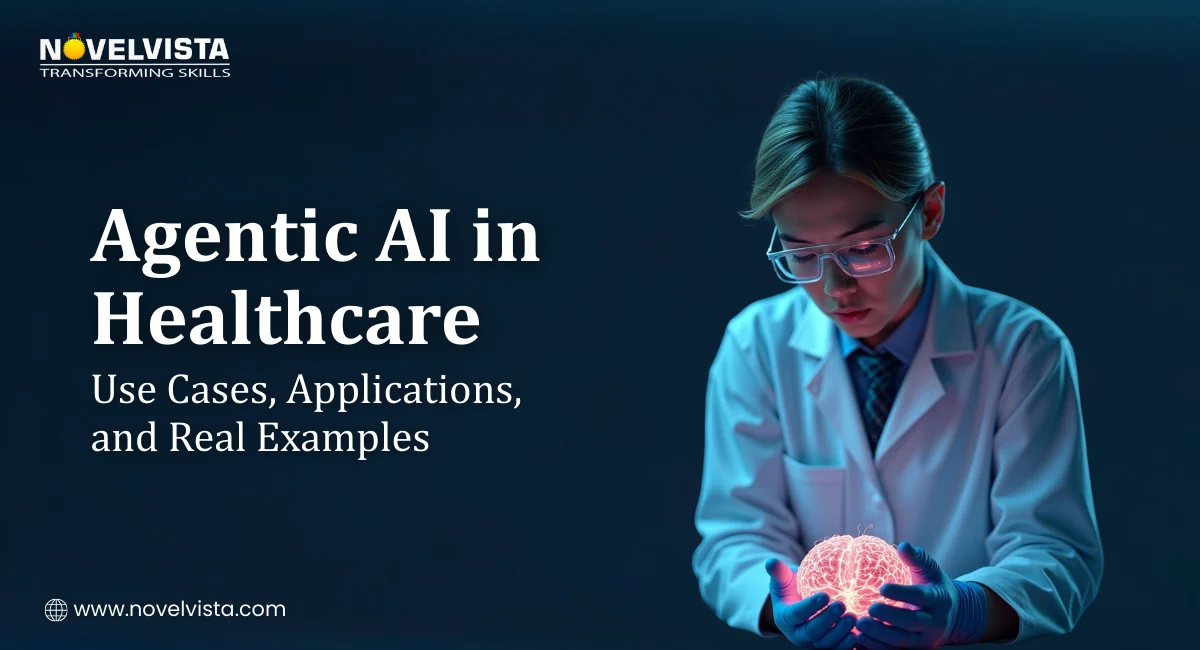
Healthcare organizations are under pressure to improve outcomes, reduce clinician burnout, manage rising patient volumes, and operate with fewer resources. Traditional AI has helped by generating predictions and recommendations, but it still depends heavily on humans to interpret insights and take action.
That is why agentic AI in healthcare is gaining attention. Unlike conventional AI systems that stop at analysis, agentic systems can reason, make decisions within defined boundaries, execute actions, and continuously learn from outcomes.
From clinical decision support and remote patient monitoring to revenue cycle automation and drug discovery, healthcare organizations are increasingly exploring how autonomous AI agents can improve both care delivery and operational efficiency.
Topic | Key Takeaway |
| What is Agentic AI? | AI systems that can plan, decide, and execute tasks autonomously within defined healthcare workflows |
| Why It Matters | Reduces delays, clinician workload, and operational inefficiencies |
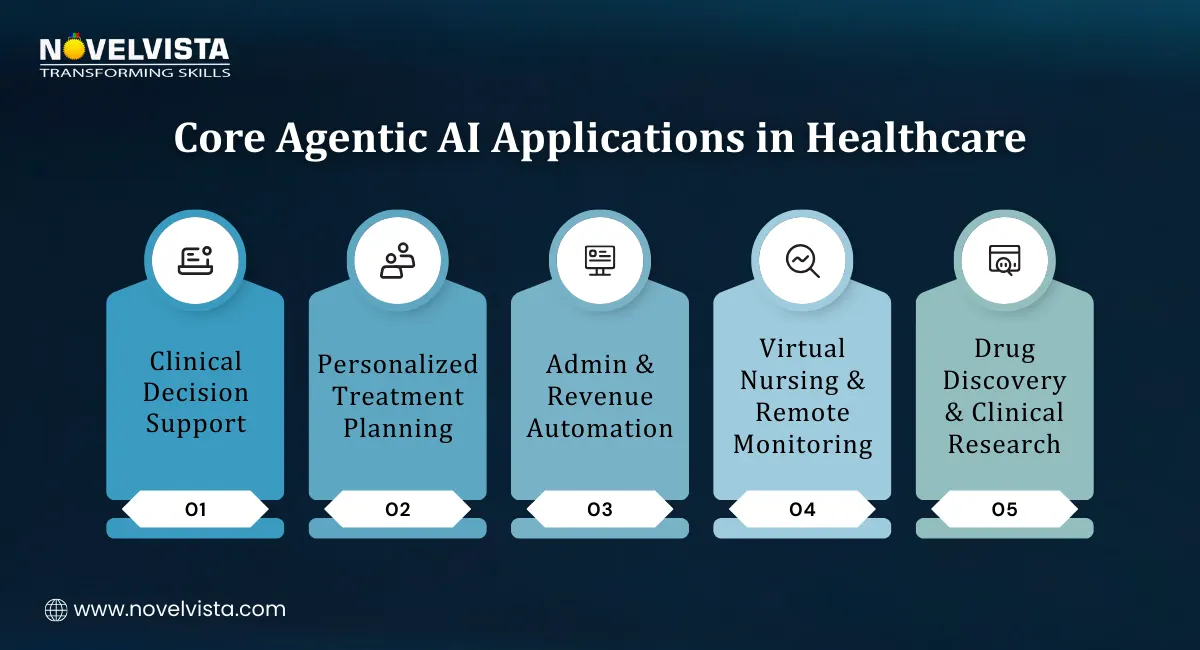
| Major Applications | Diagnostics, treatment planning, virtual nursing, administration, and drug discovery |
| Key Benefits | Faster decision-making, improved patient outcomes, scalability, and cost reduction |
| Implementation Requirements | Data readiness, governance, compliance, oversight, and integration |
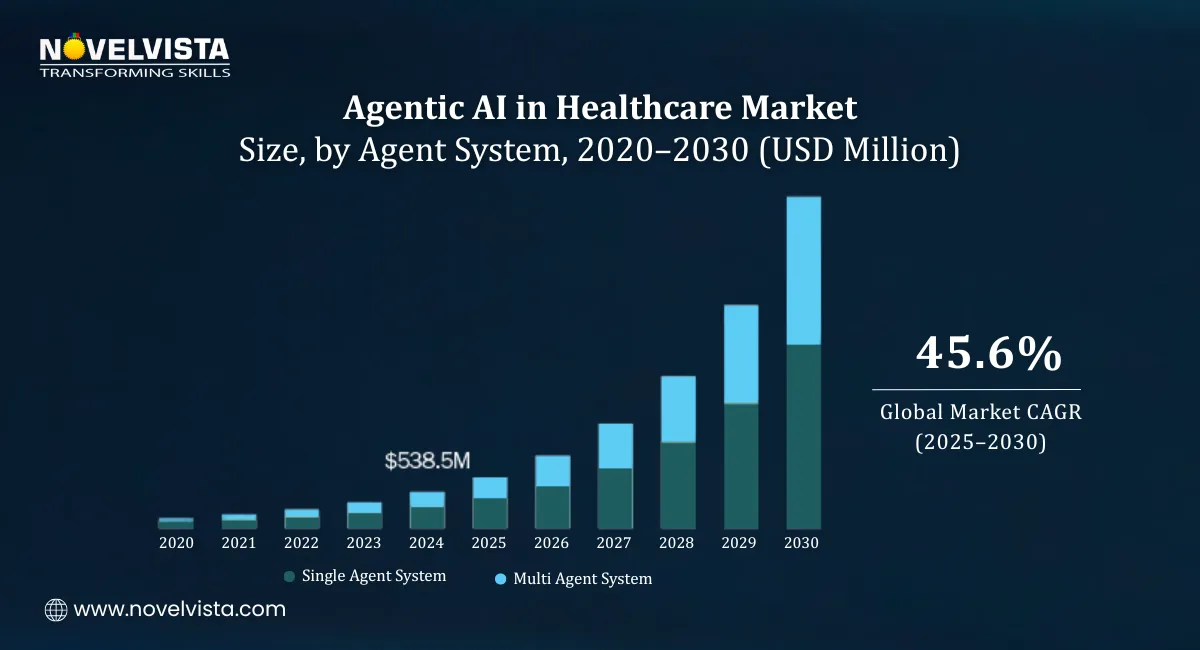
| Market Outlook | Global market reached USD 538.51 million in 2024 and is projected to reach USD 4.96 billion by 2030 at a 45.56% CAGR |
| Adoption Trend | Healthcare's share of GenAI budgets is expected to rise from 18% in 2025 to 29% in 2026 |
Agentic AI in healthcare refers to autonomous AI systems that can perceive information, reason about goals, make decisions, take actions, and learn from outcomes while operating within defined clinical, operational, and regulatory boundaries.
Traditional AI answers questions.
Agentic AI completes tasks.
For example:
Traditional AI may identify a patient as high risk for sepsis.
Agentic AI can:
The shift from prediction to autonomous execution is why healthcare leaders view agentic AI as the next major evolution beyond generative AI.
If you're new to the concept, start with our detailed guide on What Is Agentic AI before exploring healthcare-specific applications.
Healthcare environments involve:
These characteristics make healthcare particularly suitable for autonomous agents that can coordinate activities across systems and stakeholders.
The primary difference between traditional AI and agentic AI healthcare systems is that traditional AI provides recommendations, while agentic AI can autonomously execute workflows and coordinate actions to achieve predefined goals.
Dimension | Traditional AI | Agentic AI |
| Primary Function | Prediction | Decision + Action |
| Workflow Ownership | Human-led | Shared Human-AI |
| Context Awareness | Limited | Continuous |
| Multi-Step Planning | Minimal | Advanced |
| Learning Capability | Static retraining | Dynamic adaptation |
| Operational Scope | Single task | End-to-end workflow |
| Escalation Handling | Human initiated | Autonomous |
| Clinical Coordination | Limited | Cross-functional |
For a deeper comparison across autonomy, reasoning, and workflow execution, see our guide on Agentic AI vs Traditional AI.
In many hospitals, the challenge is not identifying problems.
The challenge is acting fast enough.
A delayed intervention can result in:
Healthcare agentic AI systems help close the gap between insight and action.
Agentic AI healthcare systems combine reasoning engines, healthcare data integrations, workflow automation, and human oversight models to execute complex tasks safely and autonomously.
One of the biggest misconceptions about agentic AI is that it acts independently without controls.
In reality, modern healthcare agentic AI operates within carefully defined guardrails.
A single AI agent manages an entire workflow.
Example:
A discharge management agent can:
Single-agent systems work well for focused processes.
Multi-agent systems involve several specialized agents working together.
Example:
A sepsis monitoring workflow may include:
Each agent performs a specific role while collaborating toward a shared objective.
This architecture is becoming increasingly common in enterprise healthcare environments.
Most healthcare data exists within:
Agentic AI systems typically connect through:
These integrations allow agents to access real-time patient information and execute actions across systems.
Human oversight remains critical.
Common Human-in-the-Loop (HITL) approaches include:
Decision Type | Human Approval Required? |
| Appointment Scheduling | Often No |
| Claims Processing | Sometimes |
| Medication Changes | Yes |
| Clinical Diagnosis | Yes |
| Treatment Planning | Yes |
| Emergency Escalations | Configurable |
Healthcare organizations typically establish:
These boundaries help ensure safety while enabling autonomy.
Healthcare is emerging as one of the fastest-growing sectors for agentic AI adoption because autonomous systems address both clinical workforce shortages and operational inefficiencies.
The global agentic AI market reached USD 538.51 million in 2024 and is projected to grow to approximately USD 4.96 billion by 2030, representing a CAGR of 45.56%.
(Source: GrandView Research)
Healthcare is among the leading industries driving this expansion.
Healthcare organizations are increasingly investing in:
Research acceleration
Agentic AI applications in healthcare extend beyond analytics by actively coordinating care, automating workflows, and driving clinical actions across patient journeys.
Clinical decision support remains one of the most mature agentic AI healthcare applications.
Current systems can:
Clinical decision support currently represents approximately 35.2% of the market.
Organizations are increasingly deploying AI agents to continuously monitor patients rather than relying on periodic clinician review.
For example, sepsis detection agents analyze:
When thresholds are crossed, the system can automatically escalate concerns.
The result is earlier intervention and reduced treatment delays.
Named solutions include:
These platforms increasingly move beyond recommendations and into workflow orchestration.
Personalized medicine requires analyzing enormous amounts of patient-specific data.
Agentic AI enables dynamic treatment planning by incorporating:
Unlike static treatment pathways, agentic systems continuously update recommendations.
In oncology, agents can:
This is among the fastest-growing agentic AI use cases in healthcare because precision medicine depends on ongoing adaptation.
Organizations exploring these capabilities include:
The long-term goal is individualized care plans that evolve in real time.
Administrative inefficiency remains one of healthcare's largest cost drivers.
Agentic AI for healthcare is increasingly used to automate:
Unlike traditional automation tools that simply route tasks, agentic systems can resolve issues independently.
For example, an AI agent may:
Healthcare organizations often realize measurable ROI fastest in administrative functions because these workflows involve high volumes and repetitive decision-making.
Leading vendors include:
Benefits frequently include:
Virtual nursing is rapidly becoming one of the most impactful agentic AI applications in healthcare.
Healthcare systems face ongoing nursing shortages and growing demand for continuous monitoring.
Agentic systems support:
Current industry data indicates:
AI agents can continuously review:
Instead of waiting for scheduled appointments, agents can proactively intervene when risk patterns emerge.
This approach is especially valuable for:
Organizations deploying virtual nursing initiatives include:
Drug development remains one of the most expensive processes in healthcare.
Agentic AI is transforming research by helping scientists:
Industry estimates suggest AI-driven drug discovery could generate approximately USD 150 billion in annual savings by 2026.
(Source: Accenture )
Rather than running static analyses, agentic systems continuously refine hypotheses as new evidence emerges.
This capability helps:
Organizations actively investing include:
The highest-value agentic AI use cases in healthcare combine autonomous decision-making with measurable clinical, operational, and financial outcomes.
Approximately 44% of healthcare organizations are using AI-assisted triage capabilities.
Agentic systems can:
Benefits include:
Nearly 40% of healthcare executives report AI use for long-term condition monitoring.
High-value conditions include:
AI agents continuously evaluate trends and recommend interventions before deterioration occurs.
Roughly 66% of healthcare organizations report staffing shortages.
Agentic systems assist with:
These capabilities help maintain service quality without proportional staffing increases.
Understand how AI can assist clinicians while keeping humans accountable.
Learn decision boundaries, escalation points, and safe HITL models
used in real healthcare settings.
Real-world agentic AI in healthcare examples demonstrate that autonomous systems can improve efficiency, accelerate decisions, and support better patient outcomes when deployed responsibly.
Healthcare represents just one category within a growing list of Agentic AI Examples across regulated industries.
Uses AI-powered virtual care and automation initiatives to improve patient engagement and reduce administrative burden.
Reported outcomes include:
Investing heavily in AI-enabled clinical decision support and precision medicine initiatives.
Focus areas include:
Uses AI and intelligent automation for:
Outcomes include improved access and operational efficiency.
Oracle Health Clinical AI supports:
Healthcare organizations report reduced documentation burden and improved clinician productivity.
Avaamo deploys healthcare-focused conversational and workflow agents used by hospitals for:
Kore.ai healthcare solutions support:
The FDA has deployed AI initiatives to support:
The agency's Elsa AI program has accelerated information analysis and review processes.
Implementing agentic AI in healthcare requires strong data foundations, governance frameworks, clinical oversight, and a phased deployment strategy rather than technology adoption alone.
Healthcare organizations often underestimate implementation complexity.
Successful deployments start with organizational readiness rather than software selection.
Agentic systems depend on:
Many organizations struggle because data remains fragmented across departments.
Before deployment, healthcare leaders should assess:
Governance should define:
Organizations should establish multidisciplinary governance teams involving:
Successful organizations typically follow four phases:
Phase 1: Identify a Narrow Use Case
Examples:
Phase 2: Validate Outcomes
Measure:
Phase 3: Expand Workflows
Integrate additional systems and departments.
Phase 4: Enterprise Scale
Deploy across multiple service lines with centralized governance.
Many implementations fail because of:
Technology is rarely the primary problem.
People, processes, and accountability often determine success.
Healthcare organizations should track:
Clinical Metrics:
Operational Metrics:
Financial Metrics:
Experience Metrics:
Organizations that define success metrics early are more likely to achieve meaningful outcomes.
Healthcare organizations should evaluate agentic AI vendors based on compliance, integration capabilities, transparency, governance features, and measurable clinical outcomes rather than AI sophistication alone.
Look for support for:
Verify compatibility with:
The system should clearly explain:
Ensure clinicians can:
Every autonomous action should be:
Request evidence including:
Assess whether the platform can support:
Agentic AI healthcare applications create value by improving outcomes, reducing administrative burden, enhancing consistency, and enabling scalable care delivery.
The future of agentic AI in healthcare is likely to involve collaborative human-AI teams where autonomous agents manage routine workflows while clinicians focus on judgment, empathy, and complex care decisions.
As regulatory frameworks mature and healthcare organizations gain confidence in autonomous systems, agentic AI will increasingly become part of core infrastructure.
The most successful organizations will focus on:
The goal is not replacing clinicians.
The goal is helping them make better decisions faster.
Agentic systems are no longer optional experiments. Agentic AI in healthcare is quickly becoming part of core clinical and operational infrastructure.
Strong market growth, trusted use cases, and real-world results show that autonomous systems can support care delivery safely and effectively. The organizations that lead this shift are the ones investing early in governance, integration, and oversight.
As regulations mature and expectations rise, agentic AI for healthcare will define how decisions are made, actions are taken, and outcomes are improved, at scale.

If you want to move beyond theory and understand how agentic systems are designed, governed, and applied in real environments, NovelVista’s Agentic AI Professional Certification Training Course is a strong next step. The program focuses on real healthcare use cases, ethical AI governance, and hands-on decision workflows. It’s designed for professionals who want to lead AI adoption with confidence, clarity, and real-world impact.
Author Details

Confused About Certification?
Get Free Consultation Call
Stay ahead of the curve by tapping into the latest emerging trends and transforming your subscription into a powerful resource. Maximize every feature, unlock exclusive benefits, and ensure you're always one step ahead in your journey to success.