Category | Security
Last Updated On 03/06/2026
Cybersecurity threats are growing at an unprecedented rate. According to recent industry reports, organizations worldwide face a cyberattack every 39 seconds, and global cybercrime costs are projected to exceed $10 trillion annually. At the same time, businesses are under increasing pressure to ensure compliance, manage risks, and protect critical information systems.
This is exactly where understanding CISA domains becomes crucial.
If you are considering CISA certification, you might be wondering:
This guide is designed for IT auditors, cybersecurity professionals, risk managers, and anyone looking to build a career in information systems auditing. By the end, you will have a clear understanding of all CISA domains and how they align with real-world responsibilities.
The CISA domains represent the core knowledge areas defined for the Certified Information Systems Auditor certification. These domains outline the skills required to audit, control, monitor, and assess IT systems effectively.
The updated CISA certification domains are divided into five areas, each with specific weightage in the exam:
| Domain | CISA Domain Name | Weightage |
| Domain 1 | Information Systems Auditing Process | 18% |
| Domain 2 | Governance & Management of IT | 18% |
| Domain 3 | Information Systems Acquisition, Development & Implementation | 12% |
| Domain 4 | Information Systems Operations & Business Resilience | 26% |
| Domain 5 | Protection of Information Assets | 26% |
Understanding these CISA exam domains is essential because they directly reflect the real-world responsibilities of IT auditors and security professionals.
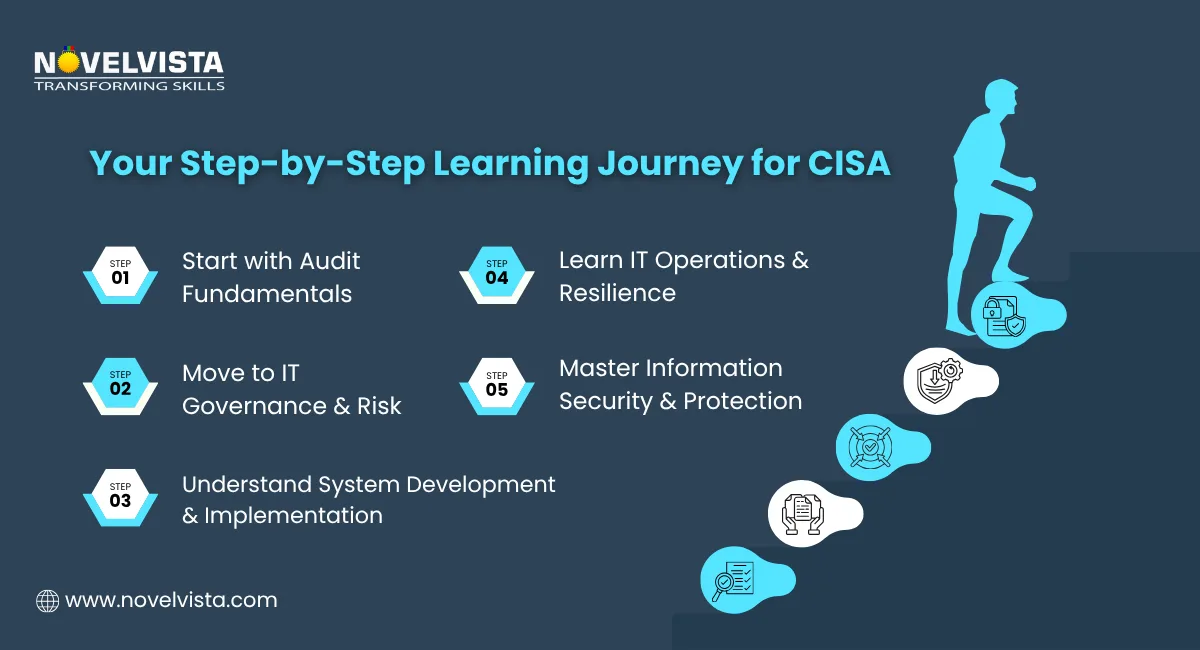
The first of the CISA domains focuses on the auditing lifecycle. It validates your ability to plan, execute, and report audits effectively.
Planning
This phase includes understanding IS audit standards, guidelines, and codes of ethics. It also covers different types of audits, assessments, and reviews. Risk-based audit planning is a key concept here, ensuring that audits are aligned with business risks.
You will also learn about various types of controls and considerations, helping you identify vulnerabilities and evaluate internal control systems.
Execution
Execution focuses on audit project management and practical techniques such as audit testing and sampling methodology. You will also gain expertise in audit evidence collection techniques and audit data analytics.
Reporting and communication techniques are equally important, as auditors must clearly present findings to stakeholders. Additionally, quality assurance and continuous improvement of the audit process are emphasized.
This domain is foundational among all CISA certification domains, as it defines the core responsibilities of an IT auditor.
This domain ensures that IT supports business objectives while maintaining compliance and risk control.
IT Governance
You will learn about laws, regulations, and industry standards that govern IT environments. Understanding organizational structure, IT governance frameworks, and IT strategy is essential for aligning IT with business goals.
Policies, standards, procedures, and enterprise architecture also play a key role in this domain. Enterprise risk management is another critical component, helping organizations identify and mitigate risks proactively.
Privacy programs and principles, along with data governance and classification, are increasingly important in today’s data-driven world.
Among all CISA domains, this one is particularly relevant for professionals aiming to move into leadership or governance roles.
This domain focuses on how information systems are built and implemented within organizations.
Information Systems Acquisition and Development
You will explore project governance and management, ensuring that IT projects align with business objectives. Business case development and feasibility analysis help justify investments in IT systems.
System development methodologies, such as Agile and Waterfall, are covered along with control identification and design. This ensures that systems are secure and compliant from the beginning.
Information Systems Implementation
This section includes system readiness and implementation testing, ensuring systems function correctly before deployment.
You will also learn about configuration and release management, system migration, infrastructure deployment, and data conversion. Post-implementation reviews help evaluate whether the system meets business objectives.
Although it has lower weightage, this domain is crucial within CISA exam domains because it connects IT development with audit and control practices.
This is one of the most important CISA domains, carrying significant weight in the exam.
Information Systems Operations
This section covers IT components, asset management, and automation processes such as job scheduling and production systems.
You will also learn about system interfaces, shadow IT, and end-user computing risks. Key operational areas include system availability, capacity management, and incident management.
Change management, configuration management, and patch management are critical for maintaining system stability. Operational log management and service level management ensure performance and accountability.
Database management is another key area, as data integrity is essential for business operations.
Business Resilience
This section focuses on ensuring business continuity in case of disruptions.
You will study business impact analysis, system resilience, and data backup strategies. Business continuity planning and disaster recovery plans are essential for minimizing downtime and ensuring operational stability.
This domain highlights how IT operations directly impact business continuity, making it a vital part of CISA certification domains.
This domain reflects the growing importance of cybersecurity in IT auditing.
Information Asset Security and Control
You will learn about security frameworks, standards, and guidelines used to protect information assets. Physical and environmental controls ensure the safety of infrastructure.
Identity and access management is a critical topic, along with network and endpoint security. Data protection techniques such as data loss prevention and encryption are also covered.
Other key areas include public key infrastructure, cloud security, and security considerations for mobile, wireless, and IoT devices.
Security Event Management
This section focuses on detecting and responding to security incidents.
You will study security awareness programs, attack methods, and testing tools. Security monitoring tools and techniques help identify threats in real time.
Incident response management and forensic investigation techniques are essential for handling security breaches effectively.
Among all CISA exam domains, this domain is the most security-focused and highly relevant in today’s threat landscape. Practice CISA Certification Exam Questions to strengthen your understanding of key concepts and improve your chances of exam success.
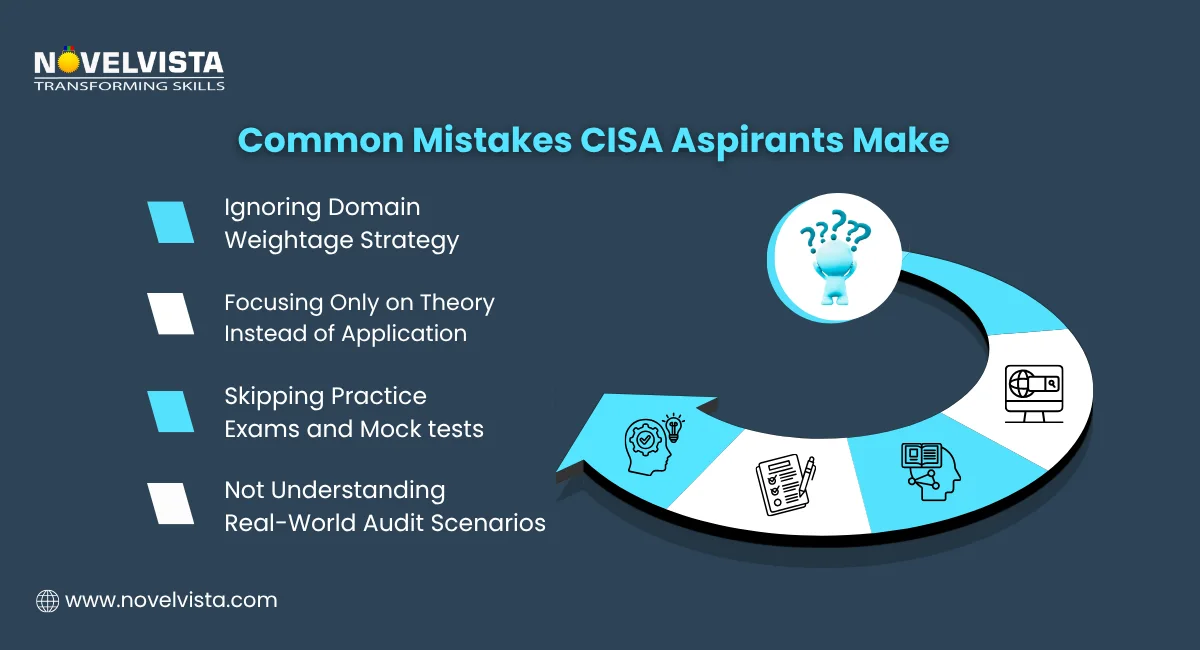
Many candidates underestimate the importance of understanding CISA domains before starting their preparation.
A clear understanding helps you:
The CISA certification domains are not just exam topics, they represent real-world responsibilities.
Preparing for CISA exam domains requires a structured and strategic approach.
Start by focusing on high-weight domains such as Domain 4 and Domain 5. Use official study materials and practice exams to understand question patterns.
It is important to focus on concepts rather than memorization, as the exam is scenario-based. Regular revision and domain-wise practice will help reinforce your understanding of all CISA domains.
Mastering CISA domains opens up a wide range of career opportunities.
Professionals with expertise in CISA certification domains are in high demand for roles such as IT auditor, risk analyst, compliance manager, and cybersecurity consultant.
Organizations value professionals who can audit systems, manage risks, and ensure compliance, making CISA certification a strong career investment. Explore the Benefits of CISA to understand how it enhances your career in IT auditing, risk management, and cybersecurity.
Understanding CISA domains is more than just an exam requirement—it is the foundation for building a strong, future-ready career in IT auditing, risk management, and cybersecurity. Each of the CISA certification domains is carefully designed to develop practical, real-world skills that enable you to evaluate controls, manage risks, and protect critical information systems with confidence.
By mastering these CISA exam domains, you move beyond theoretical knowledge and gain the ability to make informed decisions, strengthen organizational security, and contribute strategically to business success. This expertise is exactly what today’s organizations are actively seeking in skilled professionals.
If you are aiming for long-term career growth and credibility in the IT audit and security space, now is the right time to commit to mastering CISA domains and position yourself as a trusted expert in the field.

Ready to take the next step in mastering CISA domains and advancing your career in IT auditing?
Join NovelVista’s CISA Certification Training and gain in-depth knowledge of CISA certification domains, practical auditing skills, and real-world insights aligned with the latest CISA exam domains. Designed for IT auditors, security professionals, and risk managers, this course equips you with the expertise needed to confidently audit, control, and secure modern information systems.
Start your CISA journey today!
Author Details

Course Related To This blog
CISA® Certified Information Systems Auditor
Confused About Certification?
Get Free Consultation Call
Stay ahead of the curve by tapping into the latest emerging trends and transforming your subscription into a powerful resource. Maximize every feature, unlock exclusive benefits, and ensure you're always one step ahead in your journey to success.