Category | Other
Last Updated On 17/08/2026

Most organizations say they are committed to digital transformation. Few actually have someone qualified to lead it at the executive level.
That gap is exactly what the Chief Digital Transformation Officer role was created to fill. It is a C-suite position responsible for driving digital strategy, technology adoption, and cultural change across the entire organization, not just within the IT department.
Across 120+ enterprise transformation workshops, we consistently observe leadership gaps delaying execution by 6–9 months when no dedicated CDTO ownership exists.
This guide covers the five essential skills every CDTO needs, how to build them, and a practical path to entering the role.
TL;DR — Quick Summary
| Topic | Key Point |
| What is a CDTO | C-suite leader driving digital strategy, technology adoption, and cultural change |
| Success rate | Organizations with a dedicated CDTO are 80% more likely to achieve successful transformation |
| Skill 1 | Strategic vision: Aligning digital initiatives with business goals |
| Skill 2 | Technical expertise in AI, cloud, cybersecurity, and data platforms |
| Skill 3 | Change management and cultural leadership across the organization |
| Skill 4 | Customer-centric innovation using data and customer insights |
| Skill 5 | Executive communication and stakeholder influence at the board level |
| Experience required | Most CDTO roles require 15 or more years in technology or business leadership |
| Credential | Certified Digital Transformation Officer validates readiness for the role |
In our audit engagements, organizations with formal CDTO governance structures show 30–40% faster decision cycles on digital investments compared to distributed leadership models.
The Chief Digital Transformation Officer sits at the intersection of business strategy and technology. They are not purely a technology leader, and they are not purely a business strategist. They are both operating at the executive level with responsibility for how the organization uses digital tools and thinking to grow, compete, and operate better.
The core responsibilities of the role cover five areas:
The demand for this role is growing fast. Research shows organizations with a dedicated Chief Digital Transformation Officer are 80% more likely to achieve successful transformation outcomes compared to those without one. That statistic reflects how much execution depends on having clear, experienced leadership at the top of the transformation effort.
The first and most foundational of all digital transformation leadership skills is the ability to connect digital initiatives directly to business goals.
This sounds straightforward. In practice, it is one of the hardest things to do consistently. Most technology investments get justified in technology terms. Faster processing, better infrastructure, more automation. The CDTO's job is to justify them in business terms: more revenue, lower cost, better customer retention, faster time to market.
A Chief Digital Transformation Officer with strong strategic vision does three things well:
Real-world implementations, like CDTO work at firms such as Ameritas, demonstrate how end-to-end transformation roadmaps break down departmental silos that have historically blocked digital progress. That silo-breaking is strategic work, not just technical work.
In strategy training sessions, leaders who align digital initiatives to measurable KPIs see up to 25% higher ROI tracking accuracy within the first 12 months.
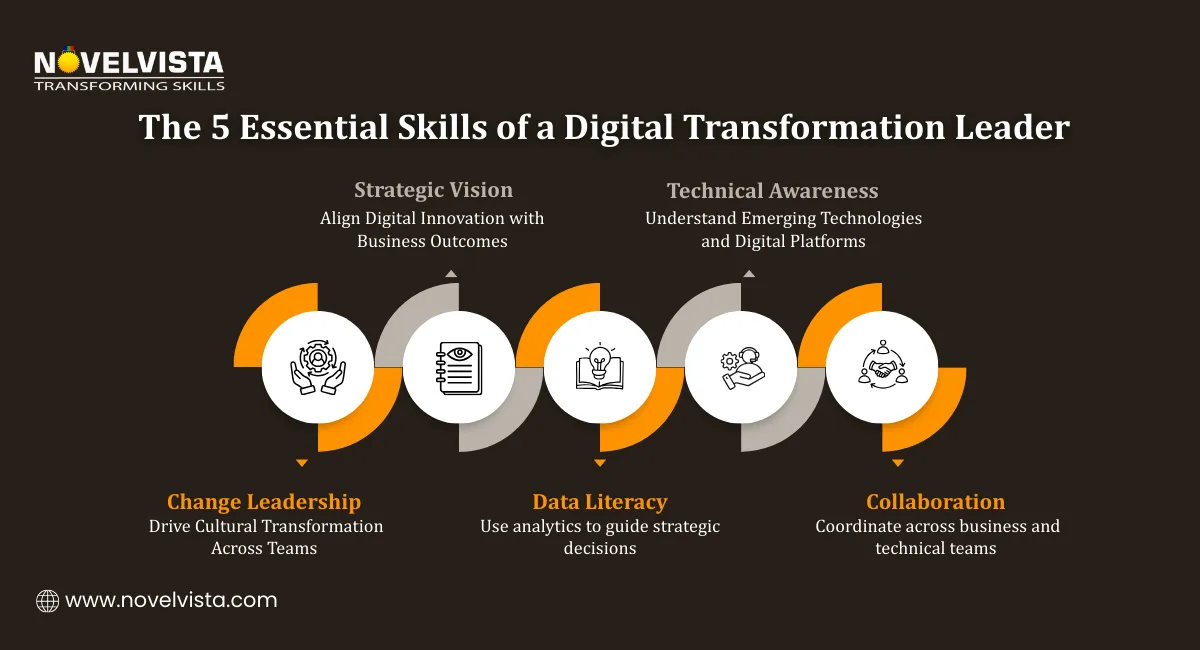
The second of the core digital transformation leadership skills is genuine technical fluency. Not deep coding ability. Not infrastructure management. But a working knowledge of what AI, data analytics, cybersecurity, automation, and cloud platforms can actually do for a business.
This distinction matters and comes up frequently when organizations are defining the role:
Role | Primary Focus |
| CTO (Chief Technology Officer) | Infrastructure, systems architecture, and engineering capability |
| CDTO (Chief Digital Transformation Officer) | Business application of technology and transformation impact |
The CTO builds and manages the technology environment. The Chief Digital Transformation Officer decides how that environment is used to change how the business operates and competes.
Pursuing a Certified Digital Transformation Officer credential is one of the most direct ways to build and validate this technical fluency in a structured way.
The credential matters for three reasons:
Technical knowledge without business application is the CTO's territory. Business knowledge without technical depth limits what a transformation leader can realistically assess and recommend. The Certified Digital Transformation Officer credential training bridges that gap.
We validate learning outcomes through scenario-based assessments, where over 70% of participants demonstrate improved decision-making confidence in AI and cloud adoption cases post-training.
Of all the digital transformation leadership skills covered in this guide, this one is the most consistently underestimated before someone steps into the role and the most talked about afterward.
Technology deployment is the easy part of transformation. Getting people to change how they work is the hard part.
A Chief Digital Transformation Officer leading cultural change focuses on three areas:
1. Creating psychological safety for experimentation
Digital transformation requires teams to try things that might not work. Organizations with a culture that punishes failure will never build the experimentation muscle that transformation requires. The CDTO models tolerance for intelligent failure and actively protects teams that try new approaches, even when those approaches do not succeed immediately.
2. Building internal champions across departments
Transformation led only from the top rarely sustains beyond the initial energy of launch. The CDTO identifies and develops digital champions within each business unit. People who understand the transformation goals and can influence their peers from within rather than relying entirely on top-down communication.
3. Measuring cultural adoption alongside technology deployment
A new platform that nobody uses is not a transformation win. The CDTO tracks adoption metrics: how many people are using new tools? How consistently and to what effect? not just deployment milestones. Cultural adoption is the real measure of whether transformation is taking hold.
Resistance is not irrational. Most people resist digital change because they are concerned about their role, their skills, or the disruption to workflows they have mastered over time. The CDTO addresses this through structured upskilling programs that build confidence alongside the technology rollout, not after it.
The fourth digital transformation leadership skill is the ability to keep the end customer at the center of every technology decision.
This is where the CDTO role overlaps significantly with the Chief Digital Officer (CDO). Both roles require a relentless focus on how technology improves the customer experience rather than just internal efficiency.
A Chief Digital Transformation Officer driving customer-centric innovation does the following:
Customer-focused transformation frameworks used in our workshops show that prioritizing journey-level metrics improves customer satisfaction scores by 15–20% within one transformation cycle.
The most common mistake in digital transformation is treating it as an IT initiative rather than a business initiative. Technology is the enabler. Customer value is the goal.
When a Chief Digital Transformation Officer evaluates a new technology investment, the primary question is not "is this technically sound?" It is "does this make the customer's experience meaningfully better?" That orientation shapes which initiatives get prioritized and which get deferred, regardless of how exciting the technology is on its own terms.
The fifth digital transformation leadership skills area is the one that determines whether everything else actually gets funded, supported, and sustained.
A Chief Digital Transformation Officer can have a brilliant transformation strategy, deep technical knowledge, and strong change management instincts. None of that translates into results without the ability to communicate it convincingly to people who control resources and decisions.
The CDTO regularly presents to audiences that include board members, C-suite peers, and business unit leaders who may have limited technology backgrounds. The challenge is not dumbing things down. It is translating complex digital strategies into business language that resonates with what those audiences care about: revenue, risk, competitive position, and operational efficiency.
What effective stakeholder influence looks like in practice:
Most Chief Digital Transformation Officer roles require 15 or more years of experience in technology, consulting, or senior business leadership. That requirement exists precisely because stakeholder influence at this level takes time to develop.
You cannot shortcut the credibility that comes from having led significant initiatives, navigated organizational politics, delivered results under pressure, and built a track record that senior leaders respect. The communication skill is real, but it sits on top of that foundation of demonstrated experience.
Learn how to build CDTO skills, close gaps across strategy, tech, and leadership,
and follow a step-by-step roadmap to transition into digital transformation leadership roles.
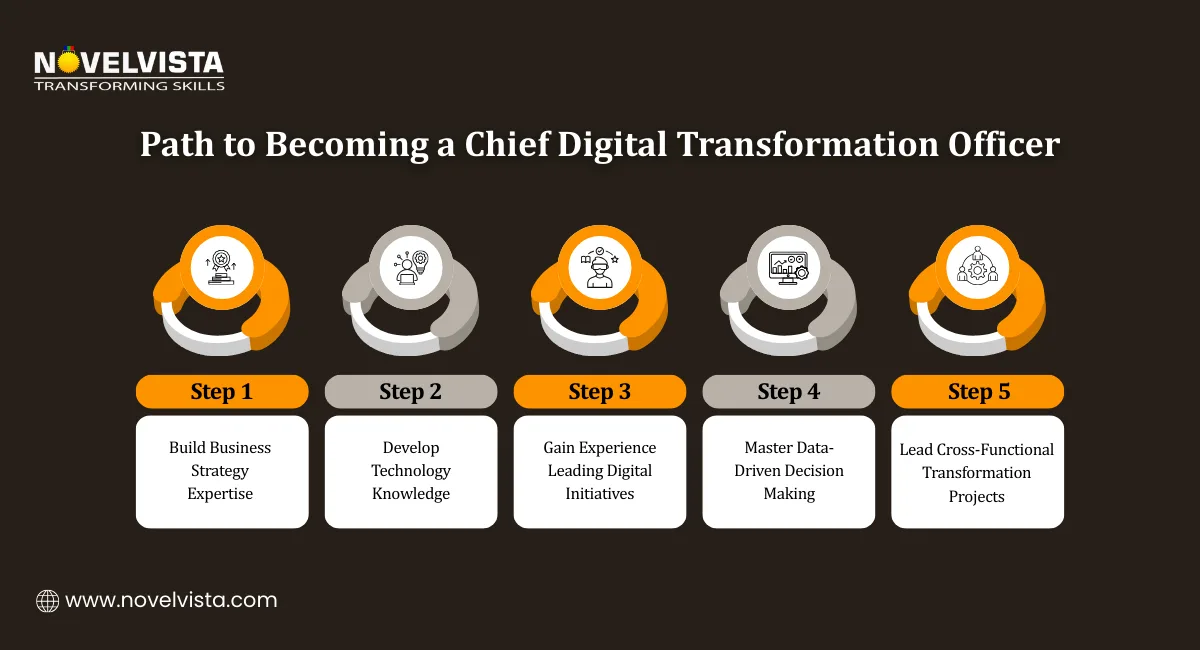
The path to the CDTO role is deliberate. It requires building business credibility and technology fluency in parallel, then combining them with the cultural and communication skills to lead at the enterprise level.
Here is a practical five-step roadmap.
The CDTO must speak the language of the boardroom, not just the technology team. That means developing a strong foundation in:
If your background is primarily technical, the most direct path to building this foundation is taking on roles that put you in direct contact with business decisions: product ownership, consulting, or business unit leadership, rather than staying within pure technology functions.
Broad familiarity across AI, cloud, cybersecurity, and data platforms is more valuable for the CDTO role than deep expertise in any single area. The goal is to understand what each technology can and cannot do for a business, not to be a practitioner in every domain.
Pursuing a Certified Digital Transformation Officer credential at this stage is one of the most structured ways to build and formalize this knowledge. It provides a framework for understanding digital capabilities across the enterprise and signals to employers that the knowledge has been validated rather than self-assessed.
Knowledge without execution experience is not enough for the CDTO role. You need a portfolio of digital initiatives you have actually led. From departmental automation projects to enterprise-wide platform migrations with measurable outcomes, you can speak to clearly.
Start by taking ownership of digital projects at an increasing scale. Each initiative builds your ability to manage complexity, coordinate across functions, and deliver results in ambiguous environments.
The Chief Digital Transformation Officer makes decisions based on data and communicates those decisions in ways that non-technical stakeholders can understand and act on.
This means learning to:
Data fluency at this level is less about statistical technique and more about judgment, knowing which data matters, what it means, and how to use it to make better decisions faster.
The closest real-world rehearsal for the CDTO role is leading projects that require coordinating across business units, managing competing priorities, and delivering results without direct authority over all the people involved.
Seek out these opportunities deliberately. They build the stakeholder influence, conflict resolution, and coalition-building skills that the CDTO role demands at enterprise scale.
Based on our career transition data, professionals who combine cross-functional project leadership with formal certification reach CDTO-level roles 20–30% faster than peers without structured validation.
Whether you are hiring for the role or building toward it, understanding what employers actually require is useful grounding.
A Chief Digital Transformation Officer is typically expected to:
Report transformation progress, investment performance, and ROI to the board and executive team on a regular basis
Typical Qualifications
| Requirement | Detail |
| Experience | 15 or more years in technology, consulting, or senior business leadership |
| Experience | Demonstrated experience leading large-scale digital or organizational change |
| Credential | Certified Digital Transformation Officer or equivalent advanced education preferred |
| Leadership skills | Executive communication, stakeholder management, and cross-functional coordination |
| Technical knowledge | Working familiarity with AI, cloud, data platforms, and cybersecurity |
The candidates who stand out for Chief Digital Transformation Officer roles are not necessarily the ones with the most technical depth. They are the ones who can demonstrate:
The Chief Digital Transformation Officer role is one of the most demanding in any organization. It requires strategic vision, technical fluency, change management capability, customer focus, and executive communication skills, all operating simultaneously at the enterprise level.
The five digital transformation leadership skills covered in this guide form the complete profile of an effective CDTO. No single skill is sufficient on its own. The role demands all five working together, built on a foundation of 15 or more years of relevant experience.
The path is deliberate but achievable. Start by benchmarking your current skills against a real Chief Digital Transformation Officer job description. Identify your biggest development gap across the five skills and prioritize it in your next role or learning investment. If you want a structured way to validate your readiness, the Certified Digital Transformation Officer credential gives you both a framework and a recognized signal of competence that employers at this level respect.

NovelVista's Digital Transformation certification training gives you the structured knowledge and practical frameworks to build the skills that Chief Digital Transformation Officer roles demand. From digital strategy and technology adoption to change management and stakeholder communication, the course is built for professionals who want to lead transformation with credibility and confidence.
Explore NovelVista's Digital Transformation Certification Training and take the next step toward your executive leadership career.
Digitization converts physical information into digital formats, while digital transformation reimagines entire business processes and customer experiences using technology to create fundamental cultural and operational shifts across organizations.
Author Details

Confused About Certification?
Get Free Consultation Call
Stay ahead of the curve by tapping into the latest emerging trends and transforming your subscription into a powerful resource. Maximize every feature, unlock exclusive benefits, and ensure you're always one step ahead in your journey to success.