Category | CLOUD and AWS
Last Updated On 18/06/2026
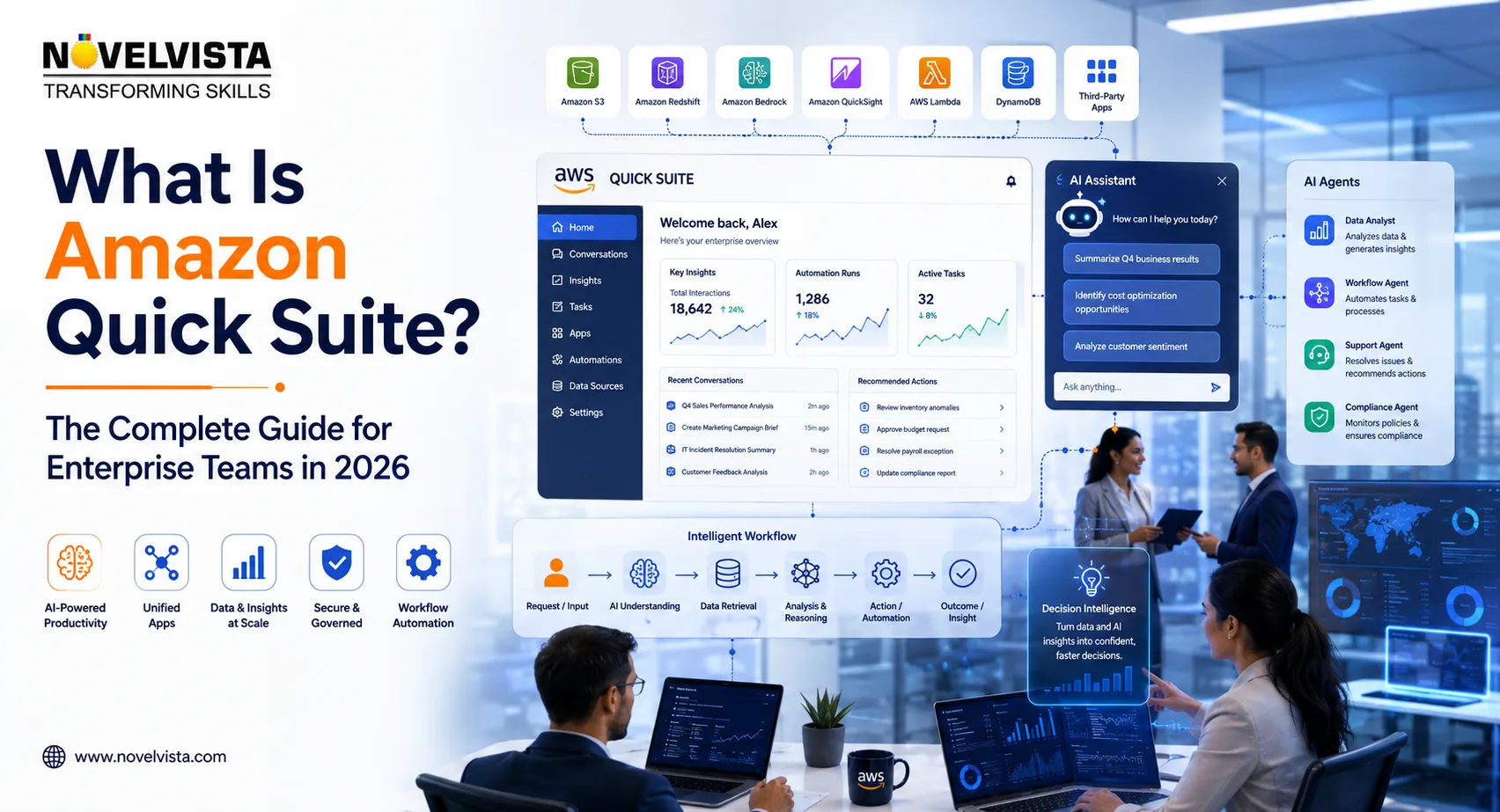
Amazon Quick Suite is AWS’s agentic AI workspace for enterprise teams that want to connect workplace data, business intelligence, research, automation, and AI agents in one environment.
This guide explains what Amazon Quick Suite is, how it works, its enterprise use cases, benefits, governance considerations, adoption roadmap, and the skills teams need to use it effectively in 2026.
Amazon Quick Suite is AWS’s agentic AI workspace built to help enterprise users search workplace knowledge, analyze data, create dashboards, automate workflows, and take action across connected business applications.
This guide explains what it is, how its AI agents work, where enterprises can use it, what risks to manage, and how teams can prepare for adoption in 2026.
Modern enterprise work is scattered across emails, dashboards, documents, ticketing tools, CRMs, cloud storage, and collaboration apps. Teams spend too much time searching for context before they can make decisions.
Amazon Quick Suite addresses this problem by bringing AI-powered research, business intelligence, automation, and action-taking into one workspace. It is designed for teams that want faster insights without constantly switching tools.
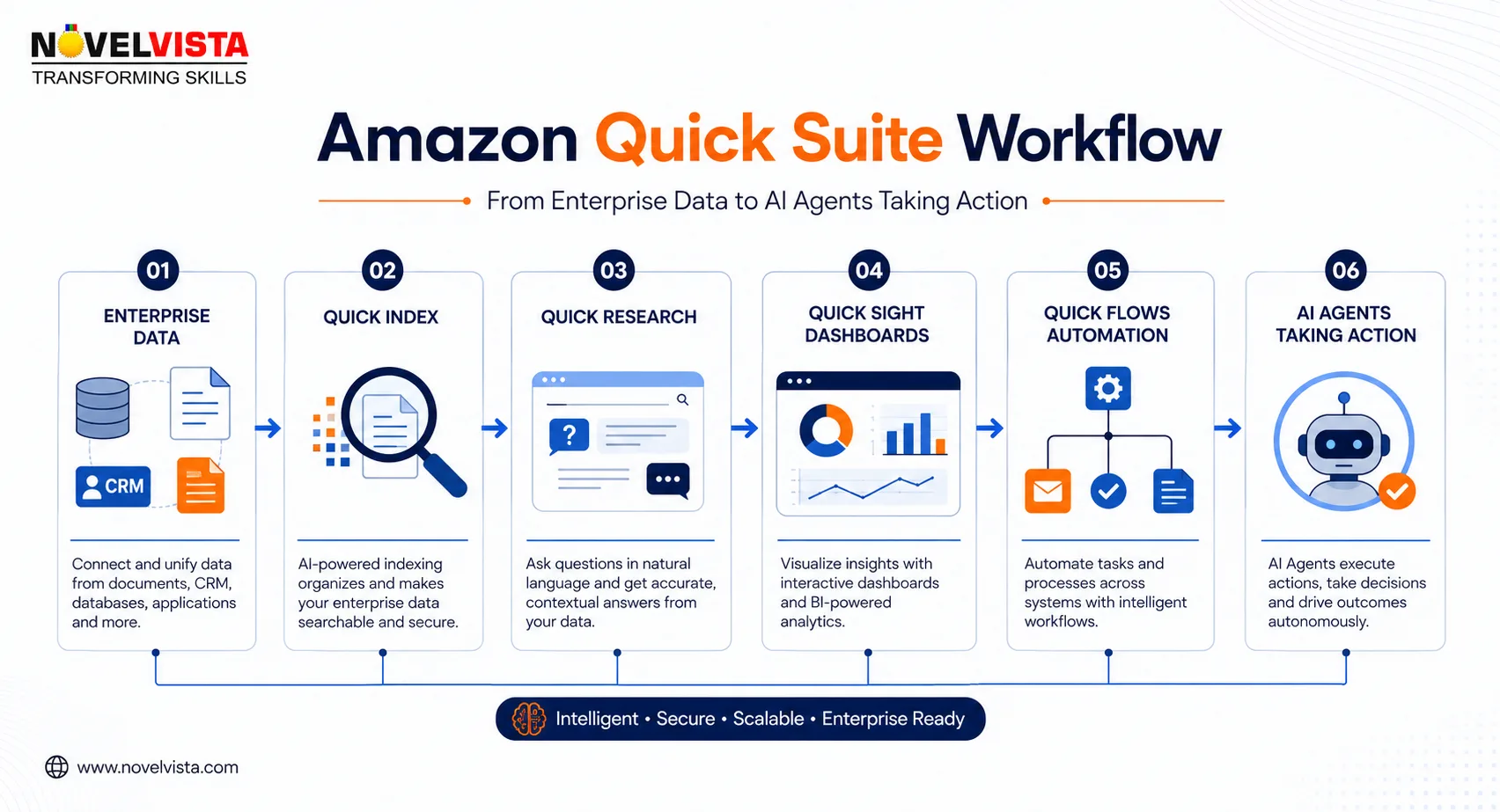
The platform combines multiple capabilities that support business users, analysts, operations teams, IT teams, and decision-makers. Its value comes from connecting data, people, and actions in one operating layer.
| Capability | Purpose | Enterprise Value |
|---|---|---|
| Quick Sight | AI-powered BI and dashboards | Faster reporting and visual insights |
| Quick Research | Deep research across data sources | Better analysis and summaries |
| Quick Flows | Workflow automation from natural language | Less repetitive manual work |
| Quick Automate | Multi-step process automation | More consistent operations |
| Quick Index | Enterprise knowledge discovery | Faster access to trusted information |
| AI Agents | Task-specific digital assistants | Scalable support for daily work |
An amazon quick suite agentic ai workspace goes beyond answering questions. It can understand user intent, search approved data sources, create outputs, trigger workflows, and help complete tasks.
For example, a sales leader could ask for a renewal risk summary. The system can pull customer history, support tickets, account notes, and pipeline data to prepare a usable business brief.
Amazon Quick Suite AI agents act like digital teammates for specific business tasks. They can help users research a topic, summarize documents, build dashboards, organize workspaces, and create repeatable workflows.
The strongest use cases are repetitive, data-heavy, and decision-oriented. Sales planning, IT incident summaries, finance reconciliation, HR policy support, and operations reporting are practical starting points.
Amazon Quick Suite can support several enterprise functions when connected to the right systems and governed properly.
Traditional BI platforms are excellent for reports and dashboards, but they usually depend on prepared datasets and predefined views. Amazon Quick Suite expands the experience by adding conversation, research, automation, and task execution.
| Area | Traditional BI | Amazon Quick Suite |
|---|---|---|
| Experience | Dashboard-first | Conversation and action-first |
| Data | Mostly structured datasets | Structured and unstructured business data |
| Output | Reports and charts | Answers, dashboards, workflows, and actions |
| Automation | Often separate tooling | Built into the AI workspace |
| Audience | Analysts and business users | Business, IT, data, operations, and leadership teams |
The main advantage of Amazon Quick Suite is speed. Employees can find information, understand business signals, create deliverables, and automate tasks from one AI-enabled workspace.
Other benefits include reduced tool switching, faster reporting cycles, better knowledge reuse, improved analytics access for non-technical users, and stronger alignment between business decisions and execution.
Enterprise adoption should not begin with unlimited access. AI agents need access controls, approval paths, monitoring, and clear ownership.
Before scaling Amazon Quick Suite, define which data sources it can access, who can create agents, which actions require human approval, how outputs will be validated, and how sensitive information will be protected.
What is Amazon Quick Suite from a workforce perspective? It is not only a platform. It is a new way of working with data, automation, and AI agents.
Teams need AI literacy, prompt writing, workflow design, governance awareness, validation skills, and practical understanding of enterprise data. Without enablement, even advanced tools can become underused software.
Start with focused pilots instead of broad deployment. Choose workflows that are repetitive, measurable, and connected to business value.
Amazon Quick Suite is one of AWS’s key moves toward agentic enterprise productivity. It combines business intelligence, research, automation, knowledge discovery, and AI agents into a single workspace.
For enterprise teams in 2026, the opportunity is clear: reduce manual work, improve decision-making, and make business data more actionable. The challenge is equally clear: success depends on use-case selection, governance, access control, and structured team enablement.
To build practical capability, explore NovelVista’s Amazon Quick Suite corporate training program. The course helps teams understand agent building, workflow automation, responsible AI usage, and practical enterprise adoption without turning the rollout into another dusty shelfware story.
Author Details

Confused About Certification?
Get Free Consultation Call
Stay ahead of the curve by tapping into the latest emerging trends and transforming your subscription into a powerful resource. Maximize every feature, unlock exclusive benefits, and ensure you're always one step ahead in your journey to success.