Category | AI And ML
Last Updated On 18/06/2026
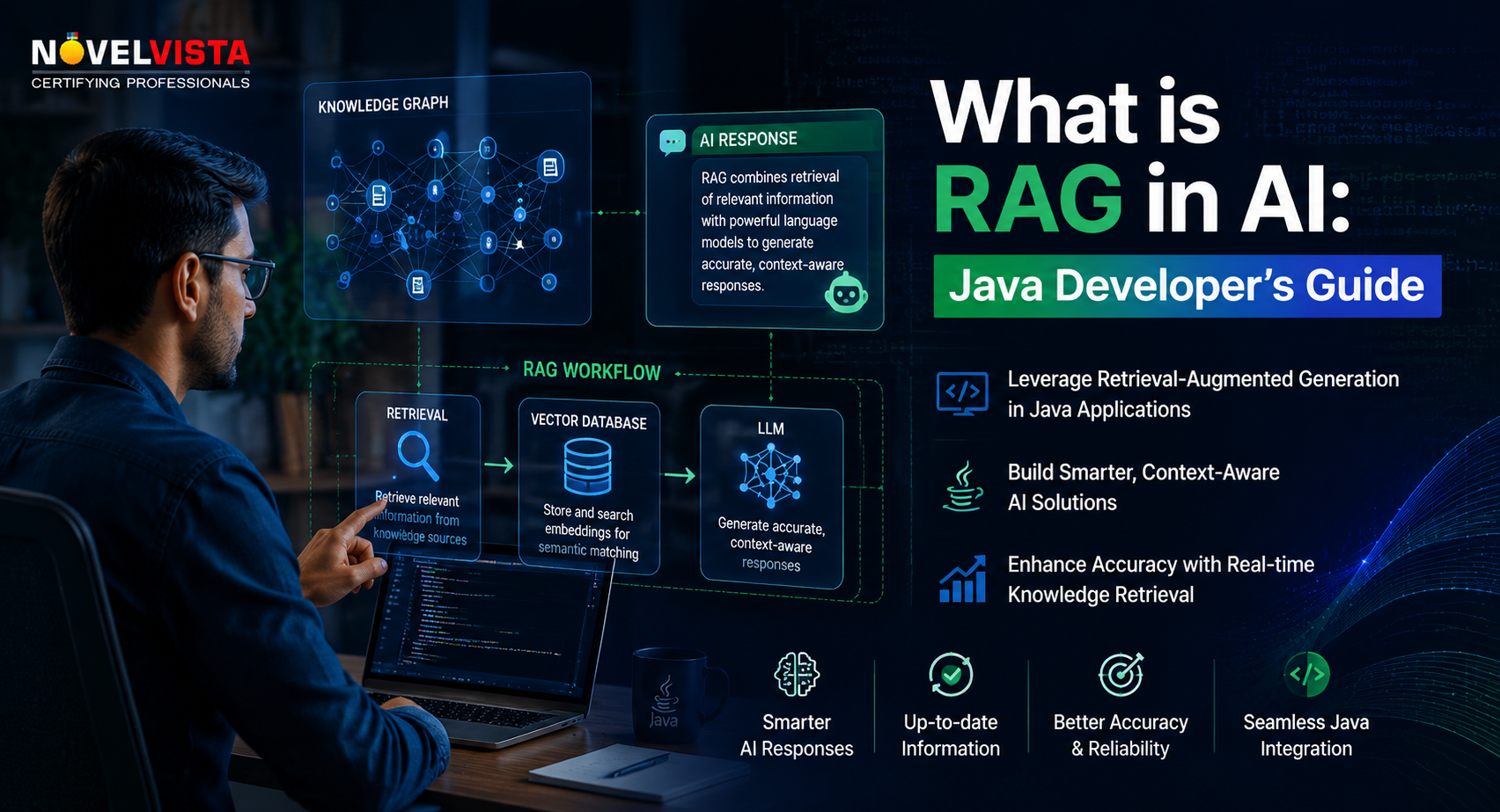
RAG (Retrieval-Augmented Generation) is transforming AI workflows by combining retrieval of relevant data with generative models. Java developers can leverage this to build smarter enterprise applications with frameworks like LangChain4j. This guide explains what RAG is in AI, architecture, developer integrations, and practical use cases.
Learn what RAG is in AI, why it matters for Java developers, and how it enables intelligent applications. This guide covers RAG definition, architecture, LangChain4j integration, and enterprise applications.
RAG, or Retrieval-Augmented Generation, combines retrieval from external sources with generative AI models. It improves factual accuracy and relevance compared to standard LLM outputs. RAG full form in AI is Retrieval-Augmented Generation.
RAG integrates retrieval, augmentation, and generation steps to produce context-aware AI responses.
| Step | Description |
|---|---|
| Retrieval | Query vector databases or document stores for relevant content. |
| Augmentation | Combine retrieved content with prompt templates. |
| Generation | Generate answers leveraging LLMs using the augmented context. |
Common tools include vector stores (FAISS, Pinecone), LLMs (OpenAI, Azure), and orchestration frameworks like LangChain4j.
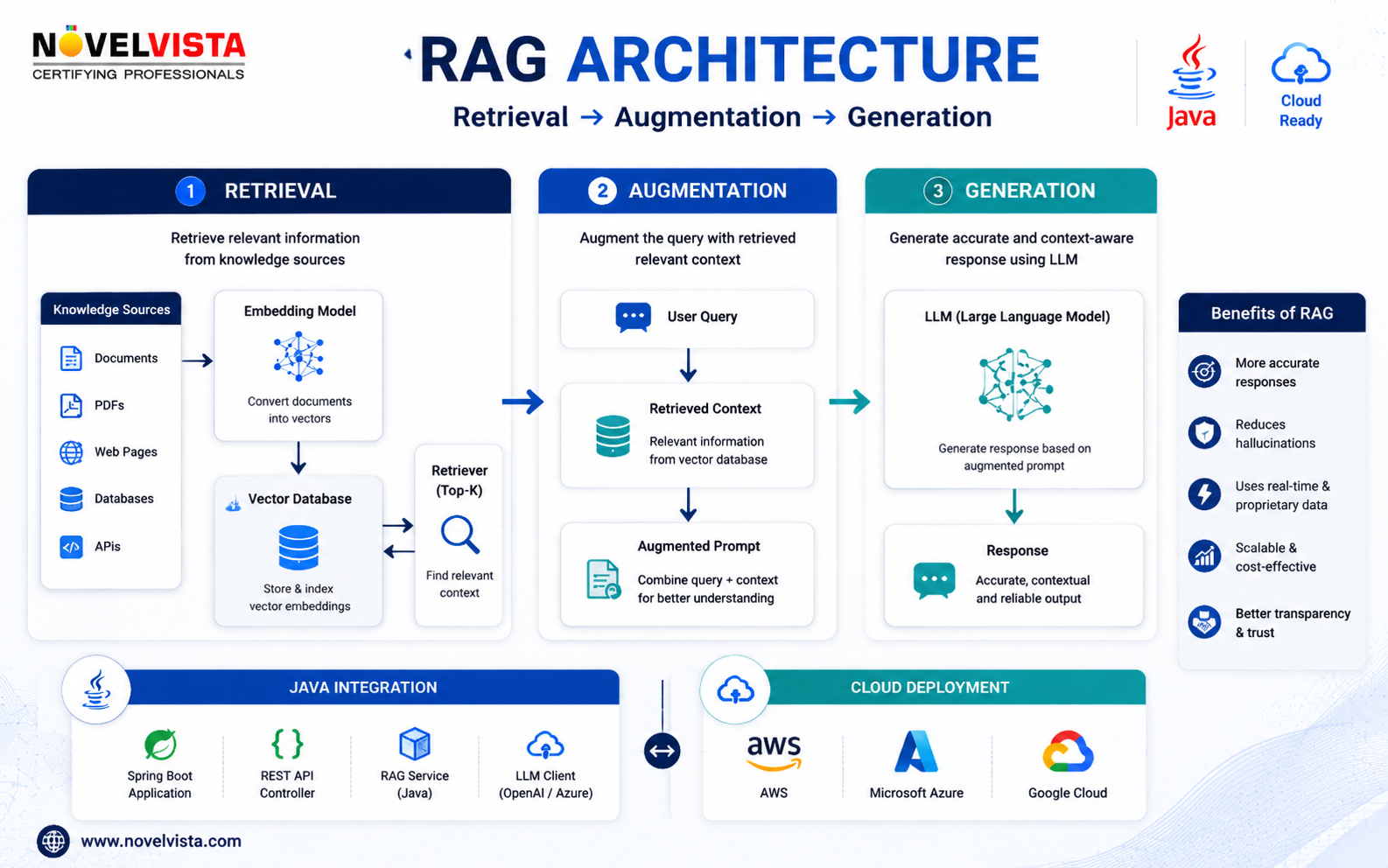
LangChain4j enables RAG workflows natively in Java, offering document loaders, vector embeddings, and chain orchestration.
VectorStore store = new FAISSVectorStore("data/faiss.index");
RetrievalQA qa = new RetrievalQA(store, llm);
String answer = qa.answer("What is RAG in AI?");
System.out.println(answer);
This setup allows Java developers to implement RAG pipelines without switching languages.
| Aspect | RAG | Standard LLM |
|---|---|---|
| Accuracy | High (context from retrieved data) | Moderate (risk of hallucination) |
| Data Integration | Dynamic, domain-specific | Static, limited to training corpus |
| Implementation | Requires retrieval setup | Simple LLM API call |
Mastering what is RAG in AI equips Java developers to create intelligent enterprise applications. Gain hands-on experience with LangChain4j and Spring AI by enrolling in NovelVista’s AI Engineer — Java Stack (Spring AI & LangChain4j) Course. Build production-ready RAG applications and understand generative AI in real-world contexts.
Author Details

Course Related To This blog
Agentic AI Engineering Bootcamp
Confused About Certification?
Get Free Consultation Call
Stay ahead of the curve by tapping into the latest emerging trends and transforming your subscription into a powerful resource. Maximize every feature, unlock exclusive benefits, and ensure you're always one step ahead in your journey to success.