Category | AI And ML
Last Updated On 15/06/2026
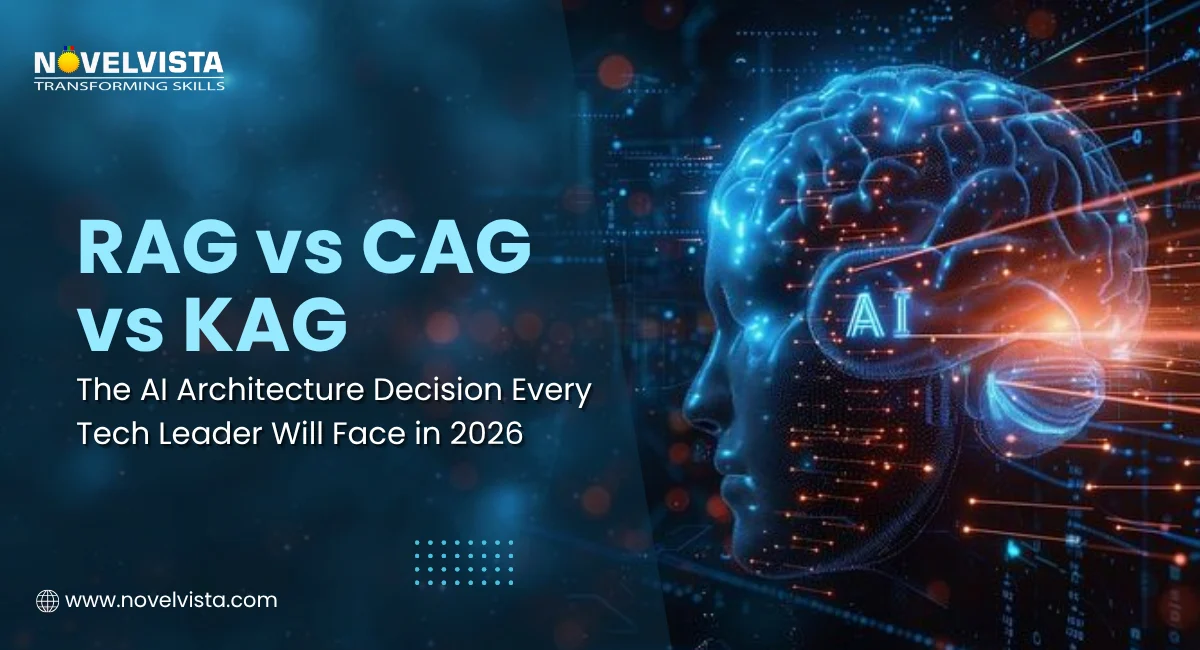
As enterprise AI adoption accelerates, choosing the right knowledge architecture is no longer just a technical decision. It is a strategic capability that organizations must build internally. Whether your teams are developing AI copilots, intelligent search platforms, or autonomous agents, understanding Retrieval-Augmented Generation (RAG), Cache-Augmented Generation (CAG), and Knowledge-Augmented Generation (KAG) is becoming essential.
For technology leaders, the challenge is not simply selecting the right architecture, but ensuring engineering teams have the skills to design, deploy, and scale these systems effectively. This blog explains how the debate around RAG vs CAG vs KAG impacts AI accuracy, governance, operational costs, business value, and the future of enterprise AI systems in 2026 and beyond.
The first wave of AI adoption was about experimenting with chatbots, copilots, and document assistants. The next wave will focus on building reliable AI systems that can answer business-critical questions with the right context.
That is where enterprise AI architecture becomes important. A model that answers from outdated knowledge can mislead teams. A model that retrieves too slowly can frustrate users. A model that cannot reason across contracts, controls, and dependencies may fail in complex business environments.
For generative AI for business leaders, the real question is not “Which model is smartest?” It is “Which architecture gives users the most accurate answer with the lowest operational risk?”
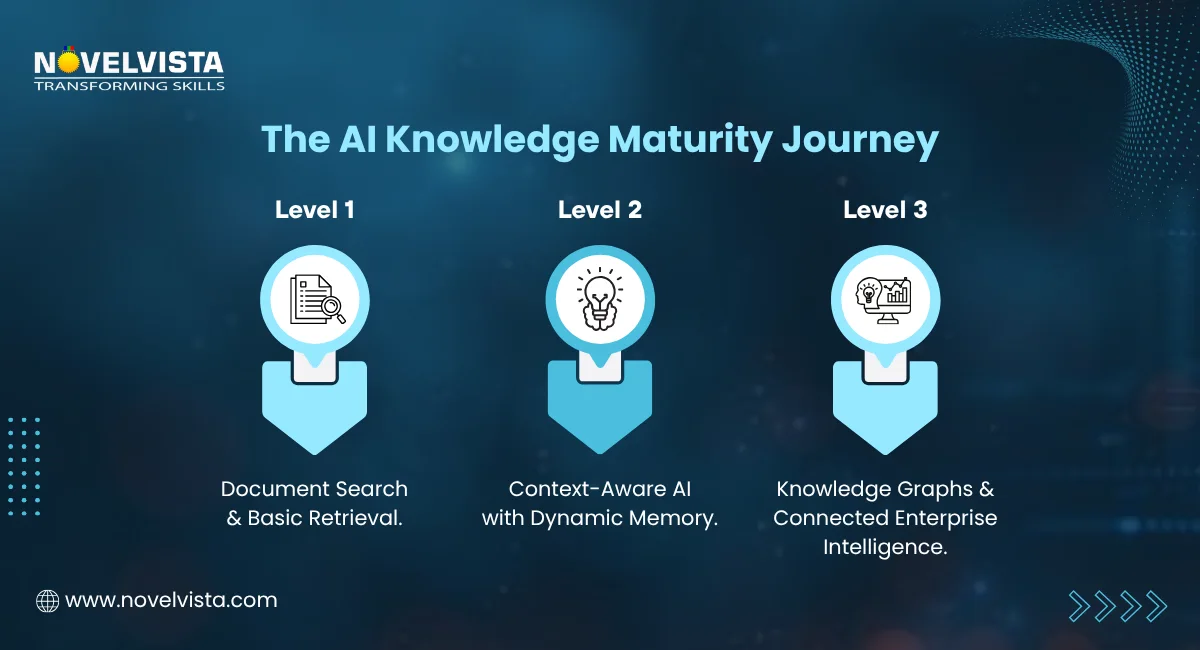
Retrieval-Augmented Generation connects a large language model with external knowledge sources such as documents, databases, policies, tickets, PDFs, or product manuals. When a user asks a question, the system retrieves relevant information and passes it to the model before generating the answer.
A typical RAG architecture includes document ingestion, chunking, embeddings, vector search, retrieval logic, ranking, prompt construction, and response generation.
The biggest strength of RAG is freshness. If your data changes frequently, RAG helps the AI system access updated information without retraining the model.
RAG works well for internal knowledge assistants, customer support search, compliance Q&A, technical documentation chatbots, and enterprise helpdesk automation.
The limitation is complexity. A RAG architecture depends heavily on retrieval quality. If chunking, metadata, or ranking is weak, the model may receive the wrong context and generate a confident but incorrect answer.
Cache-Augmented Generation works differently. Instead of retrieving information every time a user asks a question, CAG preloads or caches relevant knowledge so the model can respond faster.
This makes CAG useful when the knowledge base is stable, narrow, and repeatedly queried. For example, an HR assistant answering standard leave policy questions may not need live retrieval every time. Cached context can reduce latency, simplify the pipeline, and improve user experience.
The practical RAG vs CAG question is about freshness versus speed. RAG is better when knowledge changes often. CAG is better when knowledge is predictable and frequently reused.
CAG works well for static policy assistants, product FAQ bots, training support assistants, repetitive service workflows, and internal enablement tools.
However, CAG has limits. If cached information becomes stale, users may receive outdated responses. It also struggles when the domain is too large or too dynamic to preload efficiently.
Knowledge-Augmented Generation is designed for situations where simple retrieval is not enough. KAG combines LLMs with structured knowledge, often through knowledge graphs, rules, ontologies, entities, and relationships.
This matters because many business questions are not simple document lookups. A finance leader may ask how a regulation affects a product line. A risk team may ask which vendors touch sensitive customer data. A cloud team may ask which workloads violate security controls.
KAG helps AI reason across connected information rather than only finding similar text. It is especially useful for enterprise artificial intelligence where relationships, traceability, and governance matter.
KAG works well for risk and compliance reasoning, healthcare knowledge systems, legal contract analysis, supply chain dependency mapping, and executive decision support.
| Criteria | RAG | CAG | KAG |
|---|---|---|---|
| Core Idea | Retrieves external data in real time | Uses cached context for faster responses | Leverages structured knowledge graphs |
| Best For | AI assistants and enterprise search | High-volume, repetitive AI tasks | Complex reasoning and domain expertise |
| Speed | Moderate | Very fast | Moderate |
| Knowledge Freshness | High | Medium | High, if the graph is updated |
| Complexity | Medium | Low | High |
| Cost Efficiency | Moderate | High | Moderate |
| Key Strength | Up-to-date, grounded answers | Low latency and lower inference costs | Explainable, relationship-aware AI |
| Ideal Choice When... | Data changes frequently | Performance and cost matter most | Business logic and connected knowledge are critical |
Choose RAG when your organization needs answers based on changing information. This includes policies, technical documents, product updates, customer records, and operational knowledge.
A strong RAG architecture works best when teams invest in clean data pipelines, metadata strategy, access controls, evaluation metrics, and monitoring. RAG is not just a vector database project. It is a full knowledge operations capability.
For enterprise AI, RAG is often the practical starting point because it balances flexibility, explainability, and deployment speed.
Choose CAG when response speed is more important than real-time freshness. If users ask similar questions again and again, caching can reduce cost and improve performance.
CAG is especially useful in controlled environments where content updates are scheduled and predictable. It can also work as a layer inside a broader AI system, where frequent answers are cached and rare questions are retrieved dynamically.
This hybrid model is gaining attention because it gives teams both speed and coverage.
Choose KAG when your AI system must reason through relationships. If the answer depends on hierarchy, ownership, dependencies, rules, controls, or cause-and-effect logic, KAG deserves serious consideration.
For enterprise artificial intelligence, KAG can support stronger governance because relationships are explicit. It can show how a conclusion was reached, which data points were connected, and which rules were applied.
That makes it valuable for regulated industries and executive decision support.
Tech leaders should evaluate these architectures across five factors:
If freshness matters most, choose RAG. If speed matters most, choose CAG. If reasoning matters most, choose KAG. If all three matter, design a hybrid model.
By 2026, mature organizations will not ask only “RAG vs CAG?” They will combine retrieval, caching, and knowledge reasoning based on business use case maturity.
A service desk assistant may use CAG for common questions and RAG for new incidents. A compliance assistant may use RAG for policy lookup and KAG for rule-based interpretation. A leadership dashboard may use all three to deliver fast, grounded, and explainable insights.
This is where enterprise AI architecture becomes strategic. The winners will not adopt one pattern blindly. They will map architecture to business risk, user behavior, and knowledge complexity.
The debate around RAG vs. CAG vs. KAG is not about finding a single winner. It is about choosing the right knowledge strategy for the AI capabilities your organization wants to build. As AI becomes a core part of enterprise operations, success will depend not only on selecting the right architecture but also on having teams that understand how to design, implement, and optimize these systems in real-world environments.
For technology and L&D leaders planning long-term AI adoption, investing in practical, hands-on upskilling can help bridge the gap between AI experimentation and production-ready deployment. Programs such as NovelVista’s Retrieval Augmented Generation (RAG) Engineering corporate training are designed to equip engineering teams with the knowledge needed to build scalable, context-aware AI solutions aligned with modern enterprise needs.
In 2026 and beyond, organizations that combine the right AI architecture with the right internal capabilities will be best positioned to create AI systems that are accurate, reliable, and built for business impact.
Author Details

Confused About Certification?
Get Free Consultation Call
Stay ahead of the curve by tapping into the latest emerging trends and transforming your subscription into a powerful resource. Maximize every feature, unlock exclusive benefits, and ensure you're always one step ahead in your journey to success.