Category | AI And ML
Last Updated On 22/05/2026
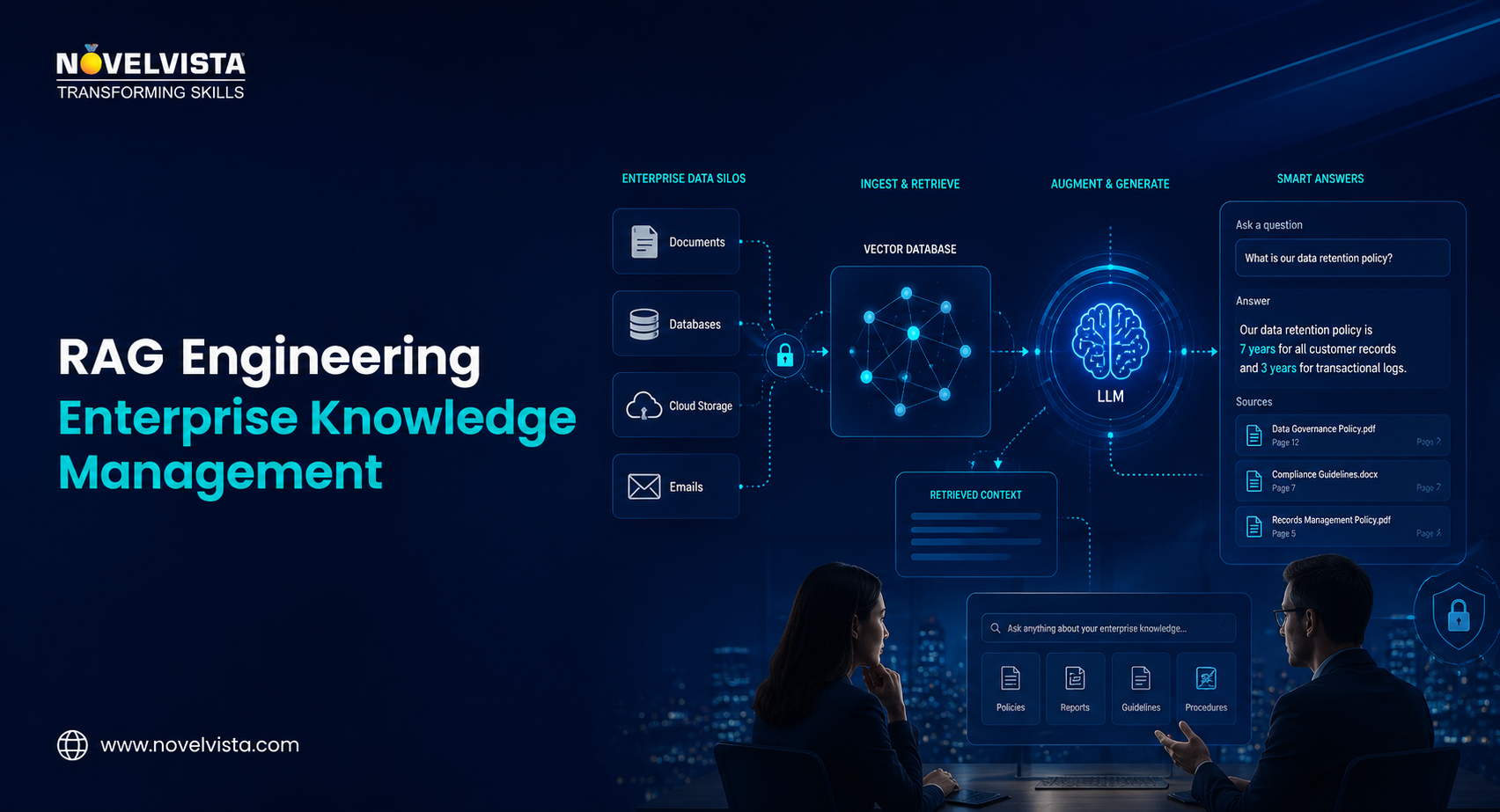
This blog explains how RAG engineering enterprise practices help organizations move from fragmented documents and disconnected systems to reliable, source-grounded AI answers. It covers enterprise knowledge problems, RAG architecture, business use cases, implementation risks, training needs, and the practical skills teams need to deploy RAG responsibly.
Enterprise knowledge management has always had a quiet enemy: data silos. Policies live in SharePoint, support answers live in ticketing tools, contracts sit in legal repositories, dashboards hide inside BI platforms, and employees still ask colleagues because search rarely understands intent.
RAG engineering enterprise systems change this pattern by connecting large language models with trusted internal knowledge sources, allowing employees to ask natural-language questions and receive contextual, traceable answers.
Modern organizations do not suffer from a lack of information. They suffer from information trapped in too many places.
RAG engineering enterprise solutions are becoming important because traditional keyword search often returns links, not decisions. Employees still need to open documents, compare versions, verify context, and ask subject matter experts.
With enterprise RAG engineering, the system retrieves relevant enterprise content first and then generates an answer grounded in that content. This reduces blind guessing and improves confidence in AI-generated responses.
The shift is simple but powerful: enterprise search moves from finding documents to delivering usable answers.
RAG engineering enterprise refers to designing, building, evaluating, and operating retrieval-augmented generation systems for business environments.
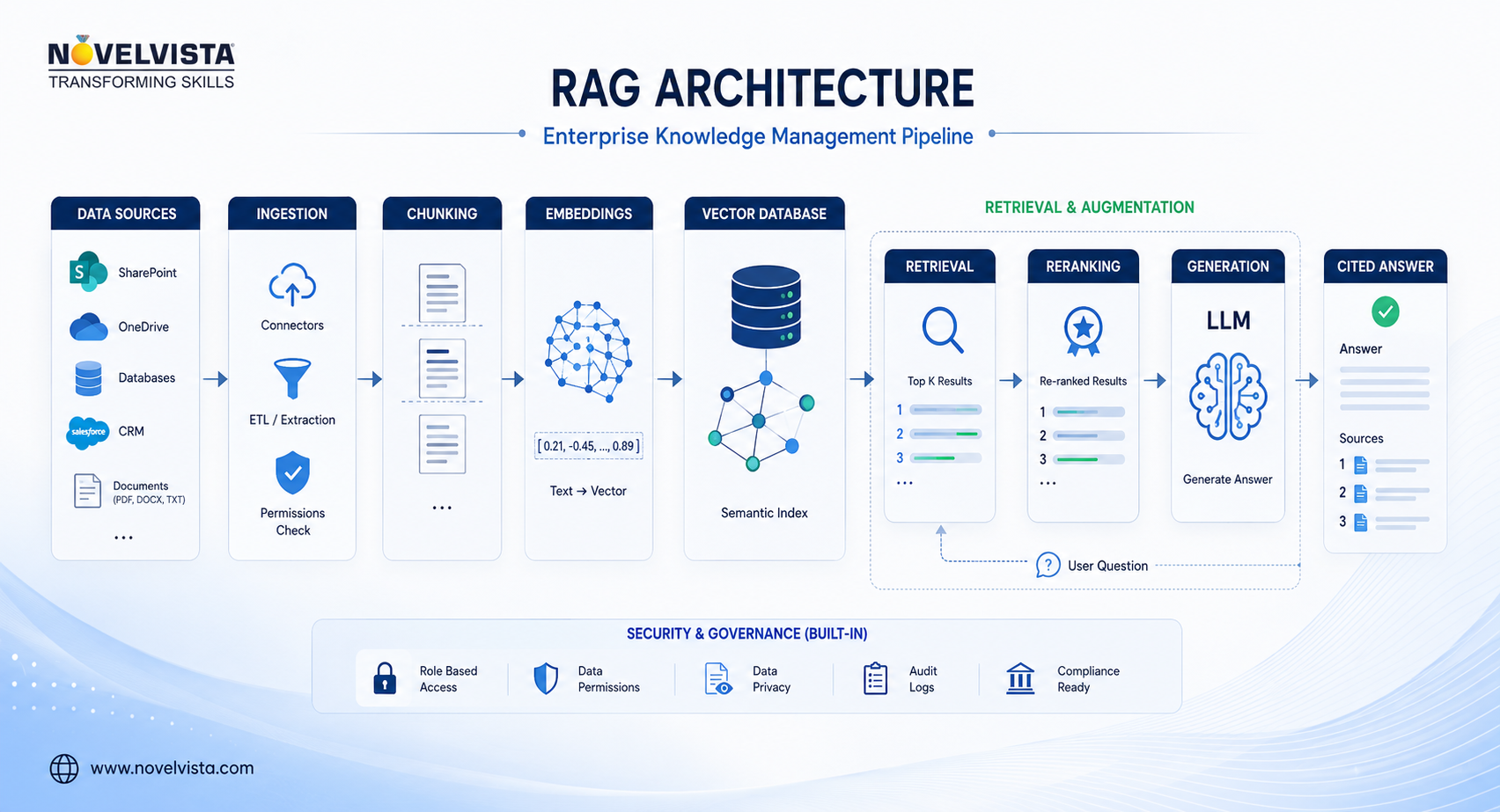
It is not only about connecting a chatbot to a document folder. A production-ready RAG system needs ingestion pipelines, chunking strategy, embeddings, vector databases, metadata filters, access control, reranking, prompt orchestration, evaluation, monitoring, and governance.
In simple terms, enterprise RAG engineering creates a controlled bridge between LLMs and trusted organizational knowledge.
This is why RAG is now a core topic in AI knowledge management training.
A strong RAG engineering enterprise workflow starts before the model receives a question. It begins with content readiness.
| Stage | What Happens | Business Value |
|---|---|---|
| Content ingestion | Documents, tickets, policies, reports, and records are collected from enterprise systems. | Breaks silos across departments. |
| Chunking and enrichment | Content is split, tagged, cleaned, and enriched with metadata. | Improves retrieval precision. |
| Embedding and indexing | Text is converted into searchable vector representations. | Enables semantic search at scale. |
| Retrieval and reranking | The system retrieves and prioritizes the most relevant passages. | Reduces irrelevant context. |
| Answer generation | The LLM generates a response using retrieved context. | Delivers smart answers instead of raw links. |
| Evaluation and monitoring | Teams track answer quality, latency, hallucination risk, and user feedback. | Supports continuous improvement. |
This structured pipeline is the backbone of RAG engineering enterprise delivery.
A strong retrieval augmented generation corporate use case usually appears where employees need fast answers from complex internal knowledge.
Common enterprise use cases include:
Each retrieval augmented generation corporate use case should be scoped around clear answer types, trusted data sources, and measurable workflow improvement.
That is where RAG engineering enterprise moves from experiment to business capability.
RAG for business intelligence is one of the most practical opportunities for enterprise teams. Instead of forcing users to navigate dashboards and SQL queries, RAG-enabled BI lets business users ask questions in natural language.
For example, a revenue leader could ask, “Which regions missed forecast last quarter and what reasons were mentioned in sales notes?” A RAG system can retrieve structured metrics, meeting notes, CRM updates, and commentary before forming a contextual answer.
RAG for business intelligence is especially useful when insights depend on both numbers and narrative context.
| Traditional BI | RAG-Enabled BI |
|---|---|
| Users search dashboards manually. | Users ask natural-language questions. |
| Insights are mostly numeric. | Answers combine metrics and source context. |
| Analysts handle most follow-up questions. | Business users self-serve more confidently. |
| Reports are often static. | Answers can reflect updated enterprise sources. |
This makes enterprise RAG engineering valuable for analytics teams that want BI to become conversational without losing source traceability.
LLM enterprise deployment becomes risky when teams rely only on a model’s pre-trained knowledge. The model may produce confident answers that are outdated, generic, or disconnected from company policy.
RAG engineering enterprise reduces this risk by grounding outputs in approved business sources.
For LLM enterprise deployment, RAG helps teams manage:
In short, RAG engineering enterprise gives LLMs a better memory without retraining the entire model.
Enterprise RAG success depends on people as much as platforms. Teams need practical skills across data engineering, AI engineering, cloud architecture, security, and product thinking.
A good AI knowledge management training program should include:
This is where RAG engineering enterprise training becomes essential for organizations moving beyond proof-of-concept pilots.
A production-grade RAG engineering enterprise architecture typically includes multiple layers.
| Component | Purpose | Common Enterprise Consideration |
|---|---|---|
| Connectors | Pull content from SharePoint, Confluence, CRM, ERP, file stores, databases, and APIs. | Permission mapping and source freshness. |
| Processing pipeline | Cleans, normalizes, chunks, and enriches content. | Document versioning and metadata quality. |
| Vector database | Stores embeddings for semantic retrieval. | Scale, latency, multi-cloud support, and security. |
| Retriever | Finds candidate passages. | Hybrid search and filtering. |
| Reranker | Prioritizes the best context. | Accuracy versus cost and latency. |
| LLM layer | Generates the final answer. | Model choice, privacy, and cost control. |
| Evaluation layer | Measures quality and reliability. | Regression tests and feedback loops. |
Each layer must be engineered deliberately. That is the difference between a demo chatbot and RAG engineering enterprise readiness.
RAG engineering enterprise initiatives often fail when governance is treated as an afterthought. A RAG system can retrieve the right document and still create risk if it exposes information to the wrong user.
Security teams should define:
Governance must be part of RAG engineering enterprise design from day one, especially for finance, healthcare, legal, HR, and regulated industries.
RAG should not be measured only by whether the chatbot responds. The real question is whether the answer is useful, accurate, secure, and adopted by users.
For RAG engineering enterprise, track these metrics:
These measurements make RAG engineering enterprise accountable to business outcomes, not AI excitement.
A practical RAG engineering enterprise roadmap should move in controlled stages.
This roadmap keeps RAG engineering enterprise focused on high-value adoption instead of uncontrolled experimentation.
Tools alone will not transform knowledge management. Employees need to know how to design, use, evaluate, and govern RAG systems.
AI knowledge management training should be role-based:
| Role | Training Focus | Expected Outcome |
|---|---|---|
| Business leaders | Use cases, ROI, governance, and risk. | Better sponsorship and prioritization. |
| Product managers | User journeys, answer quality, adoption metrics. | Better RAG product design. |
| Data engineers | Pipelines, chunking, embeddings, metadata, vector stores. | Reliable retrieval foundation. |
| AI engineers | Prompt orchestration, reranking, evaluation, monitoring. | Production-grade RAG delivery. |
| Security teams | Permissions, logging, privacy, auditability. | Safer deployment at scale. |
The best AI knowledge management training connects architecture with real business documents and real user questions.
That approach turns RAG engineering enterprise into an organizational capability, not a one-team experiment.
Many teams rush into RAG engineering enterprise projects with the belief that adding a vector database will solve knowledge management. That is rarely enough.
Avoid these mistakes:
Successful enterprise RAG engineering programs treat data quality, retrieval design, and governance as one integrated system.
The future of RAG engineering enterprise is moving toward context engineering, hybrid search, multimodal retrieval, agentic workflows, and stronger evaluation automation.
Enterprises will increasingly combine RAG with workflow automation. Instead of only answering, systems may retrieve a policy, summarize options, recommend next steps, create a ticket, and route the case to the right team.
For LLM enterprise deployment, this means RAG will become a control layer between models, users, knowledge sources, and business actions.
The winners will not be the companies that deploy the biggest model. They will be the companies that engineer the best context.
Enterprise knowledge management is entering a new phase. Static repositories, scattered search results, and tribal knowledge are giving way to grounded AI systems that can retrieve, reason, and respond with context.
RAG engineering enterprise helps organizations turn fragmented information into smart answers while maintaining traceability, governance, and business relevance.
Whether your priority is employee self-service, customer support, compliance review, knowledge discovery, or RAG for business intelligence, the right engineering skills are critical.
To build those skills, explore NovelVista’s Retrieval-Augmented Generation (RAG) Engineering corporate training course. The course is designed to help enterprise teams understand architecture, retrieval pipelines, vector databases, evaluation, governance, and practical deployment workflows for real-world RAG systems.
If your organization wants AI that answers from trusted knowledge instead of improvising, RAG engineering enterprise is the capability to build next.
Author Details

Confused About Certification?
Get Free Consultation Call
Stay ahead of the curve by tapping into the latest emerging trends and transforming your subscription into a powerful resource. Maximize every feature, unlock exclusive benefits, and ensure you're always one step ahead in your journey to success.