Category | AI And ML
Last Updated On 18/06/2026
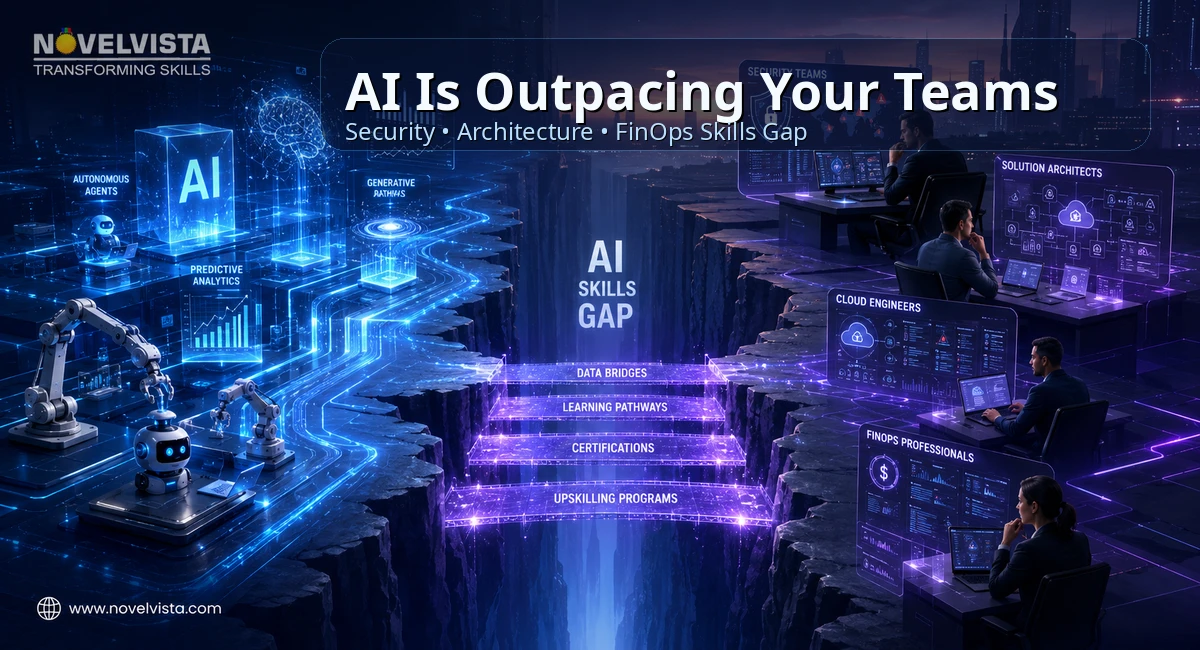
AI is moving faster than many enterprise teams can safely manage. This blog explains the AI skills gap enterprise leaders must address across security, architecture, and FinOps. It covers why traditional controls are not enough, how AI changes cloud risk and cost models, and what organisations can do to build role-based capability before AI adoption becomes operational debt.
The issue is no longer limited to data scientists or machine learning engineers. Security analysts, cloud architects, FinOps teams, business leaders, and platform owners now need practical AI judgment to make safe, cost-aware, and scalable decisions.
For years, many enterprises treated AI capability as a specialist skill. Hire a few data scientists, run pilots, and keep AI inside innovation teams. That model no longer works.
The AI skills gap enterprise leaders face is now cross-functional. AI is entering service desks, software delivery pipelines, cloud platforms, customer operations, finance workflows, and board-level planning. Every technical function now needs AI judgment, not just AI awareness.
The real gap is not only a shortage of AI engineers. It is the absence of practical AI skills inside the teams already responsible for risk, architecture, cost, compliance, and production operations.
Security teams were already managing cloud complexity, identity sprawl, SaaS risks, supply chain exposure, and compliance pressure. AI adds another layer of uncertainty because model-driven systems do not behave like traditional applications.
Cloud security challenges 2026 include securing copilots, internal chatbots, retrieval systems, autonomous agents, and third-party AI tools. Inputs are unpredictable, outputs can be manipulated, and AI agents may access data or trigger actions across connected systems.
Security teams must now understand AI-specific threat modelling, secure prompt design, agent permissions, model monitoring, and AI incident response. Without these skills, governance becomes reactive instead of preventive.
Agentic AI security risks are especially serious because agents can take actions, call tools, retrieve information, and interact with enterprise systems. That creates new failure points beyond normal application security testing.
Cloud security challenges 2026 will require stronger AI access controls, audit trails, monitoring, policy enforcement, and clear accountability for model-assisted actions.
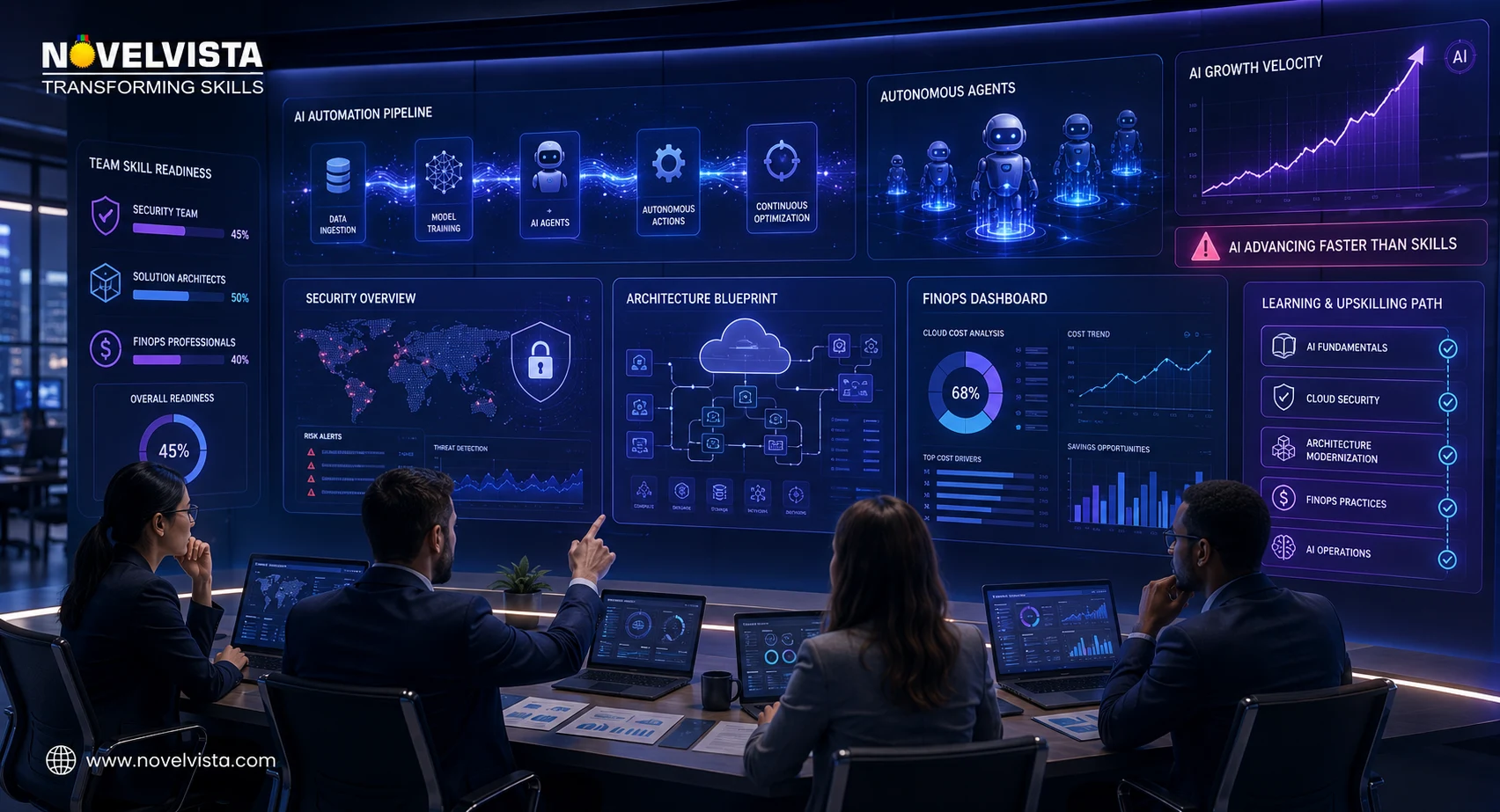
Traditional enterprise systems follow defined business logic. AI-enabled systems introduce probability, context windows, retrieval quality, prompt design, model evaluation, and human review. This changes how architects must think about reliability, performance, and governance.
Modern Solution architect skills now include model selection, vector databases, grounding data, orchestration, fallback design, evaluation metrics, and cost-aware routing. Architects also need to decide when human approval is required and how to measure output quality beyond uptime.
The AI skills gap enterprise architecture teams face becomes visible when pilots move into production. At that point, leaders need answers to practical design questions.
These questions show why Solution architect skills must now blend cloud, AI governance, security, business process design, and responsible automation.
Cloud cost management was already difficult. AI makes it more dynamic because usage can grow through tokens, inference calls, embeddings, vector storage, GPU demand, evaluation runs, and experimentation waste.
FinOps AI cost management is becoming essential because a small proof of concept can become expensive when thousands of employees start using AI across daily workflows. GenAI FinOps is not only about reducing spend. It is about linking AI usage to business value, productivity, and measurable outcomes.
Teams need budgets by use case, cost alerts, model routing policies, and real-time visibility into consumption patterns.
FinOps AI cost management requires a different operating rhythm from traditional monthly cloud reporting. Teams need to track AI consumption at the workflow, model, and business-unit level.
| Cost Area | What Teams Must Track | Why It Matters |
|---|---|---|
| Token usage | Input, output, and context length | Long prompts and responses can increase cost quickly |
| Model selection | Premium models vs smaller task-specific models | Not every workflow needs the most expensive model |
| Inference volume | API calls, user sessions, and automation frequency | Usage growth can create surprise bills |
| Data pipelines | Embeddings, retrieval, storage, and monitoring | AI cost includes more than model access |
GenAI FinOps should help teams spend intentionally, not simply spend less.
Many organisations assume AI tools are intuitive because employees can open a chatbot and get answers. That is the trap. Basic usage does not equal enterprise readiness.
The AI skills gap enterprise teams face becomes visible when AI pilots move into business-critical workflows. Security asks who owns the agent. Architecture asks how model behaviour is controlled. Finance asks why usage is rising. Business leaders ask why outcomes are inconsistent.
At that point, the problem is no longer tool selection. It is capability debt created by scaling AI faster than people, processes, and controls.
Enterprises do not need random AI awareness sessions. They need structured, role-based learning paths that match real responsibilities.
Hiring helps, but upskilling existing teams is often faster, more practical, and more scalable.
AI will continue to move faster than traditional job descriptions, training calendars, and governance models. Enterprises that wait for roles to stabilise will stay behind. The better approach is to build adaptable teams that understand AI from the perspective of security, architecture, cost, governance, and business value.
The AI skills gap enterprise leaders must close is not solved by buying more tools. It is solved by preparing the teams who secure systems, design platforms, manage budgets, and make operational decisions.
Ready to build AI-ready teams?
Explore NovelVista Corporate Training to design role-based programmes for security, architecture, FinOps, cloud, and business teams. NovelVista helps enterprises build practical AI capability that is secure, measurable, cost-aware, and aligned with real workforce needs.
Author Details

Confused About Certification?
Get Free Consultation Call
Stay ahead of the curve by tapping into the latest emerging trends and transforming your subscription into a powerful resource. Maximize every feature, unlock exclusive benefits, and ensure you're always one step ahead in your journey to success.