Category | AI And ML
Last Updated On 12/12/2025
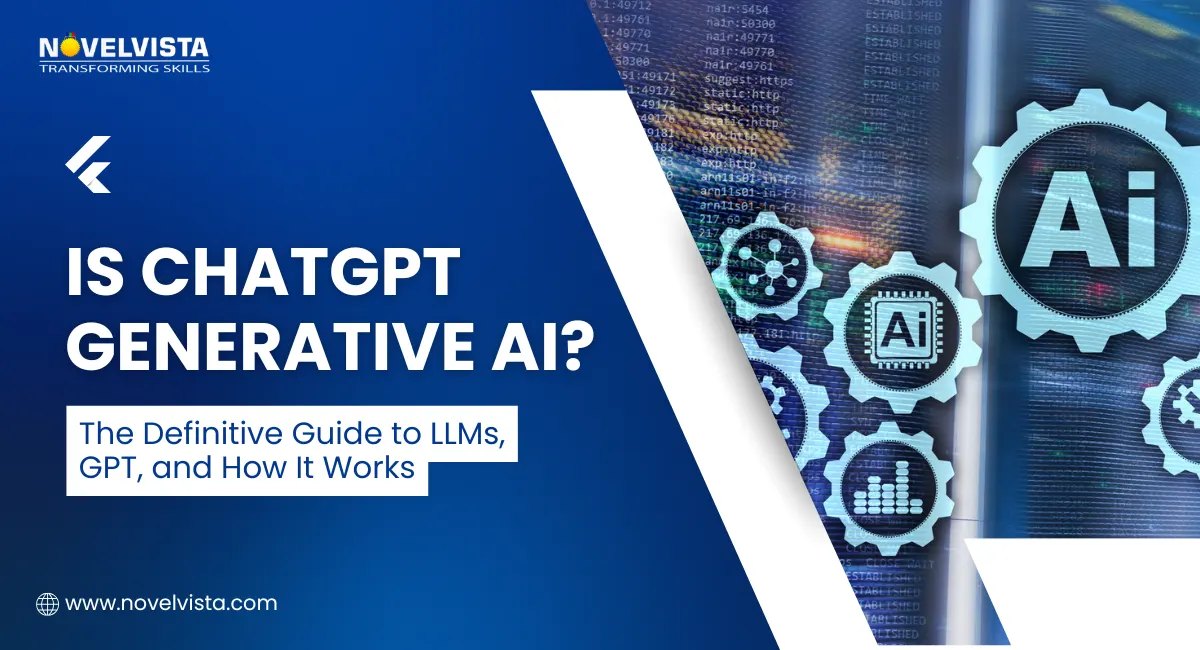
Just a few years ago, generating human-like text was science fiction. Today, AI like ChatGPT creates millions of words a day, powering everything from student essays to complex business reports. According to global reports, nearly 77% of today’s devices already use some form of AI, and the generative AI market alone is expected to surpass USD 1.3 trillion by 2032. Whether you're a student, IT professional, business leader, content creator, or someone simply curious about how tools like ChatGPT work—one question keeps coming up everywhere:
Is ChatGPT Generative AI?
This isn’t just a technical curiosity. Understanding what makes ChatGPT tick helps you make better decisions—whether you're using it for learning, automation, innovation, or business workflows. And to answer that question clearly, we must first understand audits, processing, models, and how modern AI systems generate language that feels surprisingly human.
So, let’s break it down step-by-step.
Before answering Is ChatGPT Generative AI?, it’s important to understand the basics. Generative AI refers to systems that can create new content—text, code, audio, images, video, or even simulations—by learning patterns from massive datasets rather than following fixed rules. It’s used today for writing emails, blogs, code, and documentation, designing images and marketing creatives, creating audio, translations, and real-time dialogue, and even auto-generating business insights and reports. With this foundation in place, we can now move directly into the main question.
It is one of the most advanced examples of generative AI available today.
Why? Because ChatGPT:
Generates human-like text
Understands prompts and produces new content
Engages in real-time conversation
Builds context across multiple messages
Creates structured outputs like summaries, explanations, or narratives
The model powering ChatGPT—a Large Language Model (LLM)—is designed specifically for text generation. It learns from billions of examples and uses that statistical understanding to predict and assemble sentences that make sense.
So, when we revisit the question Is ChatGPT Generative AI?, the answer remains a confident and definite yes, supported by architecture, functionality, and real-world performance.
To truly understand Is ChatGPT Generative AI?, we need to look at how it works internally. ChatGPT operates on a simple but incredibly powerful principle: predicting the most likely next word.
Here’s a simplified explanation:
This entire operation is powered by what’s called a Large Language Model (LLM). LLMs are designed to handle billions of parameters—mathematical units that help the system understand meaning, tone, context, and language structure.
This is why ChatGPT can:
The more you interact with it, the more seamless it feels. But the true power lies in the architecture beneath.
To appreciate Is ChatGPT Generative AI?, you need the GPT model explained in simple terms.
GPT stands for Generative Pre-trained Transformer.
It has two major phases:
In this stage, the model reads massive text datasets—books, articles, research papers, websites, and more—to build a broad understanding of how language works. It learns grammar, sentence structure, factual patterns, and even subtle elements like tone and context. By processing billions of examples, the model begins recognizing relationships between words and concepts, forming the foundation it later uses to generate human-like text.
It is aligned using human feedback, instructions, and safety layers to ensure conversational quality.
The evolution so far:
These improvements make today’s ChatGPT significantly more powerful, making it a leading generative AI system worldwide.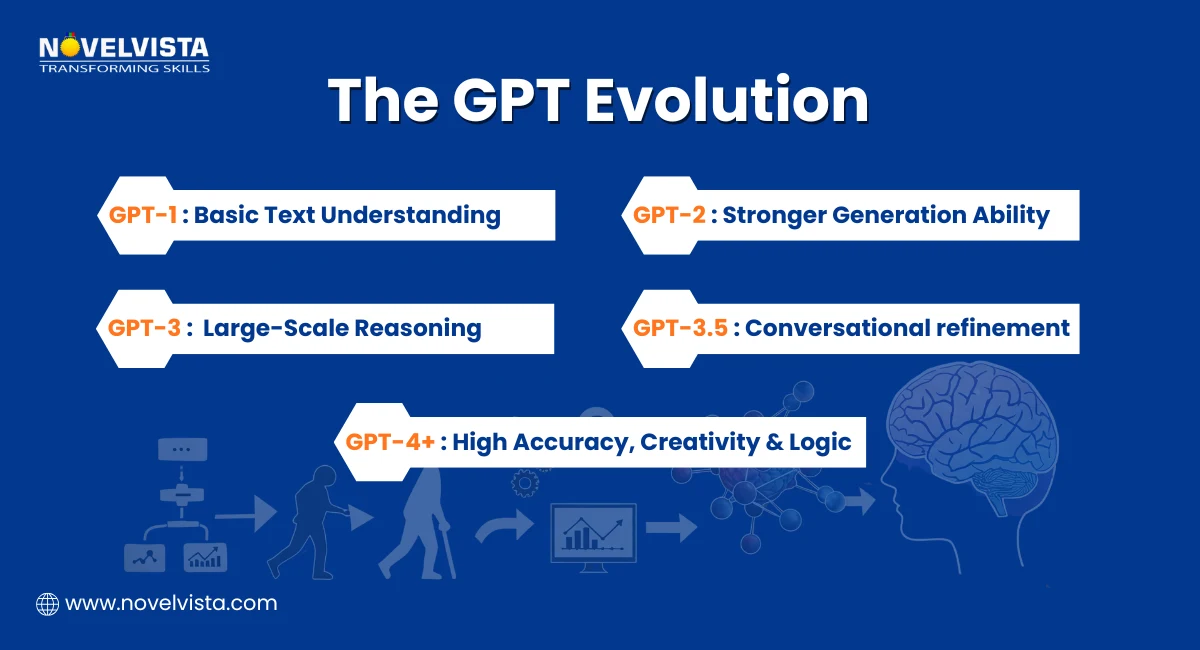
One of the most common queries apart from Is ChatGPT Generative AI? is How does it understand context so well?
The answer lies in the Transformer architecture.
Here’s the simple version:
Transformers read all words at once instead of one at a time.
This allows the model to understand:
This is why it can respond intelligently even after a long conversation.
Transformers process data simultaneously, making the model faster and more efficient than older RNN or LSTM systems.
Dozens (or hundreds) of layers analyze meaning, grammar, and patterns to produce a coherent response.
With this architecture, ChatGPT doesn’t merely mimic text—it creates high-quality content based on deep language understanding.
Another common question alongside Is ChatGPT Generative AI? is why ChatGPT feels so human in conversation. The reason is that it’s designed specifically for dialogue, not just basic text output. ChatGPT can maintain context across multiple messages, adapt its tone to user prompts, ask or answer clarifying questions, follow instructions step-by-step, and remember earlier parts of a conversation within session limits. These dialogue capabilities make it ideal for coaching, content generation, customer support, learning assistance, coding help, and brainstorming, giving it a natural conversational flow that sets it apart from traditional chatbots. One key feature of Generative AI, as explained in this blog, is its ability to produce original, human-like content by predicting patterns—something ChatGPT demonstrates exceptionally well in every interaction.
Understanding Is ChatGPT Generative AI? also means understanding what it can’t do perfectly.
Here are the major limitations:
1. Hallucinations
ChatGPT can sometimes produce information that sounds accurate but is factually incorrect or entirely made up. This happens because generative models rely on pattern prediction, not real-time verification. It’s a common limitation across all LLMs, not just ChatGPT.
2. Knowledge Cutoff
Since ChatGPT is trained on historical data, it may not know about recent events or updates beyond its training timeline. This limitation affects how ChatGPT works when answering time-sensitive queries. It cannot access the internet unless specifically connected through external tools.
3. Biases
Because the model learns from human-generated content, it may inherit certain biases present in that data. These biases can influence outputs related to culture, preferences, or opinions. Understanding these limitations is essential when evaluating answers from a Large Language Model (LLM).
4. No Real-Time Understanding
ChatGPT doesn’t “feel,” “think,” or understand the world like a human. Instead, it predicts text based on patterns learned during training. This is central to the AI model explained in simple terms—it generates responses, not conscious thoughts.
5. Context Length
ChatGPT cannot remember everything from long conversations because its memory is limited by the number of tokens it can process. Once the token limit is reached, earlier messages may be forgotten. This is a core limitation of transformer architecture, explained in practice.
Understand how ChatGPT creates intelligent, Human-like text.
Explore practical use cases you can apply immediately.
Build future-ready AI skills with this
free resource
This topic is more relevant today than ever. Here’s why:
Understanding generative AI is a key skill for modern careers.
LLM knowledge improves roles in automation, cloud, DevOps, security, and data engineering.
Knowing how generative AI works helps decision-makers:
Tools like ChatGPT provide a massive boost in productivity and creativity.
Knowing the fundamentals ensures you use the technology responsibly and effectively.
So, Is ChatGPT Generative AI?
Yes—absolutely. ChatGPT is one of the world’s most advanced generative AI systems, powered by a Large Language Model, GPT architecture, and the revolutionary transformer framework. It generates new content, creates fluid dialogue, and understands context with impressive accuracy.
Whether you're a learner, professional, or business leader, understanding how ChatGPT works empowers you to use it more wisely and confidently. As generative AI continues to grow, this knowledge becomes foundational in the digital world.
Author Details

Course Related To This blog
Generative AI Professional
Generative AI in Project Management
Generative AI in Risk & Compliance
Generative AI in Retail
Generative AI in Marketing
Generative AI in Finance and Banking
Generative AI for HR and L&D
Generative AI in Cybersecurity
Generative AI in Business
Generative AI in Software Development
Confused About Certification?
Get Free Consultation Call
Stay ahead of the curve by tapping into the latest emerging trends and transforming your subscription into a powerful resource. Maximize every feature, unlock exclusive benefits, and ensure you're always one step ahead in your journey to success.