Category | AI And ML
Last Updated On 26/09/2026
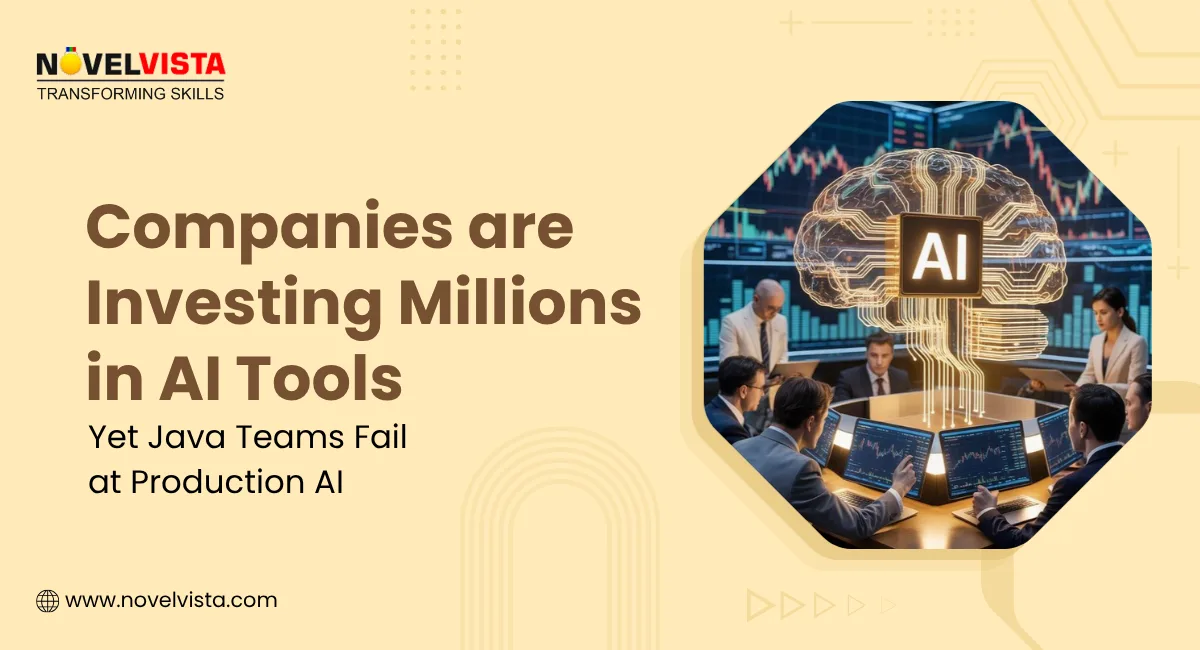
Artificial Intelligence has moved beyond experimentation.
Organizations across industries are investing heavily in AI platforms, cloud infrastructure, generative AI tools, and enterprise automation solutions. Global spending on AI technologies is expected to reach hundreds of billions of dollars annually as companies race to gain competitive advantage.
Yet despite these investments, many organizations face a frustrating reality:
Their Java development teams struggle to move AI projects from proof-of-concept to production.
The result is a growing gap between AI strategy and AI execution.
Executives see promising demos, pilot projects generate excitement, and vendors showcase impressive capabilities. However, when it comes to deploying scalable, secure, and maintainable AI solutions in production environments, many development teams encounter significant challenges.
The issue is not a lack of AI tools.
The issue is a lack of AI-ready engineering capabilities.
Most enterprise applications today are built on Java.
From banking and insurance platforms to healthcare systems, telecom applications, and large-scale enterprise software, Java remains one of the most widely used programming languages in the corporate world.
As organizations integrate AI into these systems, Java developers are expected to:
Unfortunately, many teams were never trained for these responsibilities.
Traditional Java expertise alone is no longer enough.
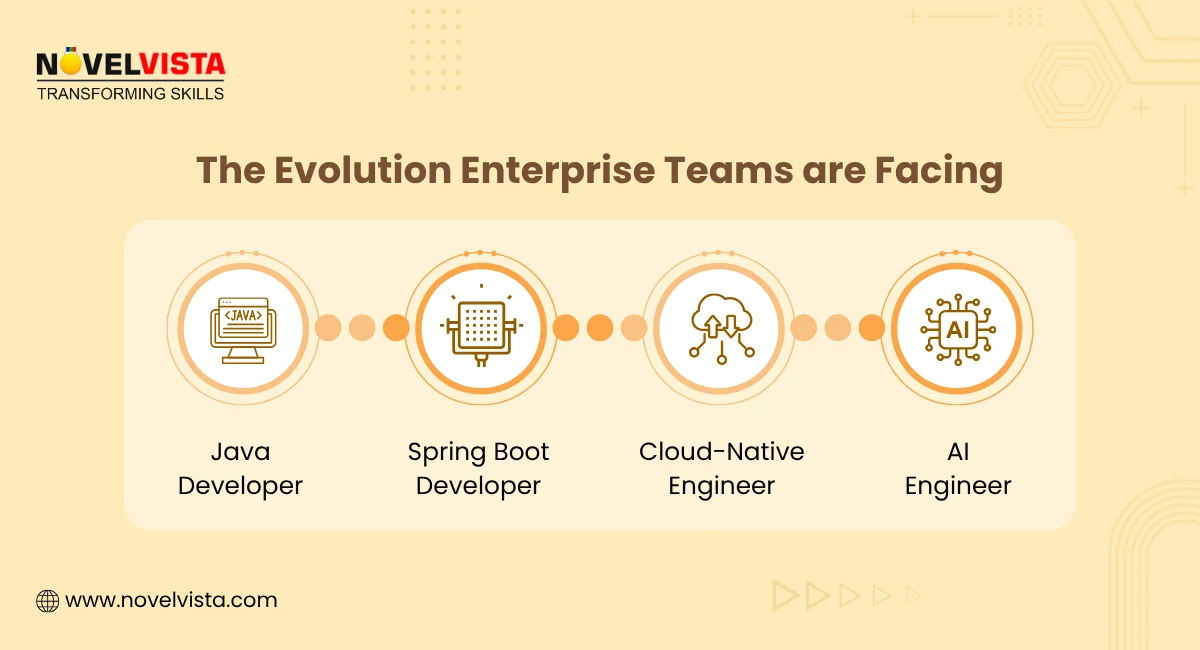
Many organizations successfully create AI prototypes.
The challenge begins when they attempt to scale.
Several common obstacles emerge:
Developers may understand Java development but often lack practical knowledge of AI architectures, prompt engineering, vector databases, model integration, and AI application design.
As a result, teams can build demos but struggle to create production-grade systems.
Enterprise AI applications introduce new risks.
Questions around data privacy, model security, compliance, access controls, and responsible AI usage become critical.
Without proper training, teams often create solutions that cannot pass enterprise governance requirements.
AI tools rarely operate in isolation.
They must connect with existing business systems, APIs, databases, workflows, and cloud infrastructure.
Many organizations underestimate the complexity of integrating AI into established Java ecosystems.
An AI application that works for ten users may fail under thousands of concurrent requests.
Production AI requires expertise in optimization, monitoring, infrastructure management, and cost control skills many development teams have not yet developed.
When AI initiatives fail to reach production, organizations pay a significant price.
The costs go far beyond software licenses and cloud spending.
Failed AI projects can lead to:
For leadership teams, this creates a difficult situation.
The organization continues spending on AI technology while struggling to generate measurable business outcomes.
Many organizations assume they need to hire entirely new AI teams.
In reality, one of the most effective approaches is often to upskill existing Java developers.
These professionals already understand:
By adding AI engineering capabilities to their existing expertise, organizations can accelerate AI adoption without rebuilding teams from scratch.
This approach reduces hiring challenges, preserves institutional knowledge, and enables faster implementation of AI initiatives.
Beyond individual AI engineering skills, many organizations also need someone who can own the overall system design — connecting APIs, data pipelines, security, and cloud infrastructure into one coherent architecture. Our AI Solution Architect is built for exactly this, helping technical leads design production-ready AI systems that development teams can build against with confidence.
To successfully deliver production-ready AI solutions, developers need practical skills that go beyond traditional programming.
Key capability areas include:
Most importantly, teams need hands-on experience applying these concepts within real-world enterprise environments.
The next phase of AI transformation will not be defined by which organization purchases the most AI tools.
It will be defined by which organization can successfully operationalize AI at scale.
Technology alone does not create a competitive advantage.
Skilled teams do.
Organizations that invest in developing AI-ready Java teams are positioning themselves to move faster, deploy solutions more effectively, and generate measurable business value from their AI investments.
While others remain stuck in endless pilot projects, these organizations will be building production-ready AI systems that drive innovation, efficiency, and growth.
For business leaders, the priority is no longer simply adopting AI it is ensuring their engineering teams have the capabilities to build, deploy, and scale AI solutions in real-world enterprise environments. Programs such as the AI Engineer with Java & Spring AI training can help organizations bridge this gap by equipping developers with the practical skills needed to turn AI initiatives into measurable business outcomes.
The question is no longer whether to invest in AI.
The real question is whether your development teams are prepared to transform that investment into lasting competitive advantage.

Author Details

Course Related To This blog
AI Engineer — Java Stack (Spring AI & LangChain4j)
Confused About Certification?
Get Free Consultation Call
Stay ahead of the curve by tapping into the latest emerging trends and transforming your subscription into a powerful resource. Maximize every feature, unlock exclusive benefits, and ensure you're always one step ahead in your journey to success.