
SRE Practitioner Training & Certification
Designed for real-world impact, the SRE Practitioner Certification helps you build resilient systems, drive automation, and fast-track your career in modern IT operations, trusted by 1000s of global professionals.
- Industry Expert Trainers
- Important IT Service Management Practices.
- Real World Application Via Case Studies
- In-detailed Learning Materials

SRE Practitioner Certification Course Overview
Thinking about taking your operations to the next level? The SRE Practitioner Certification proves you’re ready to lead with reliability. According to Analytics Insights, structured SRE adoption boosts system reliability by 47% and improves recovery speed by 32%, making it a game-changer for any tech-driven organization.
This SRE Practitioner Course is tailored for professionals aiming to drive measurable improvements. Covering core frameworks, SLIs, SLOs, error budgets, chaos engineering, automation, and observability, you’ll practice building resilient systems through labs and scenario-based learning. Tools like Prometheus, Grafana, Kubernetes, and Docker anchor the hands-on portion of the curriculum.
By completing this SRE practitioner training, you’ll gain the ability to implement SRE models suited to your organization, reduce toil, and manage incidents efficiently. The course supports SRE professional certification goals and prepares you to deliver reliability at scale as a site reliability engineering practitioner.
Ideal for DevOps engineers, operations leads, and infrastructure professionals, this SRE practitioner certification course bridges theory and practice. You’ll leave with actionable skills to embed reliability in your production workflows, align engineering efforts with business KPIs, and uphold uptime SLAs across distributed systems.

What You Will Get?

Learning Outcome: SRE Practitioner Training Course
After the completion of the course, the participants would be able to:
Training Calendar
English
- Self paced videos, assessments, recall quizzes, more
- For more details, reach us at training@novelvista.com
Includes Training, Exam & Certification
Lifetime Access
- Self paced videos, assessments, recall quizzes, more
- For more details, reach us at training@novelvista.com
Includes Training, Exam & Certification
SRE Practitioner Course Curriculum
Module 1: SRE Principles and Real-World Foundations+
- Understanding Site Reliability Engineering
- Planning for Resilience and Reliability
- SRE vs DevOps: Key Differences
- Core Principles and SRE Best Practices
- Why the SRE Role Matters Today
- Case Study: DevOps Failure Resolved by SRE
Module 2: SLI/SLO/SLA & Error Budget Strategies+
- Defining Service Level Objectives (SLOs)
- Practical Use of Service Level Indicators (SLIs)
- Distinguishing SLOs from SLAs
- Setting SLOs and SLIs: Best Practices
- Implementing Control Measures
- Understanding the Four Golden Signals
- Managing Error Budgets Effectively
- Defining Error Budget Policies
- Case Study: SLI/SLO/SLA in Action
Module 3: Reducing Toil and Improving Operational Efficiency+
- What is Toil?
- Why is Toil Harmful?
- Taking Action to Eliminate Toil
- Identifying Toil in Your Environment
- Toil vs Technical Debt
- Categories of Toil
- What Doesn’t Qualify as Toil
- Case Study: Reducing Toil Through Automation
Module 4: SRE Project Build and Transition Approach+
- Why SRE Should Be Involved Early
- Conducting a Design Assessment
- Defining Deliverables and Making Recommendations
- Performing a Production Readiness Review
- Managing Risks in Build and Transition
Module 5: High Availability and Capacity Planning+
- Understanding High Availability
- Business Continuity Management (BCM)
- Evaluating Disaster Recovery (DR) Scenarios
- Managing Unpredictable Load and Spikes
Module 6: SRE Tools and Automation+
- Defining Automation with End-to-End Thinking
- Areas of Automation Focus
- Hierarchy of Automation Types
- Building Secure Automation
Module 7: DevOps CI/CD Toolchain Pipeline+
- Software Development Life Cycle (SDLC) Overview
- Traditional Waterfall Model
- Agile Development Methodology
- Lean Development Principles
- Key DevOps Principles
- DevOps vs. SRE: Key Differences
Module 8: Chaos Engineering+
- Introduction to Chaos Engineering
- Conducting a Chaos Test
- Tools for Chaos Testing
Module 9: Communication and Collaboration+
- Importance of Clear Communication
- Tools That Enable Effective Collaboration
- Applying Agile with Lean Collaboration
Module 10: Testing for Reliability+
- Testing and Mean Time to Repair (MTTR)
- Various Types of Software Testing
- Building a Test-Ready Environment
- Scaling Your Testing Processes
- Promoting Proactive Testing Culture
Module 11: Managing Incidents+
- Why Organizations Are Embracing SRE
- Patterns for Adopting SRE Practices
- Building Sustainable Incident Response
- Practicing Blameless Post-Mortems
- Scaling SRE with Business Growth
- Anatomy of an Unmanaged Incident
- Core Elements of Incident Management
- Transitioning to Managed Incidents
- Best Practices for Incident Management
Module 12: Emergency Response+
- Troubleshooting Process Overview
- Practicing Effective Troubleshooting
- Avoiding Common Troubleshooting Pitfalls
- Root Cause Analysis (RCA) and Problem Management
- Making Troubleshooting Simpler and Faster
Module 13: Effective Troubleshooting+
- Why Organizations Are Adopting SRE
- Common Patterns in SRE Adoption
- Building Sustainable Incident Response
- Conducting Blameless Post-Mortems
- Scaling SRE Practices Effectively
- Cloud Provider Best Practices for Reliability
Module 14: Antifragility and Learning from Failure+
- Embracing Antifragility in System
- Turning Failures into Learning Opportunities
- Building a Culture of Continuous Learning
- Using Failures to Strengthen Reliability
Module 15: SRE, Other Frameworks, and Trends+
- Integrating SRE with Other Frameworks
- The Evolution of SRE
- Building a Reliability-Centric Culture
- The Continuous Improvement Cycle
- SRE Build and Transition Approach
- Managing the “Run” Phase After Go-Live
- What’s Inside the SRE Implementation Pack
Course Details
What will you learn?+
The SRE Practitioner Certification equips you with the tools, methods, and mindset required to embed reliability across engineering, operations, and leadership functions within your organization. This SRE practitioner course is designed for real-world impact, ensuring that what you learn can be applied immediately in your work environment.
Through this SRE practitioner training, you will gain:
- The ability to implement SRE models aligned with your organization’s needs
- Practical skills in building observability across distributed systems
- Techniques to architect for resilience and fault tolerance
- Proficiency in SLIs, SLOs, error budgets, and their application
- A structured approach to scalable, effective incident management
- The mindset to drive continuous improvement and operational readiness
- Alignment of reliability practices with business KPIs and user outcomes
Is this course right for you?+
The SRE practitioner training is ideal for professionals responsible for maintaining, scaling, or improving the reliability of digital services in fast-paced environments. Whether you're building your first SRE function or improving an existing one, this course gives you the structured knowledge and practical tools to lead with confidence.
SRE Practitioner Course is perfect if you are:
- A DevOps engineer or platform engineer transitioning into an SRE practitioner role
- An operations or infrastructure lead managing distributed systems and uptime SLAs
- A cloud architect or automation specialist focused on resilience and scalability.
- A service owner looking to integrate observability, SLIs, and SLOs into delivery pipelines
- A technology leader aiming to embed site reliability engineering practices across teams
- Preparing for the SRE professional certification to validate and enhance your skillset
Pre-requisites:+
It is highly recommended that learners complete the SRE Foundation course through an accredited DevOps Institute Education Partner before enrolling in the SRE Practitioner Course. This ensures a strong foundation and smoother transition into advanced SRE practitioner training topics and exam preparation.
Participants should ideally have:
- A valid SRE Foundation Certification
- Familiarity with core SRE terminology, concepts, and principles
- Hands-on experience or exposure to reliability-related roles or environments
Duration+
- 3 Days of live, instructor-led virtual sessions with real-time interaction, hands-on activities, and guided discussions for immersive SRE practitioner training.
Site Reliability Engineering Practitioner Key Benefits+
- Real-World Applicability:Learn practical SRE techniques that can be immediately applied to improve reliability, observability, and incident response in production environments.
- Cross-Team Alignment:Gain the skills to align development, operations, and business teams around shared reliability goals and measurable service outcomes.
- Career Advancement:Earning an SRE professional certification helps validate your skills and boosts your profile in high-demand reliability engineering roles.
- Tool-Driven Expertise:Get hands-on exposure to tools like Prometheus, Grafana, and Kubernetes, used widely in SRE workflows and automation.
- Improved Incident Management:Build structured, scalable incident response systems with faster recovery, blameless post-mortems, and reduced mean time to resolution (MTTR).
- System Resilience by Design:Learn how to design and architect fault-tolerant systems that scale reliably under unpredictable load and real-world failures.
- Foundation for SRE Leadership:This SRE practitioner training prepares you to lead SRE initiatives, drive cultural change, and implement long-term reliability strategies.
SRE Professional Certification Exam Format
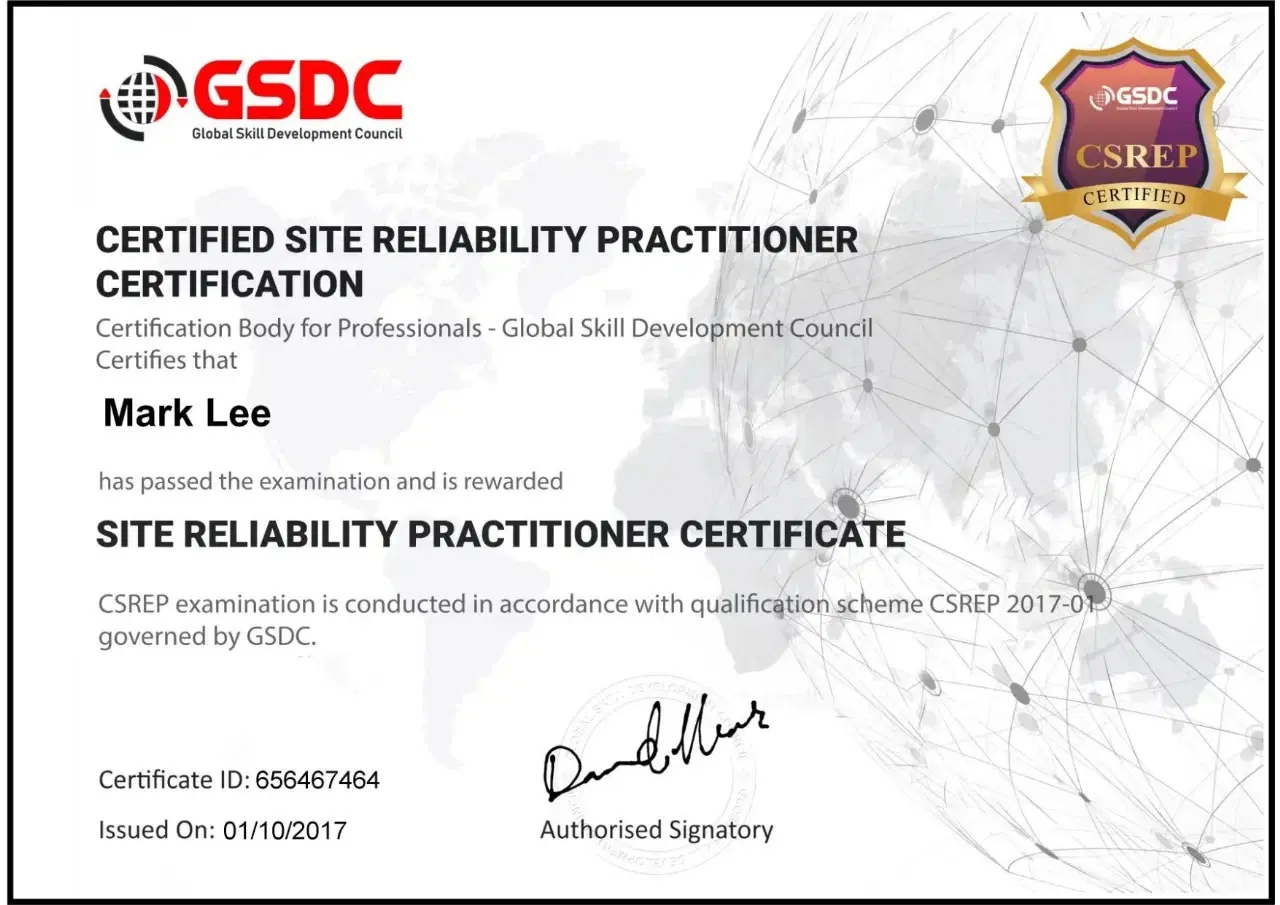
Exam Format - Multiple-choice exam of 40 marks
Exam Passing Criteria - 26 out of 40 (65%).
Exam Duration - 90 minutes
Certificate - Within 5 business days
Result - Immediately after the exam
Closed book
SRE Practitioner Training Certification Path