

Big Data Foundation Certification & Training Course 2026
This Big Data Foundation Certification by NovelVista is designed to help professionals build practical knowledge of big data concepts, technologies, and analytics. This Big Data Foundation Course helps you understand how to manage large datasets, extract insights, and support data-driven business decisions.
- Industry Expert Trainers
- Online learning session
- Accredited Trainer
- Exam fee included

Certified Big Data Foundation Course Overview
The Big Data Foundation Certification is designed to help professionals build practical expertise in big data concepts, technologies, and analytics. This Big Data Foundation Training focuses on understanding how large and complex datasets are captured, stored, processed, and analyzed to generate meaningful business insights.
This Big Data Foundation Course covers key areas such as big data characteristics, data sources, Hadoop, MongoDB, data mining, privacy, ethics, and visualization fundamentals. Through this Big Data Course Certification, learners gain the ability to understand modern data ecosystems and support informed decision-making in data-driven organizations.
Delivered by NovelVista, this Big Data Training and Certification program follows a practical learning approach with real-world scenarios, case studies, and hands-on exercises. By completing this Big Data Certification, professionals will be prepared to work confidently with big data environments and advance their careers in analytics and technology roles.

What You Will Get?
Learning Outcome
After the completion of the course, the participants would be able to:
Training Calendar
English
- Self paced videos, assessments, recall quizzes, more
- For more details, reach us at training@novelvista.com
Includes Training, Exam & Certification
Lifetime Access
- Self paced videos, assessments, recall quizzes, more
- For more details, reach us at training@novelvista.com
Includes Training, Exam & Certification
Course Curriculum
This Big Data Foundation Course is structured to help you build practical knowledge step by step, covering data concepts, technologies, analytics methods, and modern big data ecosystems.
Module 1: Big Data Introduction+
Understand the fundamentals of big data, why it matters, and how organizations use it for competitive advantage.
- History and Evolution of Big Data: Learn how big data emerged, evolved with digital transformation, and became essential for organizations managing rapidly growing information volumes.
- Definition of Big Data: Understand what big data means, how it differs from traditional data systems, and why conventional tools often struggle with scale.
- Business Benefits of Big Data: Explore how organizations use big data to improve decisions, optimize operations, personalize services, and uncover new growth opportunities.
- Characteristics of Big Data: Learn the key characteristics, such as volume, velocity, variety, veracity, and value that define modern big data environments.
Module 2: Big Data Technology Overview+
Build foundational knowledge of major technologies used to store, manage, and process large-scale datasets.
- Introduction to Hadoop: Learn the fundamentals of Hadoop, its distributed architecture, and how it enables scalable storage and processing of massive datasets.
- Hadoop Use Cases and Concepts: Understand common Hadoop applications in analytics, batch processing, and enterprise data environments requiring cost-effective scalability.
- Introduction to MongoDB: Explore MongoDB fundamentals and how document-based databases support flexible storage for modern big data applications.
- MongoDB Features and Concepts: Learn key MongoDB capabilities such as scalability, schema flexibility, indexing, and high-performance data retrieval.
Module 3: Big Data Privacy and Ethics+
Understand how privacy, governance, and ethics shape responsible use of large-scale data systems.
- Privacy Compliance Requirements: Learn the importance of regulatory compliance, consent management, and responsible handling of personal and sensitive information.
- Privacy Challenges in Big Data: Understand common privacy risks, including data misuse, unauthorized access, breaches, and re-identification concerns.
- Privacy Management Approaches: Explore strategies such as anonymization, governance controls, and secure data handling to protect information effectively.
- Ethics in Big Data Usage: Learn ethical principles related to fairness, transparency, accountability, and bias reduction in data-driven decisions.
Module 4: Sources for Big Data+
Identify the major internal and enterprise sources that generate valuable data for analytics.
- Enterprise Data Sources: Learn how transactional systems, customer platforms, and operational databases generate large volumes of usable business data.
- Enterprise Systems Data: Understand how ERP, CRM, HRMS, and other enterprise systems contribute structured datasets for analysis.
- Oracle, SAP, and Microsoft Platforms: Explore common enterprise platforms and how they serve as critical data sources within organizations.
- Data Warehouses and Metadata: Learn the role of warehouses and metadata in organizing, governing, and accessing enterprise data efficiently.
- Unstructured Data Sources: Understand how emails, documents, logs, images, and multimedia content become valuable unstructured data assets.
Module 5: Social Media Data Sources+
Learn how social platforms generate valuable data used for sentiment analysis, customer insights, and trend monitoring.
- Introduction to Social Media Data: Understand why social media data is valuable for organizations seeking customer feedback, market trends, and engagement insights.
- Facebook APIs and Data Access: Learn how Facebook data sources, feeds, and APIs support analytics, audience understanding, and campaign measurement.
- Twitter Streaming and REST APIs: Explore how Twitter data can be collected through APIs for sentiment analysis, event tracking, and trend detection.
- Other Social Media Sources: Understand how data from additional platforms contributes to broader market intelligence and behavioral analysis.
Module 6: Public Data Sources+
Discover publicly available datasets that organizations use for forecasting, benchmarking, and strategic decisions.
- Introduction to Public Data Sources: Learn how open data sources support analytics, transparency, and innovation across industries and government sectors.
- Weather Data Sources: Understand how weather datasets are used in planning, logistics, agriculture, and demand forecasting scenarios.
- Economic Data Sources: Explore economic indicators used for market analysis, investment planning, and business strategy decisions.
- Finance Data Sources: Learn how financial datasets support risk analysis, forecasting, trading insights, and performance measurement.
- Regulatory Bodies Data: Understand how information published by regulators supports compliance monitoring and industry intelligence.
Module 7: Data Mining Concepts and Tools+
Build foundational skills in extracting patterns, trends, and insights from large datasets.
- Introduction to Data Mining: Learn the purpose of data mining and how it helps uncover useful knowledge from raw data.
- Types of Data Mining: Understand major techniques such as predictive, descriptive, and exploratory data mining approaches.
- Classification Techniques: Learn how classification models categorize data into predefined groups for business decision support.
- Association Analysis: Explore association methods used to identify relationships and patterns between variables in datasets.
- Clustering Methods: Understand how clustering groups similar records together for segmentation and pattern discovery.
- Weka and Its Applications: Learn how Weka supports data mining through accessible tools for modeling and experimentation.
- KNIME and Analytics Workflows: Explore KNIME workflows for visual analytics, automation, and data transformation tasks.
- R Language Fundamentals: Understand how R is used for statistics, visualization, and data analysis in big data projects.
Module 8: Big Data Technologies and Processing+
Module 8: Big Data Technologies and Processing
Understand practical processing methods using Hadoop, MongoDB, and document database models.
- Hadoop Components and Architecture: Learn the main and additional Hadoop components that enable distributed storage and parallel processing.
- Installing and Configuring Hadoop: Understand the basics of Hadoop setup, configuration, and environment preparation for practical use.
- MapReduce Fundamentals: Learn how MapReduce processes large datasets efficiently through distributed computation models.
- Twitter Sentiment Analysis with Hadoop: Explore how Hadoop can be used to process social media data for sentiment insights.
- Network Log Analysis with Hadoop: Understand how large-scale log data is analyzed for monitoring, security, and operational intelligence.
- MongoDB Fundamentals: Learn core MongoDB concepts, including collections, documents, and flexible schema management.
- Replication and Sharding: Understand how MongoDB ensures availability and scalability through replication and sharding techniques.
- Document Databases and Data Modelling: Learn document database design principles, field structures, and modelling approaches for modern applications.
Course Details
What Will You Get?+
This Big Data Foundation Certification provides a complete, practical learning experience designed to help you build big data knowledge and achieve certification with confidence.
- Engaging digital learning videos
- Access to expert-led sessions and case studies
- Downloadable resources and reference templates
- AI-based roleplay and simulation exercises
- Practice exams and mock tests
- Certification exam voucher
- Two exam attempts
- Hands-on learning with real-world scenarios
- Interview preparation support
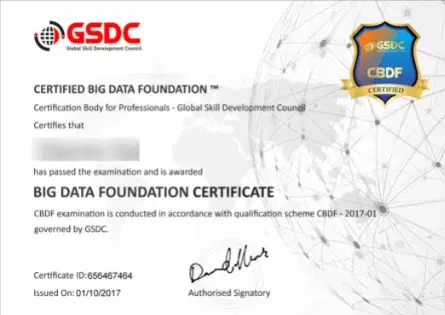
- Globally recognized certification
Eligibility+
This Big Data Foundation Course is designed for professionals who want to build expertise in data technologies, analytics, and modern big data environments.
- IT professionals and software developers
- Data analysts and aspiring data professionals
- Business analysts and consultants
- Database administrators and engineers
- Students and fresh graduates interested in data careers
- Project managers working with data-driven teams
- Professionals planning a transition into analytics roles
- Anyone looking to build a career in big data and analytics
Pre-requisites+
There are no strict mandatory requirements for this Big Data Foundation Course. However, having basic knowledge will help you learn more effectively.
- Basic understanding of computers and digital technologies
- Familiarity with databases or data concepts is helpful
- Basic analytical and problem-solving skills
- Interest in big data, analytics, and emerging technologies
- Willingness to learn practical data concepts and tools
Training Delivery Style+
This Big Data Foundation Training is delivered in a flexible self-paced format, allowing you to learn at your own pace and convenience.
- Fully self-paced online learning
- Anytime, anywhere access
- Structured digital learning modules
- On-demand expert-led video sessions
- Practice tests and mock exams
- AI-based roleplay and simulations
- Downloadable resources and templates
- Lifetime access to course content
Key Benefits of This Course+
This Big Data Foundation Certification helps you build practical data skills, understand modern big data technologies, and advance your career in analytics and technology roles.
- Build Strong Big Data Fundamentals: Learn core concepts, characteristics, and business value of big data to create a solid foundation for future technical growth.
- Understand Modern Data Technologies: Gain knowledge of technologies such as Hadoop and MongoDB used to store, process, and manage large-scale datasets.
- Improve Data-Driven Decision Making: Learn how organizations use big data insights to improve planning, operations, customer experience, and strategic decisions.
- Develop Analytics Awareness: Understand how data mining, pattern discovery, and reporting techniques help transform raw data into valuable business intelligence.
- Work with Diverse Data Sources: Learn how structured, semi-structured, unstructured, enterprise, public, and social media data sources are used in analytics.
- Strengthen Career Opportunities: Build in-demand skills that can support career growth in analytics, data operations, business intelligence, and technology domains.
- Understand Privacy and Ethical Practices: Gain awareness of data privacy, governance, and ethical responsibilities in handling large-scale information systems.
- Prepare for Advanced Data Roles: Create a strong base for future learning in data science, machine learning, cloud analytics, and data engineering.
- Gain Practical Industry Knowledge: Learn through practical scenarios, examples, and use cases that reflect how big data is applied across industries.
- Earn a Globally Recognized Certification: Validate your expertise with a certification that demonstrates your understanding of big data fundamentals and technologies.
Certified Big Data Foundation Exam Format
Exam Format - Objective Type, Multiple Choice
Exam Duration - 1 hour
No. of Questions - 40 (multiple-choice questions)
Passing Criteria - 26 out of 40 (65% is needed to pass)
Certificate - Within 5 business days
Result - Immediately after the exam
Closed book - Yes
In case the participant does not score the passing percentage, they will be allowed to take the 2nd attempt at no additional cost. Re-examination can be taken up to 30 days from the date of the 1st exam attempt