Category | Security
Last Updated On 30/01/2026
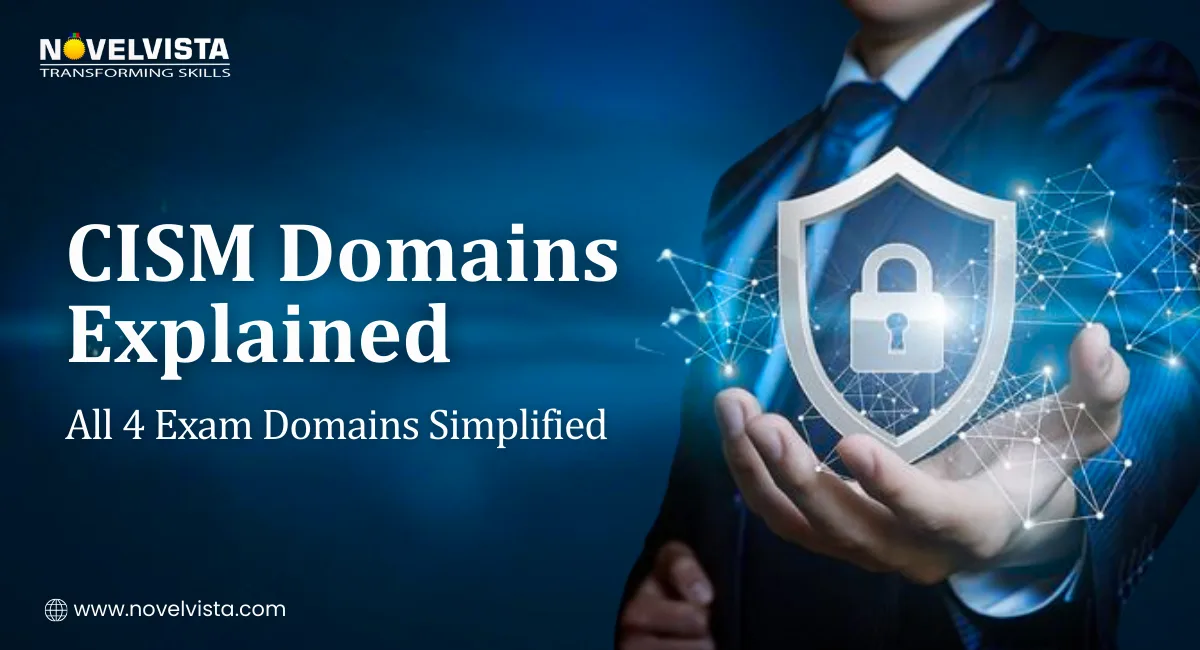
Many CISM aspirants study hard and still feel unsure during practice questions. The reason is simple. The CISM Domains are not about tools or technical controls. They test how well you think like a security manager.
If you’re wondering how many Domains in CISM? The answer is 4. These CISM Domains focus on governance, risk, program management, and incident leadership. This blog breaks down all four domains in simple terms, so you know what each one tests and how they connect in the real exam.
The CISM certification is designed for professionals who manage, govern, and align information security with business goals. That’s why the CISM Domains are structured around decision-making, accountability, and long-term direction.
Right at the start, candidates often ask: how many Domains in CISM?
There are 4, commonly referred to as the CISM 4 Domains.
Together, these domains check whether you can:
A quick CISM Domains summary shows that the exam is less about “how to configure” and more about “how to decide.” During instructor-led sessions, we explain the CISM Domains using real security leadership scenarios rather than control-level examples. This helps learners clearly see why governance, risk, programs, and incident leadership are tested together instead of in isolation.
The CISM Exam Domains are based on ISACA’s job practice areas. Each domain carries a different weight, reflecting how much time security managers typically spend on that responsibility.
Here is the current domain weightage:
This weightage matters a lot. The CISM Exam Domains are not equally tested, so your study time should not be equally divided.
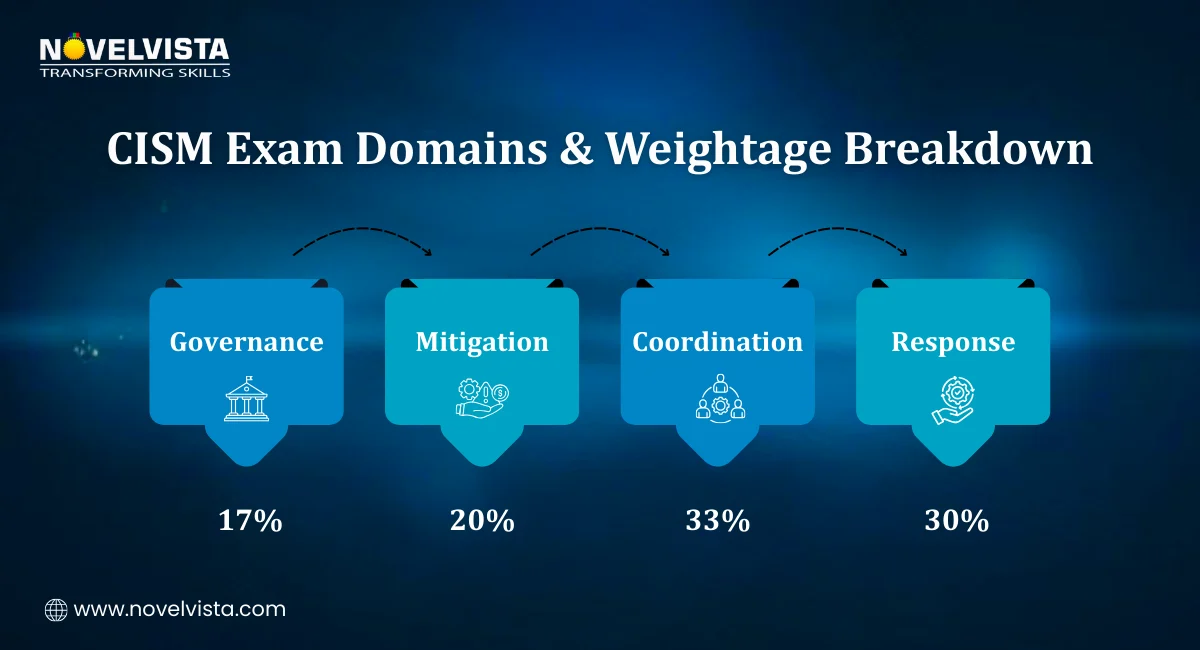
For example:
Understanding how the CISM Domains are weighted helps you plan smarter instead of studying everything the same way.
Domain 1 sets the direction for everything else. It checks whether security is governed properly at the organizational level.
This domain focuses on:
The key thing to remember is this: Domain 1 is not about security controls. It’s about leadership, accountability, and direction.
In the CISM Exam Domains, governance questions often test:
In training discussions, governance questions often challenge learners because they require executive-level thinking. We coach candidates to answer from a boardroom perspective, focusing on strategy, accountability, and business alignment rather than operational detail.
Domain 2 moves from direction to prioritization. It checks how well you manage risk in a business-focused way.
This domain tests your ability to:
In the CISM Domains, risk management is not about listing threats. It’s about helping the business make informed decisions.
Exam questions often focus on:
This domain reinforces that security risk is an enterprise issue, not just a technical one.
Revise all four CISM domains in one place. Get key concepts, frameworks, and exam-oriented insights to answer governance, risk, and incident questions with confidence.
Domain 3 is the largest and most heavily tested of the CISM Exam Domains. It looks at how security strategy and risk decisions turn into a working, sustainable program.
This domain covers:
Domain 3 is where most real-world management responsibilities sit. In the CISM Domains, the most common scenario practice is because it connects governance intent with day-to-day program execution across people, process, and technology.
Domain 4 is where leadership is tested under pressure. In the CISM Domains, this area focuses on how well you prepare for, respond to, and learn from security incidents.
This domain covers:
What matters most in this domain is not technical response. The CISM Exam Domains test whether you can:
Incident management questions often look for calm, structured leadership rather than deep technical fixes.
Check Out the Official Structured CISM Certification Syllabus at NovelVista.
The CISM 4 Domains are designed to work as one system, not as separate topics.
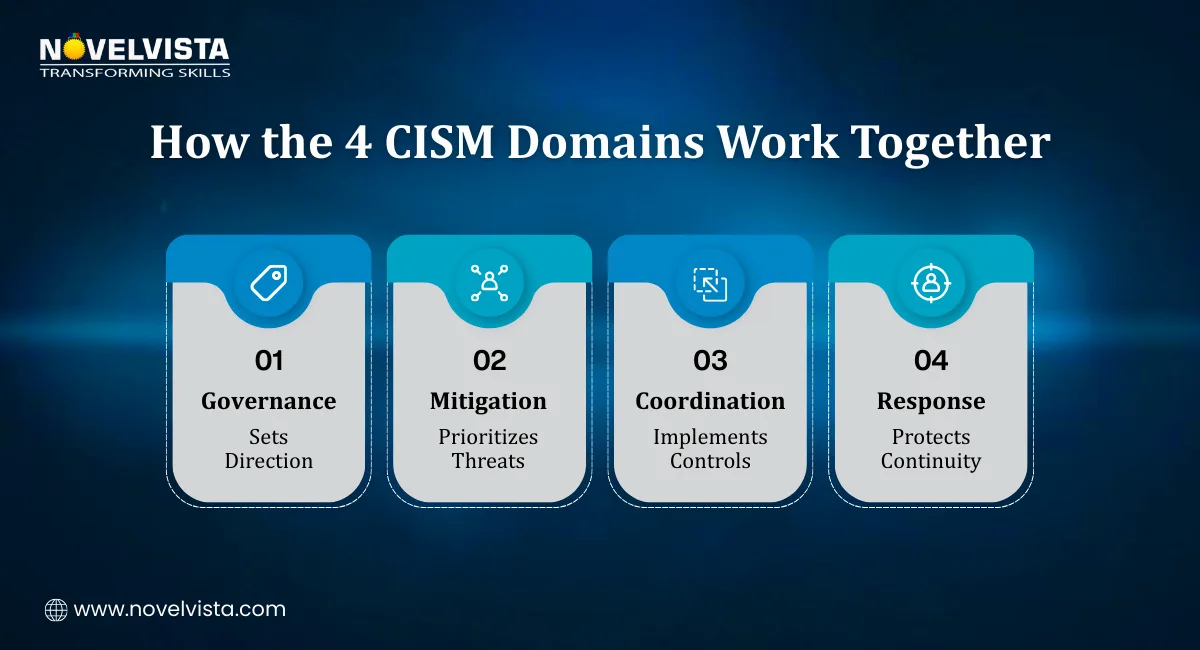
Here’s how they connect:
Understanding these relationships is key to doing well in scenario-based questions. ISACA designs the CISM Domains to evaluate cross-domain judgment. Many exam questions intentionally touch more than one domain, which is why understanding how governance, risk, programs, and incidents connect is critical for exam success.
This is why memorizing definitions is rarely enough. The exam rewards candidates who can see the bigger picture.
Before diving into practice questions, it helps to remember the exam format:
A smart study strategy for the CISM Exam Domains looks like this:
Candidates who understand how the domains are weighted usually manage time better and feel less pressure during the exam.
For focused and effective exam preparation, explore our CISM exam guide to understand question patterns and practical tips to boost your confidence.
The CISM Domains are built to test how you think as a security leader, not how much technical detail you remember. Each domain plays a role in aligning security with business goals, managing risk, running effective programs, and leading through incidents.
Mastering all four domains builds more than exam confidence. It builds credibility as a security manager who can guide decisions, communicate with leadership, and protect the organization in real situations.
Approach your preparation with a scenario-driven, management-first mindset. That’s exactly what the CISM exam and your future role expect.
Note: This article is built around practical training insights, real exam experiences, and the latest ISACA CISM domain structure. The goal is to help readers understand how the exam thinks, not just what the syllabus says.

If you’re serious about mastering the CISM Domains and thinking like a security leader, NovelVista’s CISM Certification Training Course can help. The program focuses on scenario-based learning, domain weightage strategy, and management-level decision-making. You’ll gain a clear understanding, exam confidence, and practical insight into governance, risk, program management, and incident leadership, exactly what the CISM exam and real-world roles demand.
Author Details

Course Related To This blog
CISM® Certified Information Security Manager
Confused About Certification?
Get Free Consultation Call
Stay ahead of the curve by tapping into the latest emerging trends and transforming your subscription into a powerful resource. Maximize every feature, unlock exclusive benefits, and ensure you're always one step ahead in your journey to success.