Category | Quality Management
Last Updated On 26/11/2025
If there’s one thing the IT world can agree on, it’s this: service expectations are evolving faster than most organizations can keep up with. In 2024 alone, studies revealed that 92% of businesses depend on IT services for daily operations, yet nearly 57% of service outages were caused by poor processes, not technology failures.
This widening gap between rising expectations and inconsistent service delivery is exactly why IT companies need iso 20000 as they approach 2026. Clients want predictable outcomes. Businesses want mature ITSM frameworks. And the industry is moving toward greater accountability and reliability.
In this blog, you will learn what ISO 20000 really is, why it matters for modern IT service management, and the core reasons why IT companies need ISO 20000 in 2026. You will also understand how the standard supports digital transformation, strengthens IT governance, improves operational efficiency, along with the practical benefits of adopting it, and simple FAQs to clarify the essentials.
Now, let’s begin with the foundation.
ISO/IEC 20000 is the global standard for IT Service Management (ITSM). It outlines best practices for designing, delivering, managing, and continuously improving IT services.
It ensures that organizations follow structured processes across:
Think of ISO 20000 as the “quality blueprint” for IT services—similar to how ISO 9001 governs quality, ISO 20000 governs service.
And this brings us to the central question: Why do IT companies need ISO 20000 in 2026?
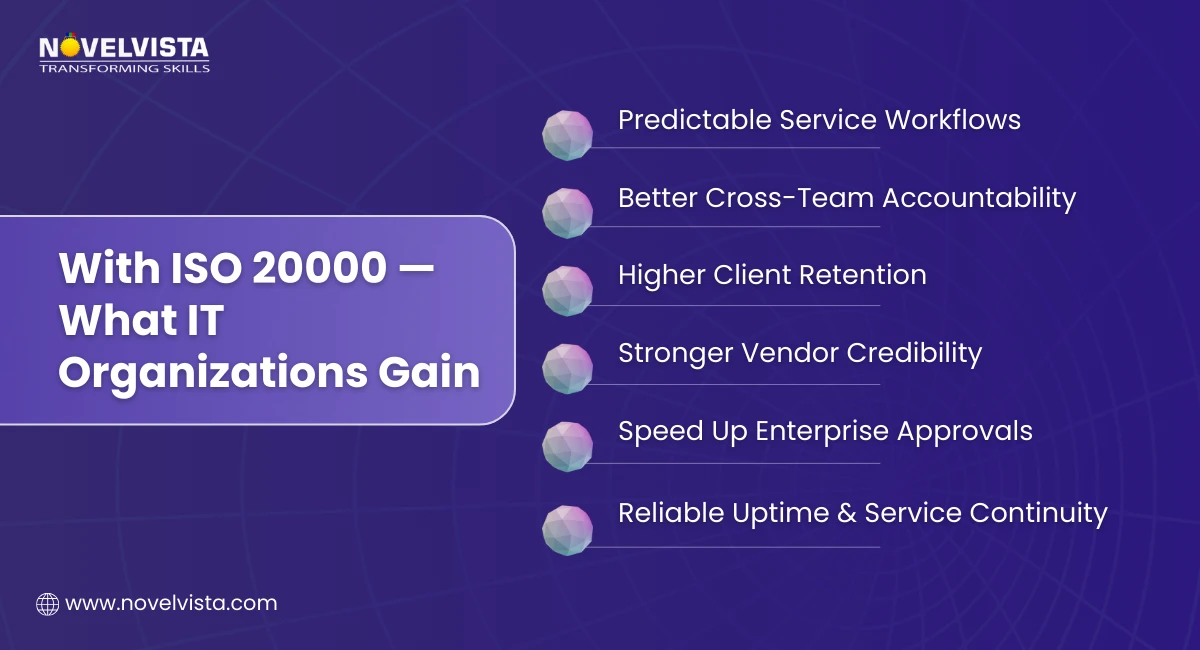
Modern clients expect predictable, reliable, and well-documented IT services, which is one of the biggest reasons why IT companies need ISO 20000. The standard helps strengthen SLA compliance, improve communication and service reporting, and build trust through transparent service delivery. As organizations continue demanding higher-quality ITSM and greater accountability, ISO 20000 is quickly becoming a necessary benchmark rather than a competitive advantage.
By 2026, IT companies will be competing not just on price, but on service maturity and credibility. Certification provides:
This helps IT companies stand out in an oversaturated market.
Many enterprises already require ISO 20000 from their IT partners, and by 2026, this demand will only intensify. Without certification, companies risk losing access to major global projects, while certified vendors benefit from faster approvals and better alignment with international compliance frameworks. This growing expectation is one of the strongest strategic reasons why IT companies need ISO 20000 to stay relevant and competitive.
A practical playbook to build reliable, efficient,
and customer-centric IT services
Many service failures occur due to inconsistent processes or reliance on “tribal knowledge,” and this is where ISO 20000 principles bring structure and stability. By establishing standardized workflows, reducing rework, and creating clear accountability across teams, the standard eliminates unnecessary operational waste. This directly results in cost savings and higher efficiency, making it one of the biggest reasons IT companies need ISO 20000.
IT incidents cost companies both revenue and reputation.
ISO 20000 brings structured approaches to:
The result? More stable and resilient IT services.
While ISO 20000 is not a dedicated security standard, it significantly strengthens cybersecurity by improving communication during incidents, ensuring controlled system changes, maintaining service continuity during threats, and aligning closely with ISO 27001 requirements. By creating a disciplined and well-governed ITSM environment, ISO 20000 makes cybersecurity measures far more effective and dependable.
Digital ecosystems are becoming increasingly complex, and AI, automation, as well as cloud architectures demand mature and well-governed ITSM practices. This is exactly why IT companies need ISO 20000 in 2026—to manage hybrid infrastructures, AI-driven service operations, automated workflows, and scalable digital service delivery with confidence. ISO 20000 certification provides the structured framework necessary to operate effectively in these evolving, technology-driven environments.
Customer experience has become one of the strongest differentiators for IT service providers, and ISO 20000 plays a key role in elevating it. By improving service reliability, increasing uptime and availability, strengthening escalation handling, and ensuring accurate service reporting, the standard helps organizations deliver a consistently superior experience. This ultimately leads to a stronger brand reputation and higher client retention.
Organizations that adopt ISO 20000 often experience a powerful cultural transformation. After implementation, companies benefit from clear roles and responsibilities, structured documentation, well-defined service ownership, and a strong focus on continuous improvement. This shift in mindset and discipline is one of the most underrated yet impactful reasons why IT companies need ISO 20000.
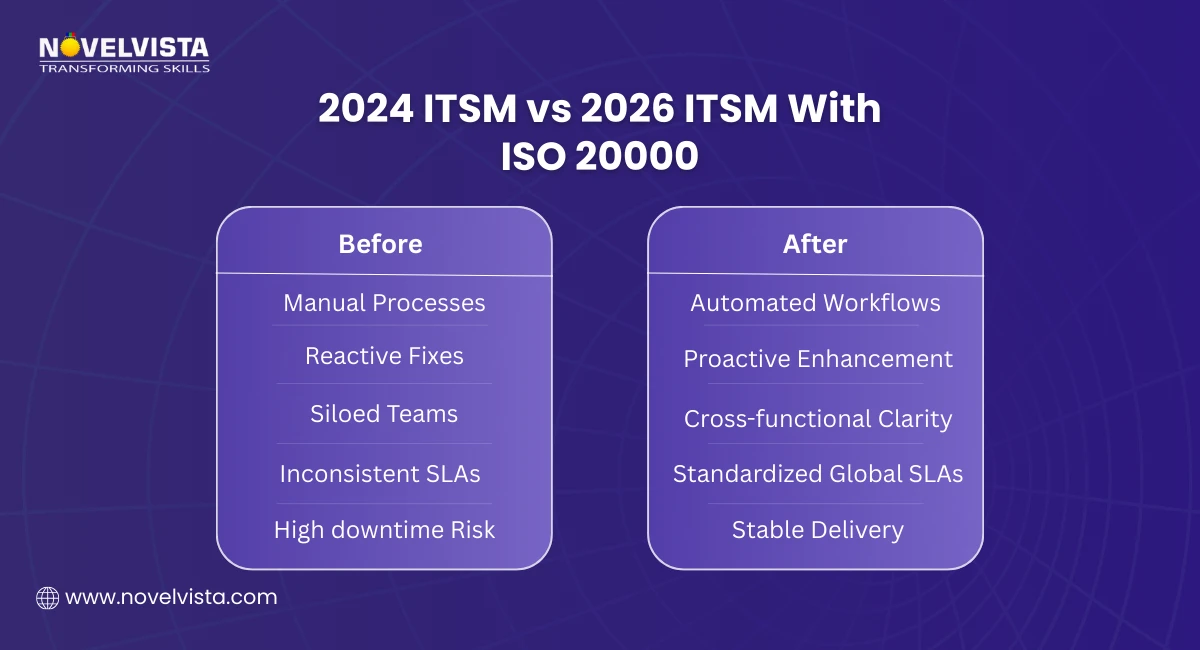
As IT services become the backbone of global businesses, the demand for consistency, reliability, and governance continues to rise. This is why IT Companies Need ISO 20000, not just to meet client expectations but to prepare their operations for the digital future.
Whether your goal is to expand globally, improve internal efficiency, or build stronger client trust, ISO 20000 provides the structure and maturity needed to excel.
If your organization wants to grow, compete, and stay relevant in 2026, implementing ISO 20000 is no longer optional—it’s essential.

If you’re ready to deepen your ITSM knowledge and grow as a service management professional, the next step is building strong audit and assessment skills. NovelVista’s ISO/IEC 20000 Lead Auditor Certification gives you hands-on auditing practice, industry-aligned frameworks, and the confidence to evaluate IT service processes end-to-end.
Whether you lead IT operations, manage service delivery, or want to advance your career in IT governance, this training helps you audit with clarity and guide organizations toward higher service maturity.
Start your ISO 20000 Lead Auditor journey today!
Author Details

Course Related To This blog
ISO 20000:2018 Lead Auditor
Confused About Certification?
Get Free Consultation Call
Stay ahead of the curve by tapping into the latest emerging trends and transforming your subscription into a powerful resource. Maximize every feature, unlock exclusive benefits, and ensure you're always one step ahead in your journey to success.