Category | Quality Management
Last Updated On 12/12/2025

In today’s fast-moving business environment, organizations face more uncertainty than ever before. According to multiple global risk surveys, nearly 70% of companies admit they are unprepared for major disruptions, while over 55% fail to document a clear risk appetite across operations. That means most teams make decisions without knowing how much risk is acceptable—or where the boundaries truly lie.
This is where the concept of ISO 31000 risk appetite becomes vital.
Whether you’re an IT professional, risk consultant, compliance manager, operations leader, or a business owner, understanding how ISO 31000 defines and guides risk appetite is crucial for better decision-making.
Before we dive deeper into risk appetite itself, let’s build the foundation with what ISO 31000 represents—and then smoothly transition into how this global framework shapes strategic clarity and organizational confidence.
ISO 31000 is the world’s leading risk management framework, providing principles and structured guidelines to help organizations identify, assess, and manage risks effectively. Unlike rigid or prescriptive standards, ISO 31000 is highly flexible, making it suitable for startups, large enterprises, government bodies, and global corporations. Its purpose is to improve decision-making, strengthen governance, build resilient operations, reduce uncertainty, and promote a proactive risk culture. With this foundation in place, we can now explore what ISO 31000 says about risk appetite.
The ISO 31000 risk appetite concept refers to the amount and type of risk an organization is willing to pursue, retain, or tolerate to achieve its objectives. It is a high-level guideline that helps decision-makers understand the boundaries for acceptable and unacceptable risk.
When organizations clearly identify their risk appetite, they create a consistent foundation for decisions—from budgeting and investments to cybersecurity and operations.
This brings us to the risk appetite definition ISO 31000 provides:
A structured expression of the level of risk an organization is prepared to accept while pursuing value and business goals.
In simpler terms, it answers:
How much risk is too much?
How much is acceptable?
And where is the line drawn?
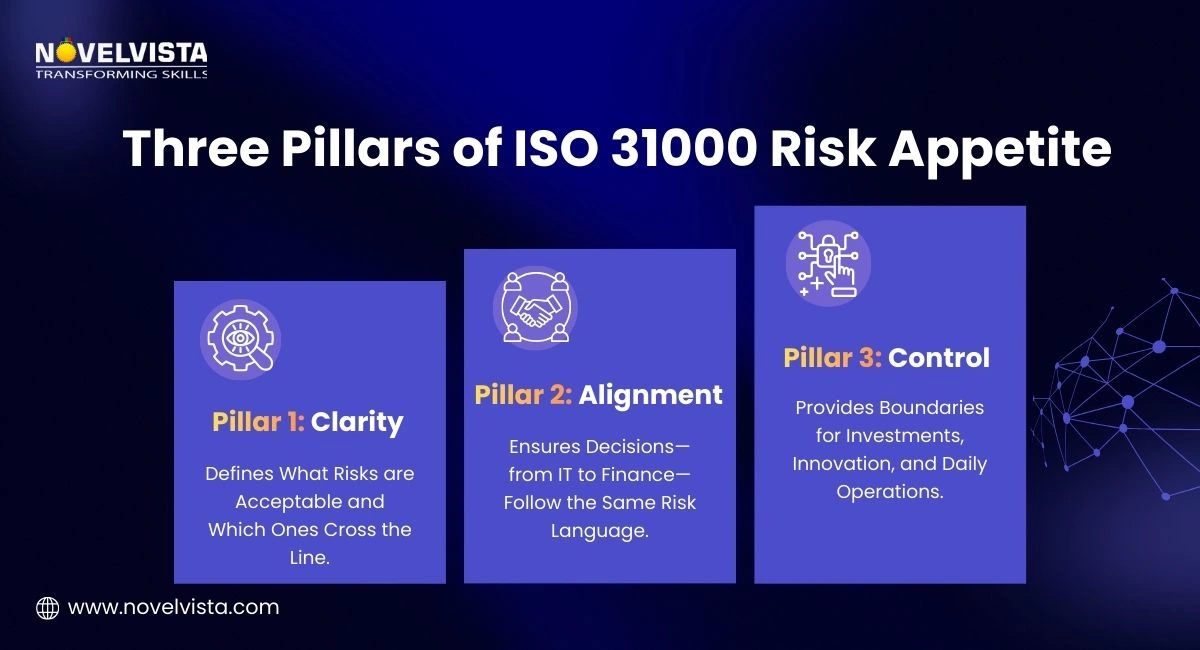
A well-defined risk appetite improves more than governance—it strengthens the core of business stability. Here’s why organizations around the world prioritize it:
When teams clearly understand the ISO 31000 risk appetite boundaries, they make decisions with greater confidence and speed. There’s no confusion about what level of risk is acceptable, which reduces delays and second-guessing. This alignment allows organizations to act decisively while staying within strategic limits.
A well-defined risk appetite helps organizations identify warning signs early and avoid crossing risk thresholds unintentionally. By understanding acceptable and unacceptable exposures, teams can proactively address potential issues. This leads to fewer unexpected disruptions and smoother day-to-day operations.
ISO 31000 risk appetite creates a shared language that IT, operations, finance, HR, and leadership can all apply consistently. When everyone works with the same definitions and boundaries, collaboration becomes smoother and more accurate. This cross-functional alignment strengthens overall risk governance and decision-making.
Clear risk appetite statements encourage employees to act responsibly and stay alert to potential risks. When people understand organizational expectations, they become more aware and proactive in managing threats. This contributes to a healthier, more resilient risk culture across all levels of the business.
Crafting and documenting risk appetite can be tricky for many organizations. However, ISO 31000 risk appetite definition guidance offers clarity through principles rather than rigid rules.
Here’s how ISO 31000 guides organizations to define risk appetite:
Risk appetite must reflect business goals—growth-focused organizations may accept higher risks, while compliance-driven sectors prefer lower exposure.
The framework encourages organizations to take calculated risks, not avoid risks altogether.
Examples include:
Everyone from the board to front-line teams should interpret risk appetite the same way.
As business conditions evolve, so should risk appetite.
Concept |
Meaning |
ISO 31000 Perspective |
Risk Appetite |
Level of risk an organization wants or is willing to accept |
Strategic, high-level boundary |
Risk Tolerance |
Acceptable deviation from the appetite |
Operational, measurable limits |
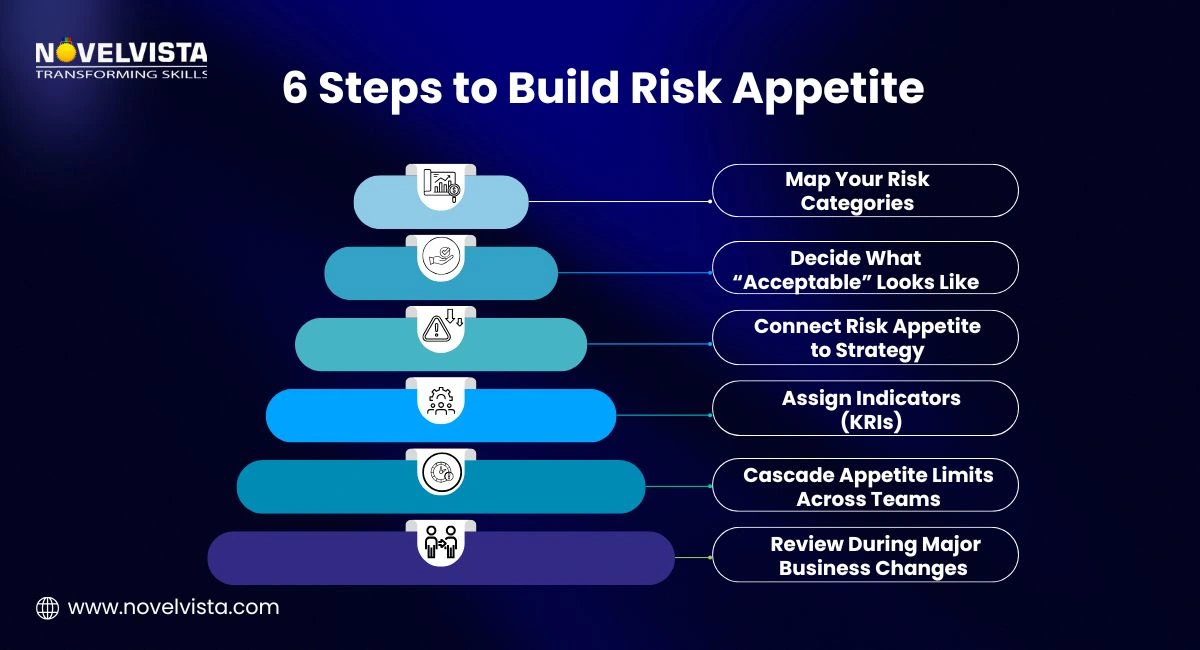
Here is a simple, practical, step-by-step approach aligned with the ISO 31000 risk appetite principles:
Begin by mapping all potential risks into broad categories such as strategic, operational, financial, compliance, reputational, and cybersecurity. This classification gives clarity on where threats may arise and helps align them with the ISO 31000 risk appetite framework. It also ensures each domain receives the right level of attention during assessment.
Once categories are clear, determine what levels of exposure are acceptable for each one. This may include qualitative labels like low, medium, or high, or quantitative limits such as maximum acceptable financial loss or downtime. Setting these boundaries ensures your ISO 31000 risk appetite is measurable and actionable.
Your risk appetite should directly reflect your organization’s goals and direction. For example, an innovation-heavy strategy may tolerate higher risks in development but require strict limits in regulatory or compliance areas. This strategic alignment ensures the risk appetite supports—not contradicts—business objectives.
A risk appetite is only effective if people understand it. Make sure teams have access to clear guidelines through policy documents, dashboards, training programs, and leadership communication. Transparency ensures consistent interpretation across the organization, strengthening alignment with ISO 31000 principles.
Integrate established appetite limits into daily and strategic decisions such as budget approvals, change management, cybersecurity controls, and vendor assessments. This ensures the ISO 31000 risk appetite isn’t theoretical but actively shapes real business actions. Embedding it into workflows builds strong organizational discipline.
1. IT & Cybersecurity: An IT company may tolerate a moderate level of innovation risk but zero tolerance toward data breaches.
2. Finance: Banks may accept higher market risks but maintain strict limits on credit and compliance risks.
3. Healthcare: Hospitals may allow operational risks during emergencies but no tolerance for patient safety risks.
4. Manufacturing: Factories may accept equipment risks to boost productivity but maintain low tolerance for environmental or safety violations.
These examples show how the ISO 31000 risk appetite concept adapts to different industries.
Even with clear guidance, organizations often struggle with:
1. Misalignment with Strategy
Risk appetite must reflect real business objectives, not vague or generic statements. When leadership goals and appetite levels don’t match, decisions become inconsistent and confusing across departments. Aligning both ensures the ISO 31000 risk appetite supports long-term direction.
2. Over- or Under-Estimating Risks
Taking too little risk can slow down innovation and competitiveness, while excessive risk exposure increases operational and financial vulnerabilities. Many organizations struggle to find this balance, making accurate estimation essential for an effective ISO 31000 risk appetite.
3. Poor Communication
Even a well-designed risk appetite fails if teams do not fully understand it. Without clear communication, employees misinterpret boundaries, leading to inconsistent decisions. To make the ISO 31000 risk appetite work, it must be shared through simple, accessible guidance.
4. Lack of Metrics
Without measurable indicators, risk appetite remains a theoretical concept instead of something actionable. Organizations need clear metrics and KRIs to track whether they are staying within acceptable limits. Strong measurement brings the ISO 31000 risk appetite to life in daily operations.
In a world full of uncertainty, organizations need clarity—not guesswork. The ISO 31000 risk appetite framework provides exactly that by defining acceptable risk levels and supporting informed decision-making.
By understanding the risk appetite definition ISO 31000 offers and applying the ISO 31000 risk appetite definition guidance, companies build resilience, take smarter risks, and protect long-term value.
A well-defined risk appetite is no longer optional—it’s a strategic advantage.
Join NovelVista’s ISO 31000 Risk Manager Certification Training and gain the practical skills needed to identify, analyze, and manage risks before they impact your organization. This globally recognized program is designed for project leaders, IT professionals, compliance managers, and risk practitioners who want to build confidence in strategic decision-making. Learn real-world frameworks, improve governance, and elevate your expertise in proactive risk management.
Start your ISO 31000 risk manager journey today!

Author Details

Confused About Certification?
Get Free Consultation Call
Stay ahead of the curve by tapping into the latest emerging trends and transforming your subscription into a powerful resource. Maximize every feature, unlock exclusive benefits, and ensure you're always one step ahead in your journey to success.