Category | Quality Management
Last Updated On 09/12/2025
Let’s start with something most leaders don’t expect: two standards can look similar on paper yet shape a business in completely different ways. That’s exactly what happens when people try to understand iso 22301 vs iso 9001. One builds quality into your daily work, while the other protects your business when things go wrong.
Many teams try to choose between them without really knowing how iso 22301 vs iso 9001 differ at the core. This blog clears that confusion. You’ll get a simple breakdown of what each standard does, how they compare, where they connect, and how businesses use both to grow stronger.
This guide gives you:
Understanding ISO 22301 vs ISO 9001 becomes easier when you look at what each one tries to protect.
This standard focuses on keeping your processes smooth, consistent, and aligned with customer needs. Its main job is to reduce mistakes, improve efficiency, and make sure customers walk away satisfied.
Here’s what it looks like:
This one plays a different game. ISO 22301 prepares your business for disruptions like system failures, fires, cyberattacks, supply chain problems, or anything that can stop your work.
It focuses on:
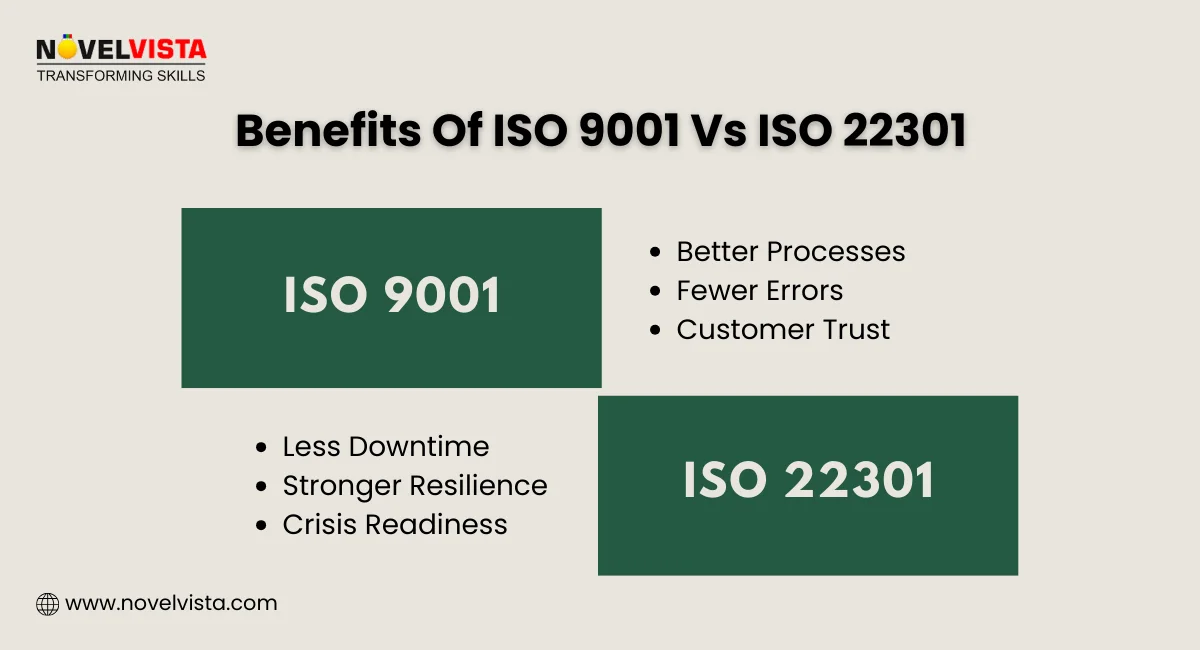
When comparing iso 22301 vs iso 9001, the simplest difference is this:
ISO 9001 builds quality. ISO 22301 builds resilience.
Both matter — one for daily performance and the other for surviving unexpected events.
Here’s a clean, easy table to make the ISO 22301 vs 9001 comparison simple:
Aspect |
ISO 9001:2015 |
ISO 22301:2019 |
Primary Goal |
Customer satisfaction, efficient processes |
Operational continuity during disruptions |
Core Focus |
Quality improvement, fewer defects |
Resilience, recovery planning |
Risk Scope |
Quality and process risks |
Disruptive incidents, outages, failures |
Key Metrics |
Customer satisfaction, defect rates |
RTO, RPO, recovery performance |
Lead Auditor Certification |
ISO 9001 Lead Auditor |
ISO 22301 Lead Auditor |
Audit Focus |
Process conformance, customer requirements |
BIA validation, BCP testing, and incident readiness |
Certification Body |
Any accredited CB |
Any accredited CB |
Recertification Cycle |
3 years |
3 years |
Industry Use Cases |
Manufacturing, service industries |
Finance, healthcare, critical operations |
Risk is where the biggest split appears between iso 22301 vs iso 9001.
ISO 9001 looks at risks inside your processes. These risks affect customer experience, product quality, timelines, and performance.
Examples:
These risks usually grow slowly over time and impact quality or consistency.
ISO 22301 focuses on sudden events that can stop your operations.
Examples:
These risks can shut down a business in minutes, which is why ISO 22301 puts so much weight on Business Impact Analysis (BIA) and recovery planning.
ISO 9001 manages quality risks, while ISO 22301 manages survival risks.
This difference defines the real power of iso 22301 vs iso 9001 for leaders making strategic choices.
Choose the right standard with zero confusion.
Follow a simple flow to know whether you need ISO 9001,
ISO 22301, or both—instantly.
Even though ISO 22301 vs 9001 differ in purpose, they use tools that feel familiar. That's because both standards follow structured thinking and organized methods.
Here’s a simple view:
Area |
ISO 9001 |
ISO 22301 |
Analysis |
Process mapping |
Business Impact Analysis (BIA) |
Planning |
Corrective actions |
Business Continuity Plans (BCP) |
Response |
Non-conformity control |
Incident response |
Testing |
Internal audits |
BCP exercises, simulations |
Metrics |
KPI dashboards |
RTO/RPO tracking |
Both use audits, metrics, planning, and improvements — but the aim changes. This shared structure helps companies integrate both systems without starting from zero.
This is where most leadership teams pause and ask, “Which one gives us the biggest return?”
The answer depends on what the business is trying to fix or improve.
ISO 9001 is the go-to choice when teams want:
It’s popular in manufacturing, IT services, logistics, hospitality, retail, and almost every industry that wants predictable results.
ISO 22301, on the other hand, is the shield organizations rely on when they want:
It’s widely used in banks, telecom, hospitals, government, critical infrastructure, data centers, and any business where disruption is expensive or dangerous.
When leaders ask about iso 22301 vs iso 9001, this is the most honest summary:
ISO 9001 = Quality you can trust
ISO 22301 = Continuity you can rely on
But here’s the fun part:
Companies that implement both see a powerful mix — strong quality + strong resilience. One makes the business run better, the other makes sure it keeps running no matter what.
A lot of organizations underestimate how much impact trained lead auditors can create. They’re not just checklist-keepers — they’re the people who see what others miss.
ISO 9001 lead auditors usually focus on:
They look for gaps like unclear responsibilities, missing records, performance dips, or process inefficiencies. Their work directly affects customer satisfaction.
ISO 22301 lead auditors, on the other hand, move in a slightly different direction. They check:
They test the organization’s ability to function during real pressure — outages, cyberattacks, failures, and disasters.
Trained auditors in both standards bring structure, confidence, maturity, and readiness.
And here’s the golden insight:
When a business has cross-trained auditors, the system becomes stronger. Quality teams understand continuity. Continuity teams understand quality. The results are smoother audits and fewer surprises.
A lot of companies get excited about combining both standards, but integration comes with its own challenges.
Common problems leaders face:
Duplicate documentation: Teams create two versions of the same record — one for quality and one for continuity. This wastes time and creates confusion.
Different scopes: The QMS might cover all processes, while the BCMS covers only critical ones. When they don’t match, integration becomes messy.
Two different risk languages: Quality teams think in process risks. Continuity teams think in disruption risks. Both matter, but they don’t always align.
Misaligned management review inputs: If leadership reviews QMS and BCMS separately, they miss the shared insights.
To make onboarding smooth, here are the best practices:
One internal audit team reviews both standards. This saves time and ensures both systems speak the same language.
Combine process risks and disruption risks in one place. Decision-making becomes easier and more realistic.
Leaders get a complete picture of:
This saves hours every quarter.
When ISO 9001 and ISO 22301 professionals understand each other’s systems, integration becomes natural.
It also reduces conflicts and improves communication.
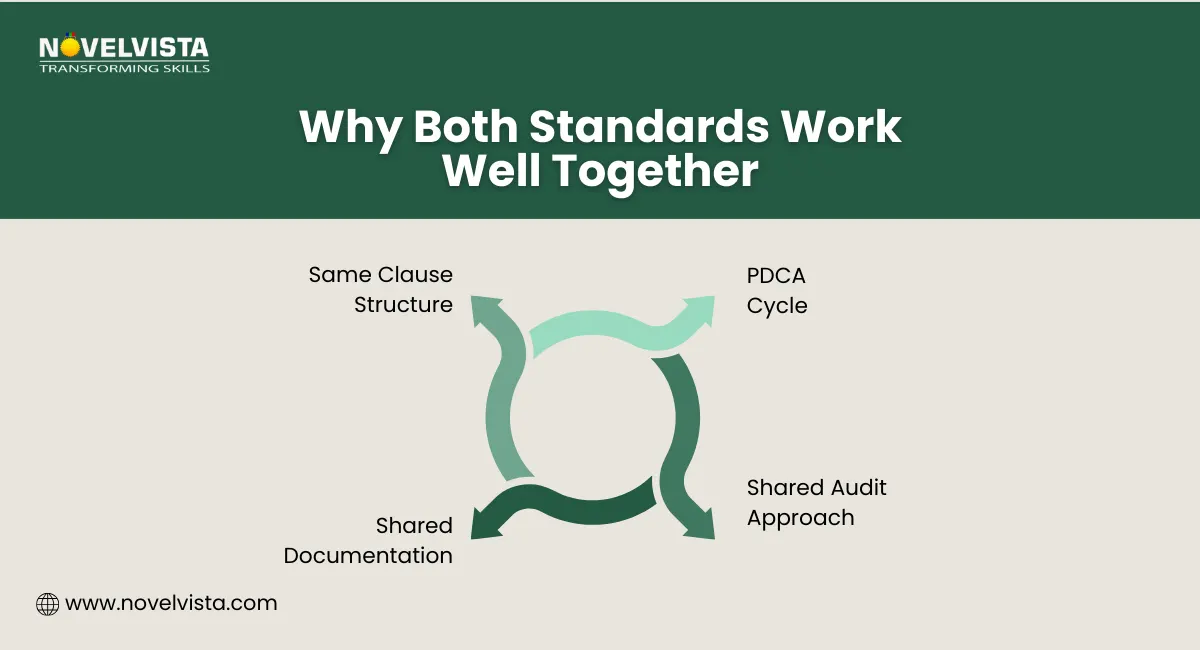
When businesses look at ISO 22301 vs 9001, they often assume integration is complicated. But with the right structure, both frameworks blend beautifully since they share the same Annex SL structure.

When you look at iso 22301 vs iso 9001, the difference becomes pretty clear:
One builds quality, the other builds continuity.
One helps you deliver a good experience every day, the other protects you when things go wrong.
Most organizations start with ISO 9001 because it strengthens the basics — process control, consistency, and customer trust.
Others pick ISO 22301 when downtime or disruptions are their biggest fear.
But the real advantage shows up when both work together.
You’re not just improving how the business runs — you’re making sure nothing can stop it.
If your goal is long-term stability, happy customers, and a business that stays strong even during tough moments, both standards bring their own value. Choosing the right path depends on where your biggest challenges are today.
If you want to move beyond theory and build real auditing confidence, our ISO 22301 Lead Auditor and ISO 9001 Lead Auditor certifications are the perfect way forward. NovelVista’s training gives you hands-on practice, real case examples, and guidance from industry experts. Whether you’re aiming for stronger business continuity or better quality systems, these programs help you grow your skills and your career. Ready to level up?
Author Details

Course Related To This blog
ISO 22301:2019 Lead Auditor
Confused About Certification?
Get Free Consultation Call
Stay ahead of the curve by tapping into the latest emerging trends and transforming your subscription into a powerful resource. Maximize every feature, unlock exclusive benefits, and ensure you're always one step ahead in your journey to success.