ISO 22301 Risk Assessment – Steps, Tools & Key Controls

Category | Quality Management

Last Updated On

ISO 22301 Risk Assessment – Steps, Tools & Key Controls | Novelvista

Sudden power cuts. Supplier delays. A system crash at the worst moment. These problems hit businesses every day, yet most teams only react after something breaks. An iso 22301 risk assessment stops that cycle by helping you spot risks early, rank them properly, and prepare actions that keep your business steady during disruptions.

This guide gives you a simple, step-by-step approach to understand risks, analyse them, treat them, and connect everything to your BCMS in a practical way.

Understanding ISO 22301 Risk Assessment (Simple Breakdown)

A risk assessment explains what might go wrong, how badly it can affect your business, and what you should do about it.

Here’s what it mainly covers:

  • Identify threats – Anything that can disrupt your important work.
     
  • Analyse impact – How a threat affects operations, money, customers, or safety.
     
  • Evaluate risks – Score likelihood and impact to see what needs priority.
     
  • Select controls – Pick steps that reduce or manage each risk.

The purpose is simple: make your continuity planning honest, clear, and linked to real-world situations.
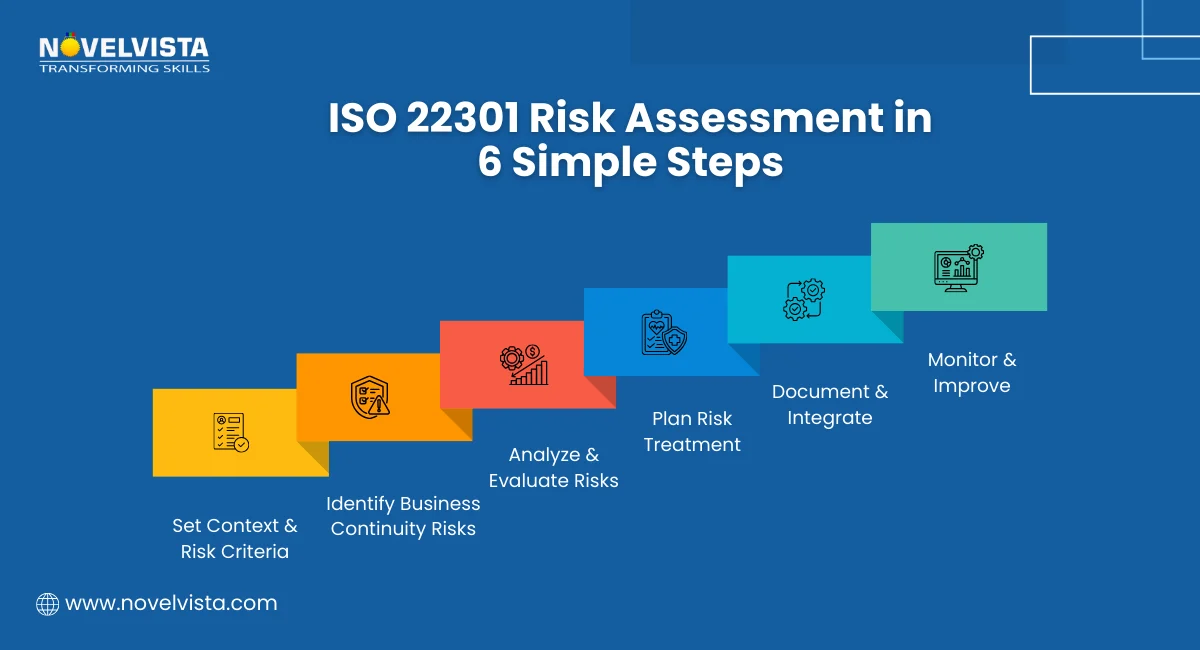
 ISO 22301 Risk Assessment in 6 Simple Steps

Step 1: Set the Context and Define Risk Criteria

Before scoring risks, get clarity on the environment you operate in.

Check internal factors:

  • Daily operations
     
  • Teams and resources
     
  • Technology and systems
     
  • Internal processes and dependencies

Check external factors:

  • Suppliers and service partners
     
  • Legal, regulatory, and industry rules
     
  • Local conditions and economic factors

Define your risk criteria clearly:

  • Impact categories: financial impact, downtime, customer issues, safety concerns
     
  • Likelihood scale: how often a threat can occur
     
  • Continuity objectives: what activities must stay running no matter what

These threat categories are drawn from real audit findings we’ve observed during live training exercises and client engagements. Participants report that considering these areas prevents overlooked risks and aligns risk assessment with actual operational vulnerabilities.

Download: Ultimate ISO Risk Management Cheat Sheet

Understand ISO 31000 and ISO 27005 risk management for ISO 2230 in minutes.
Get quick definitions, risk steps, and mapping guides to make daily
risk decisions easier and faster
and always be audit-ready.

Step 2: Identify Business Continuity Risks and Threats

Once the context is ready, start listing what could disrupt your operations. This step forms the heart of an iso 22301 risk assessment.

Common threats include:

  • Cyberattacks – Ransomware, data breaches, or system compromise
     
  • Power failures – Sudden downtime stopping production or customer service
     
  • Supply chain issues – Delayed materials, transport failures, vendor breakdown
     
  • Natural disasters – Floods, fires, storms, earthquakes
     
  • System outages – Software failure, network downtime, hardware faults
     
  • People-dependent risks – Absenteeism, lack of key skills, strikes
     
  • Third-party disruptions – Service provider failures, breakdown of support services

Each threat should connect back to critical activities identified in your BIA, so you know which disruptions actually matter.

Step 3: Analyse and Evaluate Risks the Right Way

Now score every identified risk using a simple and structured method.

Use a risk matrix:

  • Score likelihood (low/medium/high).
     
  • Score impact (low/medium/high).
     
  • Multiply or map them to get your risk level.

Set your risk appetite:

  • Decide which risks are acceptable
     
  • Identify which ones need immediate attention
     
  • Spot long-term risks that need planning

You can use qualitative, quantitative, or mixed scoring depending on what suits the organisation.

Step 4: Plan Risk Treatment and Select Controls

Once you identify and evaluate risks, the next step is deciding how to handle them. Risk treatment ensures your organization is ready to prevent, reduce, or manage threats effectively.

  • Avoid the Risk: Sometimes the best strategy is to eliminate the risk entirely. This could mean changing a risky process, discontinuing a vulnerable activity, or moving operations to a safer environment. By avoiding the risk, you prevent potential disruptions before they even happen.
     
  • Mitigate the Risk: Not all risks can be avoided, so mitigation reduces their impact or likelihood. Examples include implementing robust backup solutions, deploying redundant systems, improving network security, or setting up alert mechanisms to detect failures early.
     
  • Transfer the Risk: Transfer involves sharing responsibility with a third party. This could mean outsourcing critical operations to a reliable partner, purchasing insurance to cover business interruptions, or having agreements with suppliers to ensure service continuity.
     
  • Accept the Risk: Some risks are minor and within your organization’s tolerance level. Accepting these risks allows your team to focus resources on higher-priority threats while monitoring them regularly to ensure they remain manageable.

Key Controls for Risk Treatment:

  • Regular data backups and disaster recovery solutions.
     
  • Redundant IT systems and alternative work locations.
     
  • Supplier continuity agreements to ensure critical services remain uninterrupted.
     
  • Emergency communication plans to alert employees and stakeholders quickly.
     
  • Crisis management procedures that define clear roles and actions during disruptions.
     
  • System hardening measures, such as patches, access controls, and network segmentation.

Risk treatment strategies described here reflect both ISO 22301 guidance and real-world implementations observed in audited organizations. Our courses show participants how to select practical, measurable controls that stand up to both internal and external audits.

Step 5: Document Everything and Integrate Into the BCMS

Documentation is the backbone of ISO 22301 risk management. Clear, structured records make it easier to track risks, demonstrate compliance, and implement continuous improvements.

  • Maintain a Risk Register: Capture every identified risk, its likelihood, potential impact, assigned owners, and planned treatments. This central record provides a clear overview and helps prioritize actions.
     
  • Update Business Continuity Plans (BCPs): Integrate risk assessment findings into existing BCPs to ensure all scenarios are covered, and mitigation measures are actionable.
     
  • Keep Mandatory ISO Records: Include assessment results, treatment actions, review notes, and audit trail evidence. Proper records support audits and management reviews.

Good documentation not only strengthens your BCMS but also allows teams to respond quickly and confidently during incidents. It creates transparency and ensures all staff understand their responsibilities in maintaining continuity.

Step 6: Monitor, Review, and Improve Continuously

ISO 22301 emphasizes that risk assessment is not a one-time task. Regular monitoring and improvement are essential for effective business continuity management.

  • Review Risks Regularly: Reassess risks after incidents, operational changes, or significant market events. Keeping risks up-to-date ensures your controls remain relevant.
     
  • Track Performance: Measure control effectiveness, track reduced exposure, and verify that mitigation strategies are working as intended.
     
  • Leverage Audit Findings: Use insights from internal audits, incident reports, and testing exercises to refine your risk assessment methodology.
     
  • Continuous Improvement: Document lessons learned, adjust risk criteria, and update treatment plans. This ongoing cycle helps maintain resilience and keeps your BCMS aligned with ISO 22301 standards.

Continuous monitoring and review practices follow ISO 22301 recommendations and are reinforced with examples from organizations we’ve trained. Professionals learn to track effectiveness, refine criteria, and incorporate lessons learned for evolving threats.

ISO 22301 Risk Assessment vs Business Impact Analysis (BIA)

Understanding the difference between risk assessment and BIA is key to effective business continuity planning.


Aspect

Risk Assessment

Business Impact Analysis (BIA)

Focus

Identifying threats, evaluating likelihood, and determining potential impact

Analyzing consequences of disruptions and identifying critical processes

Key Question

“What could go wrong and how likely is it?”

“How long can we survive this disruption before it affects business outcomes?”

Purpose

Preventive: Understand risks and their probability

Strategic: Determine recovery priorities, RTO, and RPO

Outcome

List of risks with severity and likelihood

Recovery strategies, critical process mapping, and impact timelines

While risk assessment identifies what could threaten operations, BIA prioritizes which processes need protection. Together, they provide a complete view for informed decision-making.

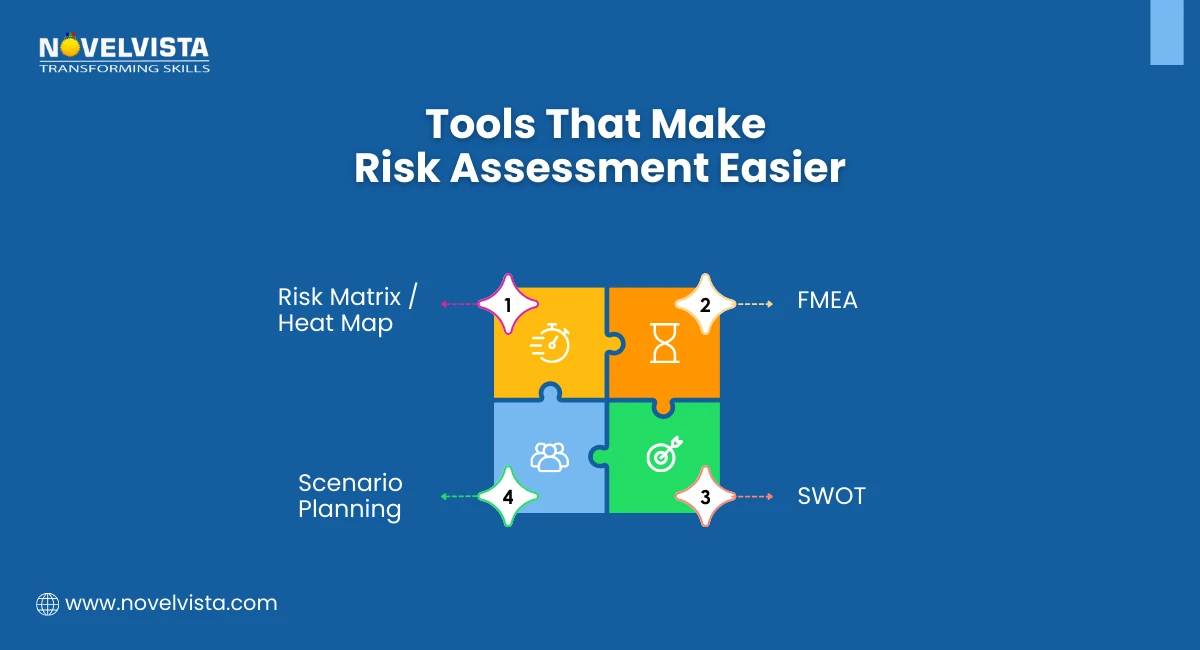
Essential Tools for ISO 22301 Risk Assessment

Use simple tools that make your assessment more accurate and easier to explain.

Useful tools include:

  • Risk Matrix / Heat Map: Helps you compare risks visually and prioritise actions quickly.
     
  • FMEA (Failure Mode and Effects Analysis): Breaks down critical processes and helps you understand failure points clearly.
     
  • SWOT Analysis: Gives a wider view of strengths, weaknesses, and risk areas tied to strategy.
     
  • Scenario Planning: Simulates disasters or heavy disruptions to test how your business would respond.

The tools recommended have been tested in multiple industries during workshops and real audits. Trainees consistently report that using these tools improves clarity, engagement, and decision-making during assessments.
Tools That Make Risk Assessment Easier

Practical Tips, Best Practices & Common Mistakes

Best Practices:

  • Use structured templates for risk assessments to maintain consistency across departments.
     
  • Engage cross-functional teams to ensure all perspectives are considered and no risk is overlooked.
     
  • Update risk assessments regularly, especially after operational, technological, or environmental changes.
     
  • Integrate risk assessment results with BC plans, internal audits, and management reviews.

Common Mistakes to Avoid:

  • Limiting threat identification to a narrow list, missing critical risks.
     
  • Treating risk assessment as a one-time activity rather than an ongoing process.
     
  • Conducting assessments in isolation without consulting other teams or stakeholders.
     
  • Failing to document evidence and decisions, which complicates audits and continuous improvement.

Guidance for Lead Auditor Professionals

What Lead Auditors Look For:

  • Evidence that risk assessments are systematic, comprehensive, and repeatable.
     
  • Clear alignment between risk assessment findings and BIA results.
     
  • Consistency in scoring, prioritizing, and linking risks to treatment actions and continuity plans.

Skills Lead Auditors Need:

  • Strong understanding of business continuity scenarios and potential threat landscapes.
     
  • Ability to validate the effectiveness of controls and evaluate mitigation measures.
     
  • Proficiency in auditing supplier risks, operational dependencies, and resilience strategies.
     
  • Capability to coach teams on maintaining accurate, compliant, and actionable risk assessments.

Lead auditors ensure ISO 22301 risk assessments are thorough, reliable, and aligned with organizational objectives, supporting stronger BCMS performance and audit readiness.

Become A Certified ISO 22301 Lead Auditor And Strengthen Organizational Resilience

Conclusion

A well-executed ISO 22301 risk assessment is more than a checklist—it’s the foundation of a resilient organization. By systematically identifying threats, evaluating impacts, and applying effective controls, businesses can protect critical operations and maintain continuity during disruptions. Integrating risk assessment with BIA, documenting actions, and continuously reviewing processes ensures informed decision-making and strengthens overall preparedness. 

When teams follow these structured practices, audits become smoother, gaps are minimized, and recovery capabilities improve. Prioritizing risk management within the BCMS not only safeguards operations but also builds stakeholder confidence and long-term operational stability.

Every step and recommendation in this guide is derived from a combination of ISO standards, real audit experience, and practical training outcomes. Following these practices ensures businesses not only meet compliance requirements but also strengthen resilience, maintain stakeholder confidence, and improve recovery readiness.

Next Step: Advance Your ISO 22301 Expertise

To master ISO 22301 risk assessment and lead effective BCMS audits, NovelVista’s ISO 22301 Lead Auditor Certification is your ideal next step. This practical, industry-aligned training equips professionals with the skills to evaluate continuity risks, interpret clauses, verify controls, and guide organizations toward full compliance. 

Whether you aim to enhance audit readiness, strengthen business resilience, or advance your career in governance, risk, and continuity roles, this certification ensures hands-on expertise and professional credibility in real-world scenarios.

Frequently Asked Questions

ISO 22301 uses risk management as a foundation for building business continuity. It requires organizations to identify threats, assess their impact, evaluate vulnerabilities, and implement controls to minimize disruption. In simple terms, risk management determines what can go wrong, and ISO 22301 ensures you can continue operating even if it does.
Organizations often use tools like risk matrices, Business Impact Analysis (BIA) templates, threat catalogs, scoring models, heat maps, and continuity planning software. These tools help quantify risks and prioritize actions based on likelihood and impact.
ISO 22301 recommends reviewing risk assessments at planned intervals, typically annually or whenever there are major changes—such as new processes, technology updates, incidents, or organizational restructuring. Frequent reviews ensure the continuity plan remains aligned with current risks.
Key KPIs include the number of critical risks identified versus mitigated, the time taken to complete assessments, the percentage of high-impact risks with controls, the effectiveness of existing controls, and how frequently risk reviews are conducted. These metrics help determine how efficiently an organization manages continuity-related risks.
Your risk assessment is effective if it clearly identifies major threats, provides realistic impact ratings, leads to actionable controls, and supports decision-making during disruptions. Regular reviews, testing outcomes, and audit findings also validate its accuracy and reliability.

Author Details

Akshad Modi

Akshad Modi

AI Architect

An AI Architect plays a crucial role in designing scalable AI solutions, integrating machine learning and advanced technologies to solve business challenges and drive innovation in digital transformation strategies.

Enjoyed this blog? Share this with someone who'd find this useful

Confused About Certification?

Get Free Consultation Call

Sign Up To Get Latest Updates on Our Blogs

Stay ahead of the curve by tapping into the latest emerging trends and transforming your subscription into a powerful resource. Maximize every feature, unlock exclusive benefits, and ensure you're always one step ahead in your journey to success.

Topic Related Blogs