Category | Quality Management
Last Updated On 01/09/2026
Unexpected downtime often hits harder than most teams expect. One small disruption can freeze operations, break trust, and leave people confused about what to do next. That’s exactly why iso 22301 BCP (Business Continuity Plan) becomes so helpful, it gives you a clear, ready-to-use path so your business can continue to function even when something goes wrong.
This guide walks you through how the framework works, the key components of a strong plan, and how different industries use it to stay prepared.
Over the years, many professionals who joined our continuity workshops shared how even a single mismanaged outage slowed operations for days. During the 2023 cloud service disruptions, several teams explained how the absence of a documented response plan left departments confused and customers frustrated. These first-hand stories show how important structured continuity planning is for any organization trying to stay stable during uncertainty.
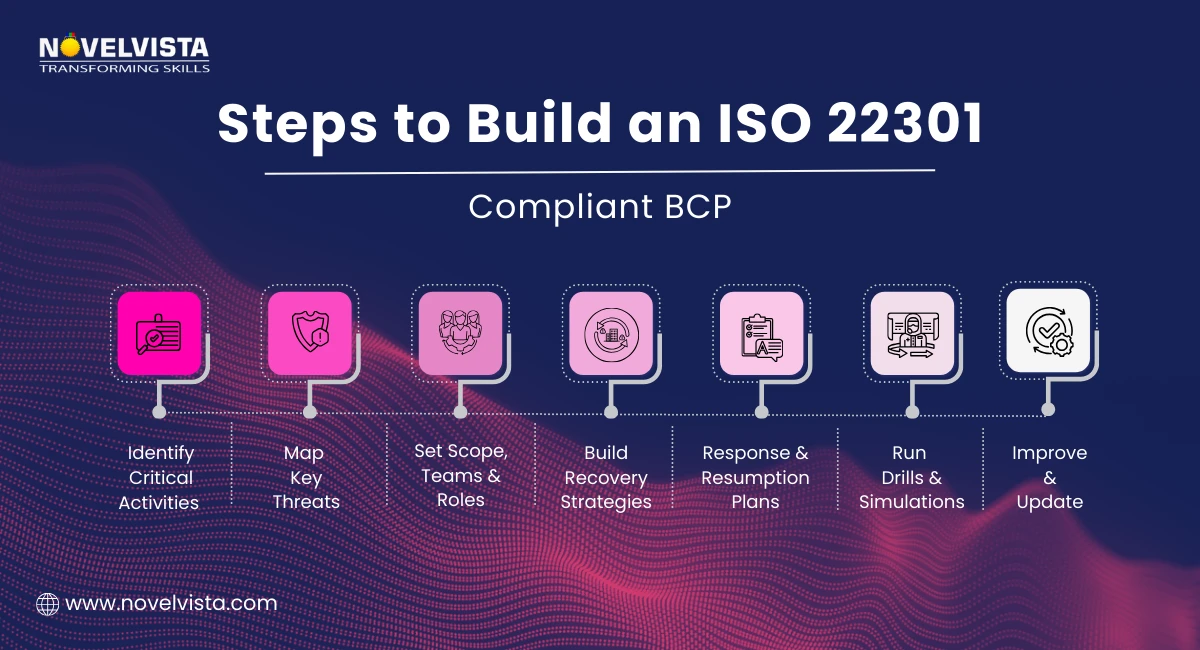
Creating a strong iso 22301 BCP becomes simple when you break the process into steps that everyone understands.
A BIA reveals which business activities cannot stop, how long they can be down, and what resources they depend on. This helps you set your RTO and RPO based on real operations.
You identify threats like outages, cyber issues, supply failures, or human mistakes. Each threat is rated so you know which ones can harm your operations the most and what controls you need.
You clarify which departments fall under the plan, who activates the response, and which team handles communication, recovery steps, and decision-making during an incident.
You create simple, direct instructions for detection, activation, resource use, technical recovery, and service restoration. This makes sure anyone can follow the plan without confusion.
Testing builds confidence and reveals gaps before a real disruption happens. Tabletop sessions, drills, and simulations help your team understand their actions and fine-tune the iso 22301 BCP.
Based on our experience training continuity and risk teams across industries, the smoothest implementations happen when BIA and risk assessments are done by people who understand day-to-day operations. One of our client groups in the telecom sector improved its recovery time by aligning BIA results with trained incident teams, something they achieved only after undergoing dedicated ISO 22301 skill-building sessions with us. This proves that trained teams make the entire BCP lifecycle stronger and more practical.
A complete continuity plan includes all the building blocks that help people act quickly under pressure. These elements keep the plan clear, practical, and easy to follow:
Get a clean, one-page summary of ISO 22301 clauses,
key terms, and team responsibilities. Bring instant
clarity to your business continuity planning.
A well-developed plan only works when it is implemented with discipline. Organizations usually follow this path:
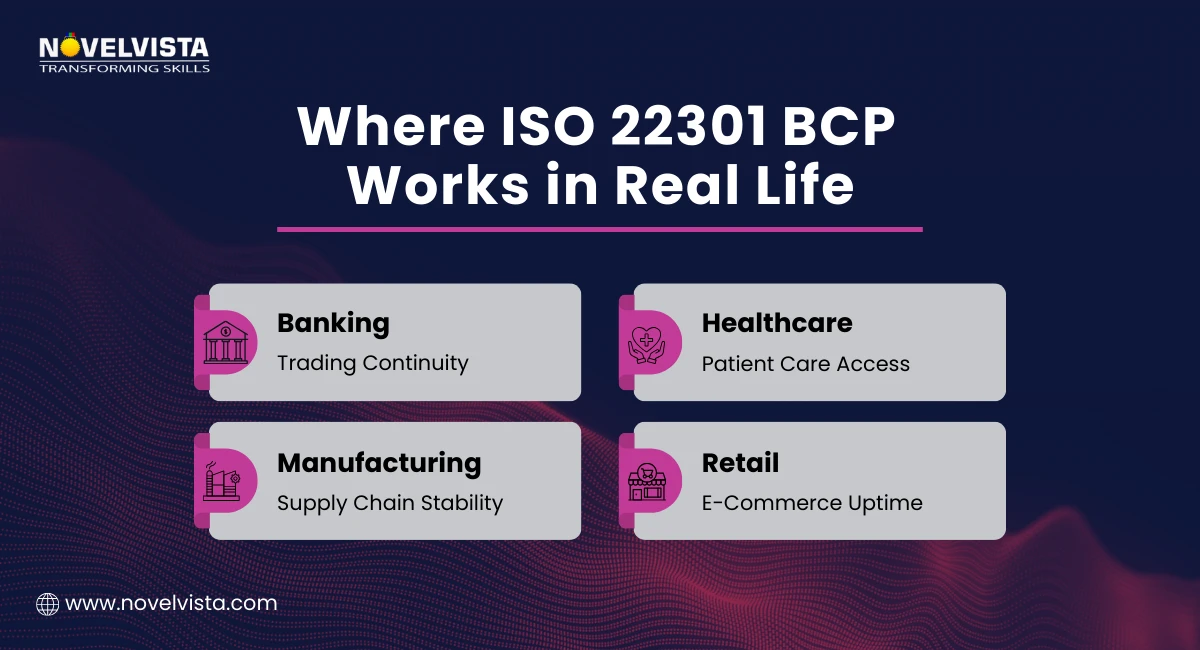
The easiest way to understand the value of iso 22301 BCP is to see how different industries use it when things suddenly break. Real examples show how a structured plan saves time, money, and reputation.
Banks rely on continuous transactions, so even a short outage can affect thousands of customers. With iso 22301 BCP, trading desks, payment systems, and online channels continue to work even when cyber issues or system failures happen.
Clinics and hospitals need constant access to patient data and medical devices. Continuity planning makes sure that treatment, reports, and emergency services keep running even during network failures or large-scale outages.
Factories depend heavily on supply chains and machinery. When something breaks, a well-built continuity plan reduces downtime, shifts production quickly, and protects delivery timelines.
Online stores can’t afford long outages because customers move on fast. ISO 22301 helps them maintain order processing, customer support, and online storefront availability even during natural disasters or data center failures.
A solid continuity plan becomes stronger when someone with a trained eye reviews it. That’s where Lead Auditors play an important role. They look at the entire BCP lifecycle and help organizations reach a higher maturity level.
Lead Auditors understand how to review BIA, risk assessment, team roles, and recovery strategies. They spot missing links that normal teams may not see. Their audit skills help strengthen documentation, improve evidence control, and ensure the plan can actually work during a real incident.
They also guide teams during testing, helping them understand what works, what doesn’t, and what needs fine-tuning. This brings structure, confidence, and clarity to the entire iso 22301 BCP setup.
Professionals who handle continuity, compliance, or risk often choose Lead Auditor training because it improves how they think, plan, and review processes. It also opens doors to roles where organizations expect strong decision-making and BCMS understanding.
A trained Lead Auditor helps an organization get certification faster because they already know how audits work and what evidence is needed. Their audit-based mindset improves monitoring, testing, and reporting, making the iso 22301 BCP stronger and more reliable.
This skillset is beneficial not just for auditors but also for managers, consultants, and team leads who support business continuity in day-to-day operations.
When a company builds a solid iso 22301 BCP, the benefits start showing in several areas:
A strong plan doesn’t just reduce damage; it helps the organization stay steady when competitors struggle during disruptions.

A well-built iso 22301 BCP gives your business the confidence to run smoothly even when unexpected situations appear. When you understand your important processes, prepare for real risks, build clear recovery actions, and keep your teams trained, continuity becomes easier to achieve. This framework supports resilience, faster recovery, and long-term stability for any organization that wants to stay dependable.
Everything shared in this guide is shaped by years of conducting accredited continuity and resilience training, real case reviews from our learners, and references from trusted standards like ISO 22301, ISO 27001, and BCI recommendations. The goal is to give you reliable guidance that matches both industry expectations and real operational needs.
If you want to strengthen your skills and help organizations build continuity the right way, the ISO 22301 Lead Auditor program is a great next step. NovelVista’s training gives you hands-on understanding, audit techniques, practical scenarios, and expert guidance. You learn how real audits work and how to improve BCMS for any industry. This helps you grow your career and support companies in staying prepared for disruptions.
Author Details

Course Related To This blog
ISO 22301:2019 Lead Auditor
Confused About Certification?
Get Free Consultation Call
Stay ahead of the curve by tapping into the latest emerging trends and transforming your subscription into a powerful resource. Maximize every feature, unlock exclusive benefits, and ensure you're always one step ahead in your journey to success.