Category | Quality Management
Last Updated On 21/05/2026
If your business delivers IT services, sooner or later, you reach a point where clients expect more than “we do our best.” They want proof of reliability, structured processes, and consistent service quality. That’s exactly where ISO 20000 for your Organization makes a difference. It shows that your IT Service Management System (ITSMS) is well-governed, efficient, and aligned with global best practices.
With ISO 20000 for organizations, companies build stronger credibility, reduce chaos in IT operations, improve efficiency, and gain trust during customer deals, RFPs, and compliance requirements. In this guide, we’ll walk through a clear roadmap so you understand what it really takes to achieve ISO 20000 smoothly and confidently.
Before starting the journey, it’s important to know what the standard really expects from you. ISO 20000-1:2018 focuses on building a structured IT Service Management System that ensures planning, delivery, support, monitoring, and continual improvement of IT services.
You need to pay attention to the full lifecycle of ITSMS:
Meeting these expectations builds the foundation for ISO 20000 for your Organization readiness and proves your organization is serious about systematic service management.
Your certificate journey always begins with understanding where you currently stand. Conduct a clause-wise gap assessment against Clauses 4 to 10 to see:
Identify gaps in:
ISO 20000 is not an IT-only exercise. Senior leadership must:
Without leadership involvement, ISO 20000 for Organization becomes a paperwork exercise rather than a real improvement journey.
We’ve seen many organizations struggle initially with ISO 20000 because they treat it as a documentation exercise. However, companies that focus on real process maturity, incident handling, SLA governance, supplier control, and continual improvement perform far better during audits. These recommendations reflect lessons learned from real implementation and audit preparation scenarios.
Once the gaps are clear, it’s time to strengthen real operational capabilities, not just documentation. ISO 20000 expects core ITSM processes to be structured, consistent, and evidence-backed.
Core Area |
Requirement for ISO 20000 for your Organization |
| Service Planning & Design | Build a clear service catalog, define SLAs, and structure the service portfolio |
| Incident / Problem / Change | Standard procedures, defined priorities, response targets, and continuous improvement tracking |
| Service Delivery | Strong control over availability, capacity, continuity, and supplier performance |
| Continual Improvement | PDCA cycle, KPI monitoring, reviews, and measurable improvements |
Many organizations fail because they prepare only documents. ISO 20000 auditors look for working processes, real records, and traceability. When you implement these processes well, your path toward ISO 20000 for your Organization becomes far stronger.
Documentation is important, but control over documentation is even more important. ISO 20000 expects organizations to maintain structured, secure, and updated documented information.
This is where you self-check system effectiveness. Internal audits:
Leadership must review ITSMS performance and:
Strong governance here builds maturity and increases confidence in achieving ISO 20000 for the organization successfully.
Once your ITSMS is implemented, documented, and internally validated, it’s time for the official journey. ISO 20000 for your Organization follows a structured two-stage audit approach.
This is like a preparation health check:
If any major gaps are found, organizations can fix them before moving to Stage 2.
This is where real validation happens:
A structured and well-executed ITSMS increases the chances of success in the first attempt.
Once your organization successfully clears Stage 2, ISO 20000 for Organization is awarded. It remains valid for three years, demonstrating strong governance and service delivery capability.
Auditors conduct annual surveillance audits to confirm you are maintaining compliance, improving performance, and sustaining operational consistency.
At the end of the three-year period, a recertification audit is conducted to renew ISO 20000 for your Organization and validate long-term maturity.
This ongoing cycle ensures the certificate remains meaningful, active, and beneficial rather than becoming a one-time achievement.
Lead auditors take a practical, evidence-based approach while assessing ISO 20000 for Organization. They typically focus on:
 These auditor expectations come from real lead auditor experience, audit simulations, and discussions we conduct during ISO 20000 Lead Auditor training programs. Organizations that prepare with this mindset build stronger confidence, clearer evidence, and higher certificate success rates.
Technology plays a huge role in strengthening ISO 20000 for your Organization. Auditors value organizations that leverage smart ITSM tools.
These tools don’t just ease audits; they help teams govern services effectively every single day.
See the real ROI of ISO 20000 and check if your IT team is truly ready, and avoid costly decisions made on assumptions.
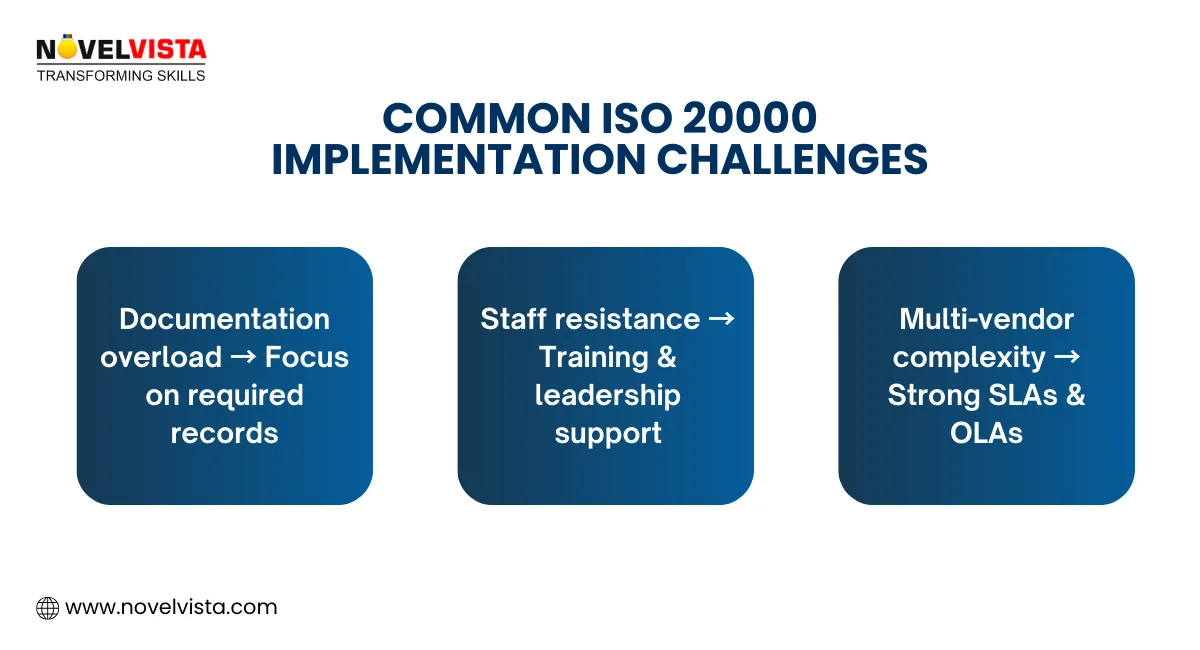
Challenge |
Practical Solution |
| Documentation overload | Focus only on necessary records with operational value |
| Team resistance or lack of awareness | Leadership involvement, communication, and training |
| Multi-supplier complexity | Strong SLAs, OLAs, and supplier governance |
| Limited resources | Phased implementation and automation support |
ISO 20000 for Organization becomes easier when tackled systematically instead of overcomplicating the journey.
A certificate is not overnight. It’s a structured maturity journey.
Costs depend on:
The value, however, far outweighs the investment when done right.
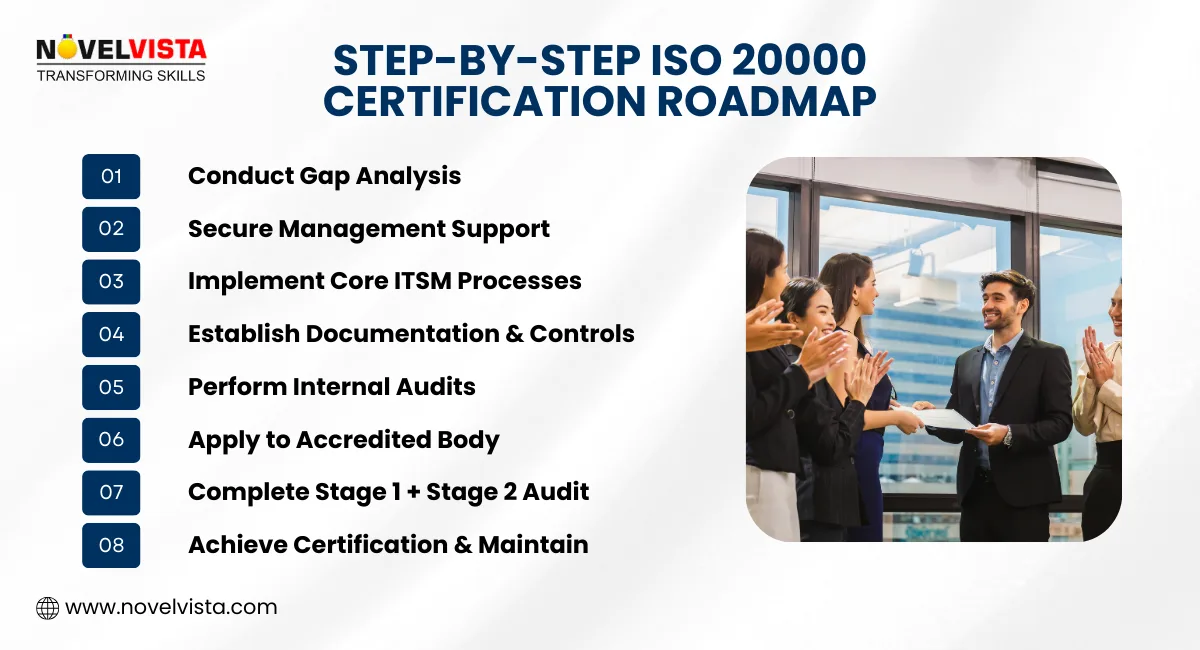 ISO 20000 Certificate for your Organization isn’t just a badge; it’s a powerful statement of trust, discipline, and service excellence. The path is clear: Gap Analysis → Implementation → Documentation → Internal Audits → Certification Body → Certification Achievement. Organizations that commit to structured ITSM maturity gain stronger credibility, better control, and long-term business trust.
Everything shared in this blog is backed by globally accepted ISO 20000 guidance, practical ITSM experience, and structured auditor insights. This ensures readers get advice that is reliable, realistic, and directly applicable when preparing their organization for ISO 20000.
If you want to lead ISO 20000 journeys confidently, NovelVista’s ISO 20000 Lead Auditor Certification Training Course is a smart next move. The program helps professionals understand audits deeply, assess ITSM maturity, verify compliance, and guide organizations toward success. Build real auditing confidence, enhance your profile, and position yourself as a trusted ISO 20000 expert.
Author Details

Confused About Certification?
Get Free Consultation Call
Stay ahead of the curve by tapping into the latest emerging trends and transforming your subscription into a powerful resource. Maximize every feature, unlock exclusive benefits, and ensure you're always one step ahead in your journey to success.