Category | Quality Management
Last Updated On 09/01/2026
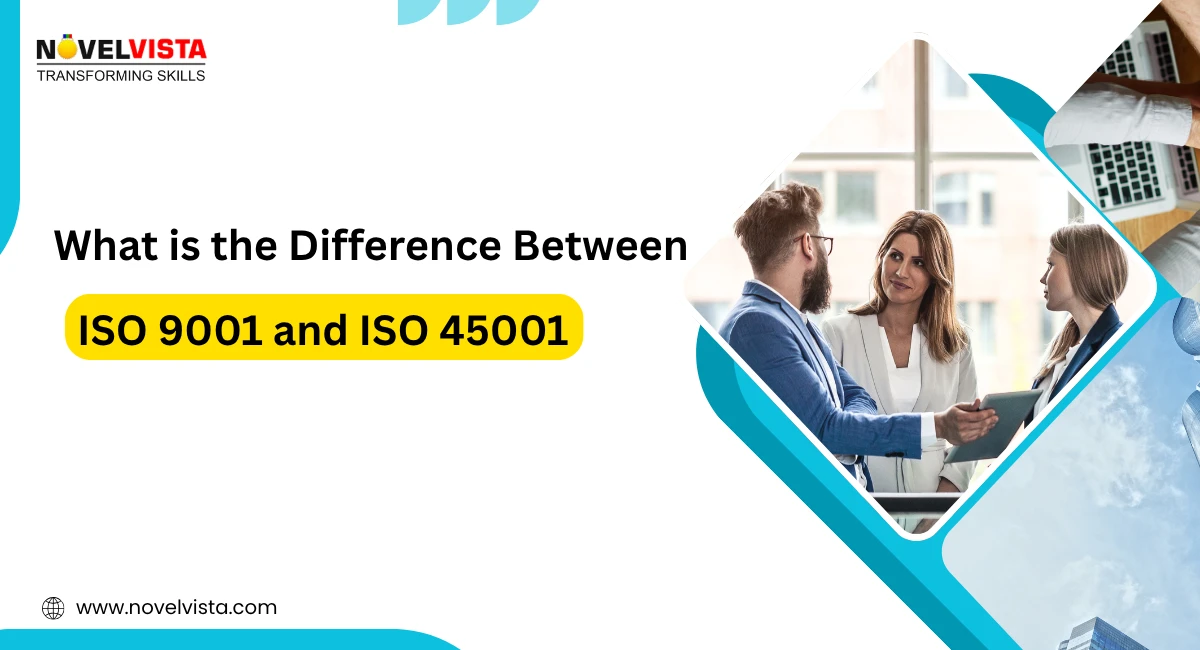
ISO 9001 and ISO 45001 are two of the most powerful management standards driving organizational excellence today. While ISO 9001 focuses on delivering quality products and ensuring customer satisfaction, ISO 45001 prioritizes employee health, safety, and workplace well-being. Together, they create a perfect balance between product excellence and people’s safety, a foundation every successful business needs.
In this blog, we’ll break down the key differences between ISO 9001 and ISO 45001, explore their core objectives, benefits, and how integrating both can boost your organization’s efficiency, compliance, and overall performance. Get ready to uncover how these two standards can shape a smarter, safer, and more sustainable business future.
ISO 9001 is a global standard that helps organizations deliver products and services consistently while meeting customer requirements. At its core, it’s about quality management. Businesses following ISO 9001 aim to improve processes, reduce errors, and ensure customer satisfaction.
For a deeper dive into ISO 9001, its principles, implementation tips, and real-world benefits, explore our comprehensive guide on ISO 9001 certification and quality management.
ISO 45001 is all about protecting the most valuable asset in any organization, its employees. This standard provides a framework for managing occupational health and safety (OH&S) risks. The goal is to prevent work-related injuries and illnesses, creating a safe and healthy workplace.
Key elements of ISO 45001 include:
Example in practice: A construction company using ISO 45001 ensures workers wear safety gear, receive proper training for working at heights, and that hazards are controlled. The focus is on preventing accidents before they happen, not just reacting after they occur.
ISO 45001 promotes a proactive safety culture. Employees feel valued and protected, which also improves morale and productivity.
So, what is the difference between ISO 9001 and ISO 45001? Let’s break it down:
Feature |
ISO 9001 |
ISO 45001 |
Focus |
Quality management & customer satisfaction |
Workplace health & safety |
Objective |
Improve processes, reduce defects |
Prevent injuries, ensure safety |
Scope |
Processes affecting products/services |
Processes affecting employee safety |
Applicable |
Any industry |
Any industry |
Core Requirements |
Process approach, continuous improvement, risk-based thinking |
Hazard identification, risk assessment, compliance |
Standard Structure |
Follows Annex SL / High-Level Structure (10 Clauses) |
Follows Annex SL / High-Level Structure (10 Clauses) |
Leadership Involvement |
Top management ensures quality goals align with strategy |
Top management ensures worker participation and safety accountability |
Risk Management |
Focus on quality risks and process failures |
Focus on safety hazards and operational risks |
Employee Involvement |
Engages staff in process improvements |
Encourages worker consultation and participation in safety initiatives |
Performance Measurement |
Quality KPIs: defect rate, customer satisfaction, process efficiency |
Safety KPIs: incident rate, near misses, lost-time injury frequency rate |
Documentation |
Quality manual, procedures, and records of product/service conformity |
Safety policy, hazard registers, incident logs, compliance records |
Tools & Techniques |
Root Cause Analysis, Six Sigma, Lean, Process Mapping |
Hazard Analysis, Job Safety Analysis (JSA), HIRA, Safety Audits |
Audit Type |
Quality audits (internal & external) |
Occupational health & safety audits (internal & external) |
Integration Possibility |
Easily integrates with ISO 14001 & ISO 45001 |
Easily integrates with ISO 9001 & ISO 14001 |
Training & Awareness |
Focused on quality objectives, customer satisfaction |
Focused on hazard awareness, emergency preparedness |
Certification Benefit |
Quality consistency, customer trust, competitive edge |
Safer workplace, regulatory compliance, reduced incidents |
KPIs (Examples) |
Defect density, customer complaints, and on-time delivery rate |
Recordable injury rate, safety training completion, and audit compliance rate |
Best Suited For |
Manufacturing, service, healthcare, IT, logistics |
Construction, manufacturing, oil & gas, heavy industries |
Implementation Complexity |
Moderate — requires data-driven quality control |
Higher — involves behavioral and cultural change |
Certification Path |
Internal auditor → Lead auditor → Quality manager |
Safety officer → Lead auditor → Safety manager |
Certification Cost (for lead auditor) |
₹35,000 – ₹70,000 (varies by course & provider) |
₹40,000 – ₹75,000 (varies by course & provider) |
Professional Recognition |
Recognized globally for quality leadership |
Recognized globally for safety leadership |
Career Impact |
Opens roles in QA/QC, operations, auditing, and consulting |
Opens roles in EHS, compliance, and risk management |
Potential Salary Increase |
15–25% for certified professionals |
20–30% for certified professionals |
Continual Improvement Cycle |
PDCA (Plan-Do-Check-Act) |
PDCA (Plan-Do-Check-Act) |
Audit Frequency |
Annual surveillance audits |
Annual surveillance audits |
Validity of Certification (for lead auditors) |
3-5 years (renewable) |
3-5 years (renewable) |
ISO 9001 drives performance through quality, ensuring customers are satisfied. ISO 45001 protects employees and minimizes workplace risks. Both standards focus on continual improvement, but in different areas, quality vs safety.
When businesses implement both, they get a comprehensive system that balances product excellence with employee welfare.
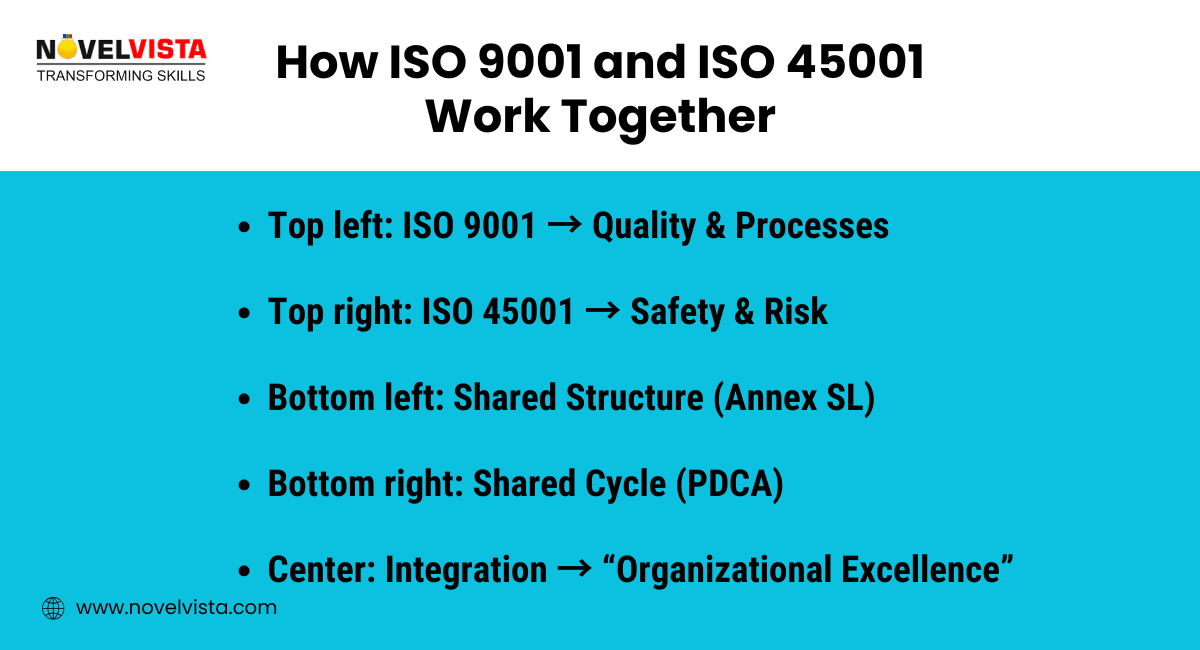
Implementing ISO 9001 and ISO 45001 together creates a stronger, more resilient organization. Here’s why it matters:
Companies that integrate these standards often report higher employee engagement, better customer retention, and smoother regulatory compliance. It’s not just about ticking boxes, it’s about creating a culture of excellence and safety.
Adopting ISO 9001 and ISO 45001 together doesn’t just cover compliance, it drives real results:
A combined approach transforms the organization into one that’s resilient, competitive, and trusted by employees and customers alike.
Build your path to dual certification.
Learn how to become a certified Lead Auditor
in Quality and Safety—faster than most professionals do.
Many organizations wonder if they need both standards or if one is enough. Here are a few clarifications:
Understanding these points helps leadership make informed decisions about implementing both standards efficiently.
Manufacturing Company: Implements ISO 9001 to ensure each product meets specifications and ISO 45001 to keep assembly line workers safe. Reduced defects and fewer workplace injuries boost profitability and morale.
Construction Firm: ISO 9001 ensures project deliverables meet client expectations; ISO 45001 reduces accidents on-site. Both standards together improve client trust and employee retention.
IT Organization: ISO 9001 improves software quality and delivery timelines, while ISO 45001 ensures ergonomics and mental health programs for employees. Enhances productivity and reduces burnout.
These examples show that what is the difference between ISO 9001 and ISO 45001. It isn’t just academic; it directly impacts business operations and people.
So, what is the difference between ISO 9001 and ISO 45001? In short, ISO 9001 guarantees quality for customers, and ISO 45001 guarantees safety for employees. Both are essential for organizations aiming for sustainable success. Together, they create a balanced system where business performance and human well-being go hand in hand.
Implementing both standards isn’t just about compliance; it’s about building a trustworthy, resilient, and high-performing organization.

Ready to take your skills to the next level? NovelVista’s ISO 9001 Lead Auditor Certification Training equips you with practical knowledge to implement, audit, and improve quality management systems confidently. Learn from industry experts, gain hands-on experience, and enhance your career or your organization’s operational excellence.
Enroll today and start driving measurable improvements in quality while understanding how ISO 45001 complements your safety management goals.Author Details

Course Related To This blog
ISO 9001:2015 Lead Auditor Training and Certification
Confused About Certification?
Get Free Consultation Call
Stay ahead of the curve by tapping into the latest emerging trends and transforming your subscription into a powerful resource. Maximize every feature, unlock exclusive benefits, and ensure you're always one step ahead in your journey to success.