Difference Between ISO 20000-1 and ISO 20000-2 – Which One Matters?

Category | Quality Management

Last Updated On

Difference Between ISO 20000-1 and ISO 20000-2 – Which One Matters? | Novelvista

Audit season arrives.
Policies are ready.
Processes look fine on paper.

Then the question drops: Are we following ISO 20000-1 or ISO 20000-2?

This is where many ITSM teams pause.

The difference between ISO 20000-1 and ISO 20000-2 sounds small at first, but in real audits and implementations, it decides whether you pass, fail, or over-document everything.

Both standards sit under the ISO 20000 family. Both talk about IT Service Management. Both use similar wording. Yet they serve very different purposes. One is mandatory and auditable. The other is supportive and advisory.

This blog clears that confusion in a practical way. You’ll understand what ISO 20000-1 really demands, what ISO 20000-2 actually helps with, and how auditors look at both during certification and surveillance audits.

What Is ISO 20000-1? The Certifiable ITSM Standard

ISO 20000-1 is the core standard of the ISO 20000 family. It defines what must be implemented in an IT Service Management System (SMS) if an organization wants certification.

Think of ISO 20000-1 as the rulebook auditors follow.

Here’s what makes it different and important:

  • Defines mandatory requirements: ISO 20000-1 clearly states what an organization must do to design, implement, operate, monitor, and improve its ITSM system. These requirements are not optional and must be met fully.
     
  • Structured under Annex SL (Clauses 4–10): It follows the common ISO structure covering context, leadership, planning, support, operations, performance evaluation, and improvement. This makes it align well with ISO 27001 and ISO 9001.
     
  • Auditable and certifiable: Every clause in ISO 20000-1 can be audited. Auditors collect evidence, test effectiveness, and raise nonconformities if requirements are not met or not sustained.
     
  • Drives contractual and business trust: Many enterprises, government contracts, and regulated sectors require ISO 20000-1 certification as proof of consistent and reliable service delivery.

In simple terms, if your goal is certification, audits, or tender eligibility, ISO 20000-1 is non-negotiable. This is where the difference between ISO 20000-1 and ISO 20000-2 starts becoming very clear.

What Is ISO 20000-2? Practical Guidance for Implementation

ISO 20000-2 plays a very different role.

It does not define requirements. Instead, it explains how organizations can meet the requirements of ISO 20000-1.

Here’s what ISO 20000-2 actually offers:

  • Clause-by-clause guidance: For each requirement in ISO 20000-1, ISO 20000-2 provides explanations, examples, and suggested practices to help teams understand intent and application.
     
  • Implementation-friendly explanations: It helps ITSM teams translate high-level requirements into day-to-day processes, roles, records, and workflows without guessing what auditors might expect.
     
  • No certification attached: ISO 20000-2 is not auditable. You cannot get certified against it, and auditors do not raise findings against ISO 20000-2 clauses.
     
  • Ideal for training and process design: Teams often use ISO 20000-2 during SMS design, internal training, or process improvement phases to avoid misinterpreting ISO 20000-1 requirements.

This is where confusion often begins. Organizations sometimes treat ISO 20000-2 guidance as mandatory, which leads to unnecessary documentation and audit issues. Understanding this separation is essential when discussing ISO 20000-1 and ISO 20000-2 together.

ISO 20000-1 and ISO 20000-2 Compared Side by Side

Looking at both standards together makes the difference clearer.


Aspect

ISO 20000-1

ISO 20000-2
Purpose Mandatory ITSM requirements Practical implementation guidance
Certification Auditable and certifiable Not certifiable
Focus What must be implemented How to implement effectively
Audit Use Primary audit criteria Not used for audit findings
Best For Service providers, auditors Implementers, ITSM teams
Outcome Certification and compliance Better understanding and execution

This comparison aligns with how ISO 20000 auditors and certification bodies differentiate mandatory requirements from advisory guidance. Lead auditors rely on this distinction to assess compliance accurately and to avoid common audit misunderstandings.

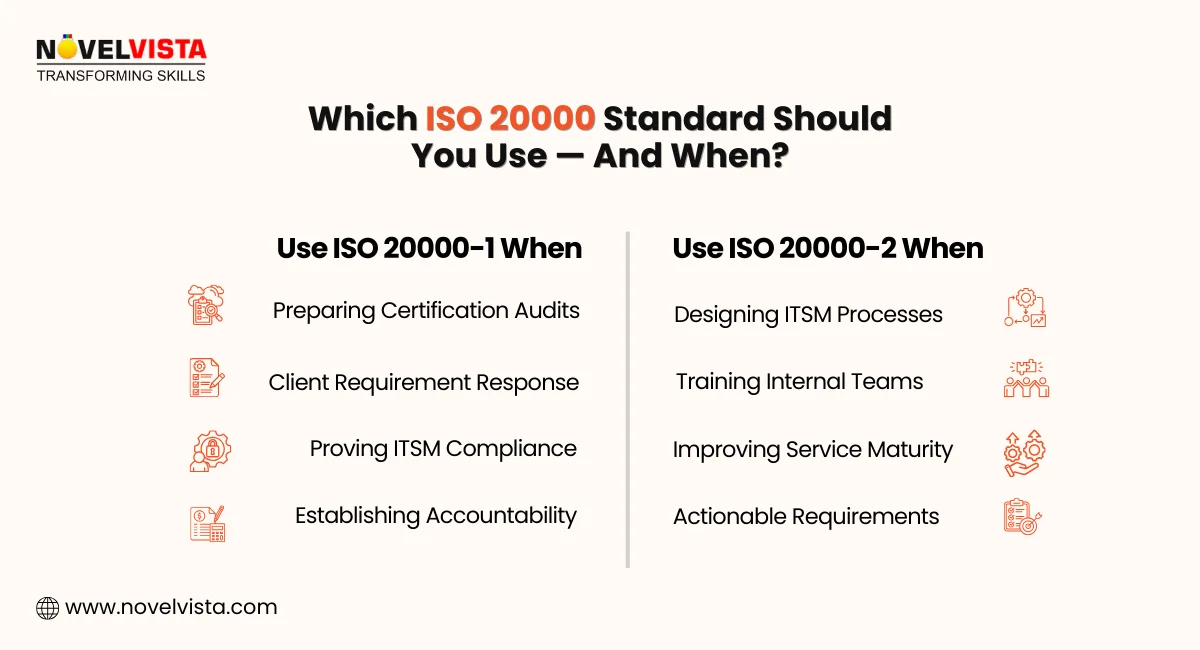
ISO 20000-1 vs ISO 20000-2: When Should You Use Which?

Knowing when to use each standard avoids wasted effort and audit surprises.
Which ISO 20000 Standard Should You Use — And When?When ISO 20000-1 is essential

  • Certification and surveillance audits: Auditors assess only ISO 20000-1 requirements. Evidence must map directly to clauses in ISO 20000-1, not guidance notes.
     
  • Client contracts and tenders: Many RFPs explicitly require ISO 20000-1 certification as proof of service maturity and reliability.
     
  • Compliance-driven environments: Regulated industries rely on ISO 20000-1 to demonstrate consistent service management controls.

When ISO 20000-2 adds value

  • SMS design and rollout: During early implementation, ISO 20000-2 helps teams understand what “good” looks like without overcomplicating processes.
     
  • Internal training and awareness: It’s useful for educating teams on the intent behind requirements rather than forcing checklist-based compliance.
     
  • Process improvement initiatives: Organizations use ISO 20000-2 to refine workflows while staying aligned with ISO 20000-1 controls.

Most mature organizations use both together: ISO 20000-1 as the compliance backbone and ISO 20000-2 as the implementation guide. This balanced approach avoids the common mistakes seen during audits and strengthens long-term ITSM maturity.

ISO 20000-1 vs ISO 20000-2 Auditor Decision Guide

Get clear on what auditors can and cannot raise findings on. Understand requirements vs guidance, reduce audit stress, 
and avoid unnecessary over-documentation.

ISO 20000-1 vs ISO 20000-2 in Real-World Audits

This is where theory meets reality, and where many teams get confused.

In real audits, lead auditors always assess ISO 20000-1, not ISO 20000-2. That’s because ISO 20000-1 contains the actual requirements that must be met for certification.

Here’s how both are used correctly during audits:

  • ISO 20000-2 is used before the audit, during preparation: Teams rely on ISO 20000-2 to understand intent, design processes, and interpret requirements. It helps answer the “how should we do this?” question while building the ITSM system.
     
  • ISO 20000-1 is used during the audit, for evidence: Auditors look for documented processes, records, performance data, and improvement actions that directly map to ISO 20000-1 clauses.

A practical example:

  • A service provider designs Incident Management using guidance from ISO 20000-2.
     
  • During the audit, the auditor checks ISO 20000-1 to verify:
     
    • Incident processes exist
       
    • SLAs are met
       
    • Incidents are tracked, reviewed, and improved

This is why understanding the difference between ISO 20000-1 and ISO 20000-2 is so important for audit success. One prepares you. The other validates you.

The audit practices described here reflect industry-standard approaches used by certification bodies. We teach auditors to distinguish between evidence that supports ISO 20000-1 compliance versus advisory suggestions in ISO 20000-2, helping teams focus on what auditors will actually check.

How ISO 20000-1 and ISO 20000-2 Work Together in Implementation

Strong ITSM implementations rarely rely on just one document.
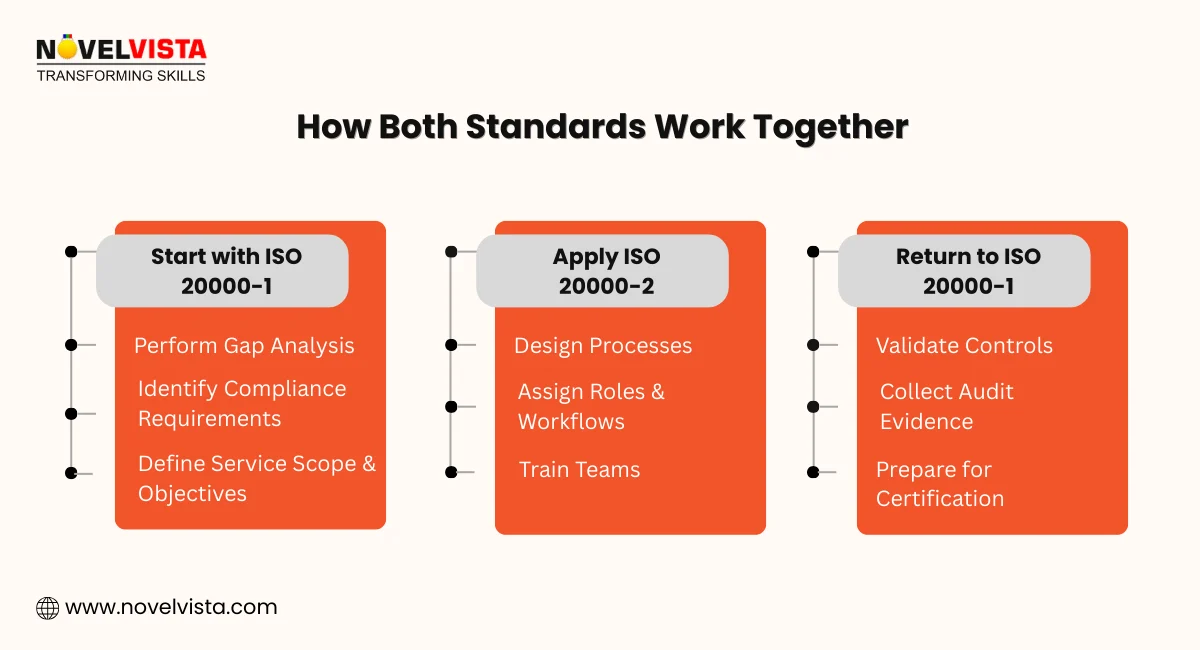
How Both Standards Work TogetherMost mature organizations use ISO 20000-1 and ISO 20000-2 together, each for what it does best.

A common and effective approach looks like this:

  • Start with ISO 20000-1
     
    • Perform a gap analysis against clauses 4–10
       
    • Identify missing controls, unclear ownership, or weak monitoring
       
    • Set certification and audit goals
       
  • Use ISO 20000-2 as the playbook
     
    • Design processes using practical examples
       
    • Decide what documentation is “enough”
       
    • Align roles, tools, and workflows realistically
       
  • Align with ITIL practices
     
    • ISO 20000-2 naturally maps to ITIL guidance
       
    • This improves operational maturity while still meeting ISO requirements

This combined use avoids two common extremes:

  • Bare-minimum compliance that fails audits later
     
  • Over-engineered systems that teams don’t actually use

When used correctly, ISO 20000-1 vs ISO 20000-2 stops being a debate and becomes a balanced strategy.

Explore proven ways to get ISO 20000 right the first time. Read our comprehensive guide on ISO 20000 Implementation Best Practices to see what works in real environments and how to avoid common mistakes

Common Mistakes Organizations Make Between ISO 20000-1 and ISO 20000-2

Many audit issues don’t come from a lack of effort, but from a misunderstanding roles of the standards.

Here are mistakes auditors see again and again:

  • Treating ISO 20000-2 as mandatory: Teams assume every example or suggestion must be implemented, leading to unnecessary complexity and wasted effort.
     
  • Over-documenting processes: Guidance is mistaken for requirements, resulting in long documents that add no audit or operational value.
     
  • Ignoring ISO 20000-1 wording: Some teams rely only on ISO 20000-2 and fail to meet specific “shall” requirements in ISO 20000-1.
     
  • Arguing guidance during audits: Organizations try to justify gaps by referencing ISO 20000-2, which auditors cannot accept as audit evidence.

The mistakes listed here are based on repeated audit findings we’ve seen across multiple industries. Highlighting them is intended to help teams avoid wasted effort and audit penalties. Our training emphasizes these pitfalls to prepare organizations for smoother certification journeys.

Avoiding these mistakes starts with clarity on the difference between ISO 20000-1 and ISO 20000-2 and using each standard for its intended purpose.

Conclusion: ISO 20000-1 or ISO 20000-2 – What Really Matters?

Both standards matter—but not in the same way.

  • ISO 20000-1 is non-negotiable for certification, audits, and external credibility.
     
  • ISO 20000-2 is a powerful support tool that helps teams implement ISO 20000-1 in a practical, realistic way.

The smartest organizations don’t choose one over the other. They use ISO 20000-1 and ISO 20000-2 together, requirements for assurance, guidance for sustainability.

Once this distinction is clear, ITSM teams and auditors stop struggling and start building systems that actually work.

This guidance is grounded in the ISO 20000 standards, audit practices, and practical experience from helping organizations implement and certify ITSM systems. Following this approach ensures compliance, operational efficiency, and long-term sustainability in IT service delivery.

Become A Certified ISO 20000 Lead Auditor And Strengthen Your ITSM Audit Authority

Next Step: Become an ISO 20000 Lead Auditor

If you want to confidently audit, implement, or guide ISO 20000 programs, NovelVista’s ISO 20000 Lead Auditor Certification Training is the right next move. The course focuses on real audit scenarios, clause-level understanding, and practical interpretation of ISO 20000-1, while showing how ISO 20000-2 supports implementation. You’ll gain the skills to assess ITSM systems accurately and add real value during audits, not just check boxes.

Frequently Asked Questions

The main purpose of ISO 20000-1 is to define mandatory requirements for establishing, implementing, maintaining, and continually improving an IT Service Management System (ITSMS). It is the auditable standard organizations use to demonstrate formal compliance with IT service management best practices.
ISO 20000 is a certifiable international standard with defined requirements, while ITIL is a best-practice framework that provides guidance on how to manage IT services. Organizations get certified against ISO 20000, whereas ITIL is used to design and improve service management practices.
ISO 20000-1 specifies what requirements must be met to achieve certification, whereas ISO 20000-2 provides practical guidance on how to implement and interpret those requirements. ISO 20000-1 is mandatory for audits, while ISO 20000-2 is advisory.
ISO 20000-2 is not mandatory for certification, but it is widely used as a reference during implementation. Many organizations and lead auditors rely on ISO 20000-2 to better understand intent, controls, and acceptable approaches to meeting ISO 20000-1 requirements.
Lead auditors often use ISO 20000-2 as a supporting guideline to interpret requirements, assess implementation maturity, and evaluate conformity. While audit decisions are based strictly on ISO 20000-1, ISO 20000-2 helps ensure consistent and practical audit judgments.

Author Details

Mr.Vikas Sharma

Mr.Vikas Sharma

Principal Consultant

I am an Accredited ITIL, ITIL 4, ITIL 4 DITS, ITIL® 4 Strategic Leader, Certified SAFe Practice Consultant , SIAM Professional, PRINCE2 AGILE, Six Sigma Black Belt Trainer with more than 20 years of Industry experience. Working as SIAM consultant managing end-to-end accountability for the performance and delivery of IT services to the users and coordinating delivery, integration, and interoperability across multiple services and suppliers. Trained more than 10000+ participants under various ITSM, Agile & Project Management frameworks like ITIL, SAFe, SIAM, VeriSM, and PRINCE2, Scrum, DevOps, Cloud, etc.

Enjoyed this blog? Share this with someone who'd find this useful

Confused About Certification?

Get Free Consultation Call

Sign Up To Get Latest Updates on Our Blogs

Stay ahead of the curve by tapping into the latest emerging trends and transforming your subscription into a powerful resource. Maximize every feature, unlock exclusive benefits, and ensure you're always one step ahead in your journey to success.

Topic Related Blogs