- Understanding Continual Improvement in ISO 20000
- Role of Continual Improvement in ISO 20000
- PDCA Cycle Behind Continual Improvement in ISO 20000
- The 7-Step Improvement Method Used in ISO 20000
- Key Sources That Drive Continual Improvement in ISO 20000
- Improvement Policy and Objectives in ISO 20000
- How ITIL CSI Supports Continual Improvement in ISO 20000
- Benefits of Continual Improvement in ISO 20000 for Organizations
- Best Practices to Implement Continual Improvement in 2026
- Role of Lead Auditors in Supporting Continual Improvement
- Why ISO 20000 Lead Auditor Skills Strengthen Improvement Efforts
- Conclusion: Building Long-Term Improvement with ISO 20000
- Next Step: Boost Your Expertise with ISO 20000 Lead Auditor Training
Understanding Continual Improvement in ISO 20000
Continual improvement is about more than just addressing failures—it’s about creating a culture where every process, service, and procedure is constantly evaluated and enhanced. It ensures your SMS remains effective and responsive.
Key aspects include:
- Processes are effective and up to date: Continual improvement ensures workflows are regularly evaluated, updated, and refined to eliminate inefficiencies and align with changing business requirements.
- Services deliver real value to users: By enhancing services continuously, organizations ensure that customer expectations are met consistently, reducing downtime, improving satisfaction, and increasing trust in IT operations.
- Efficiency and alignment with business goals: Continual improvement helps organizations allocate resources smartly, reduce waste, and focus efforts on services that directly support strategic objectives and measurable outcomes.
Through our training sessions with ITSM teams across banking, healthcare, and retail sectors, we’ve seen how small, consistent improvements drastically reduce service disruptions. One participant shared that after applying Continual Improvement practices, their incident resolution time dropped by 30%, showing the practical benefits of structured continual improvement.
Role of Continual Improvement in ISO 20000
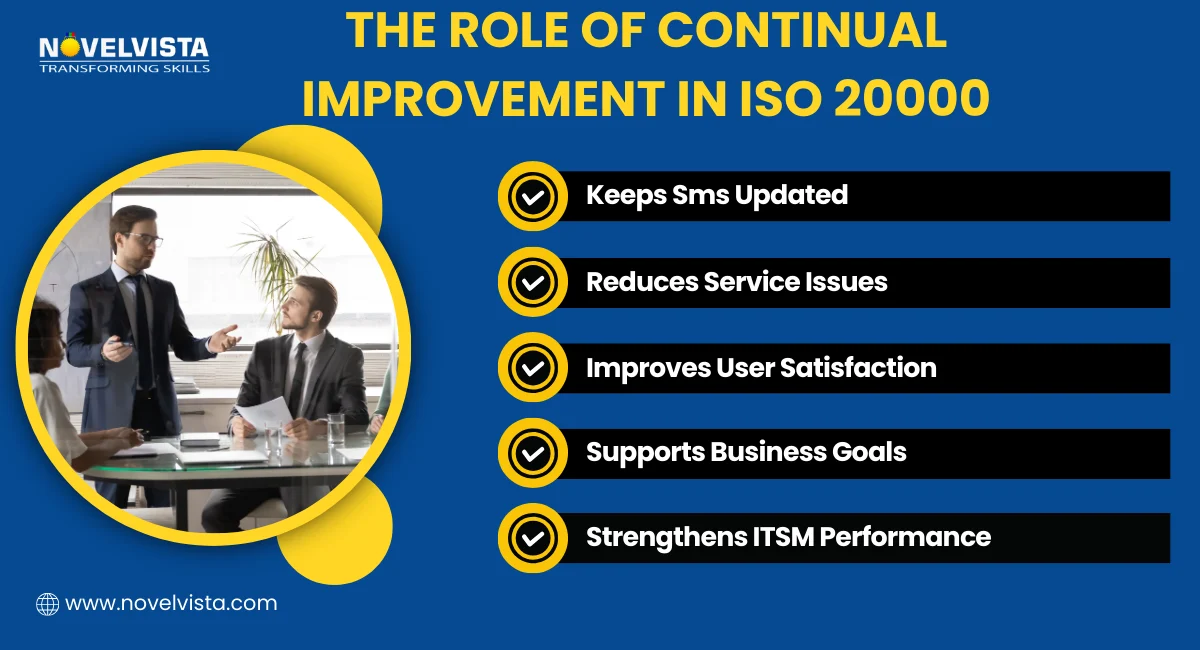
The role of continual improvement in ISO 20000 is to keep the SMS relevant, effective, and aligned with business goals. It moves beyond reactive problem-solving, embedding enhancement as a core part of the system.
Some of its key contributions include:
- Strengthening service quality: Continual improvement helps identify gaps in service delivery and allows teams to implement changes that enhance reliability, efficiency, and overall customer satisfaction.
- Enhancing customer satisfaction: By constantly reviewing services and acting on feedback, organizations can meet or exceed customer expectations, building trust and loyalty over time.
- Boosting operational efficiency: Improvement initiatives streamline processes, remove bottlenecks, and optimize resource use, resulting in faster, more predictable service outcomes.
- Creating a culture of ongoing enhancement: Encouraging every team member to participate in improvement activities fosters engagement, accountability, and a mindset focused on excellence and learning.
Through continual improvement, organizations ensure that services are not only maintained but are progressively refined to meet evolving requirements and industry standards.
PDCA Cycle Behind Continual Improvement in ISO 20000
The PDCA (Plan-Do-Check-Act) cycle is a fundamental tool that makes Continual Improvement in ISO 20000 systematic and measurable. It ensures that every improvement is planned, executed, monitored, and refined.
- Plan: Set specific improvement goals, understand service requirements, and map out processes that need enhancement. Planning ensures actions are strategic and aligned with business priorities.
- Do: Execute the planned improvements and deliver services according to the updated processes. This stage emphasizes practical implementation while ensuring minimal disruption to existing operations.
- Check: Monitor KPIs, perform audits, and analyze outcomes to determine if changes are meeting objectives. Checking ensures accountability and highlights areas that need further adjustment.
- Act: Apply corrections based on insights from the checking stage, refine processes, and standardize successful improvements across the SMS. Acting ensures that improvements are sustainable and repeatable.
Using PDCA creates a structured, continuous feedback loop where every step reinforces the SMS, promoting lasting operational excellence.
Learn more about the Plan-Do-Check-Act (PDCA) Model and how it drives continual improvement in management systems.The 7-Step Improvement Method Used in ISO 20000
ISO 20000 provides a 7-step method to make continual improvement actionable and trackable. Each step ensures improvements are deliberate, measured, and standardized.
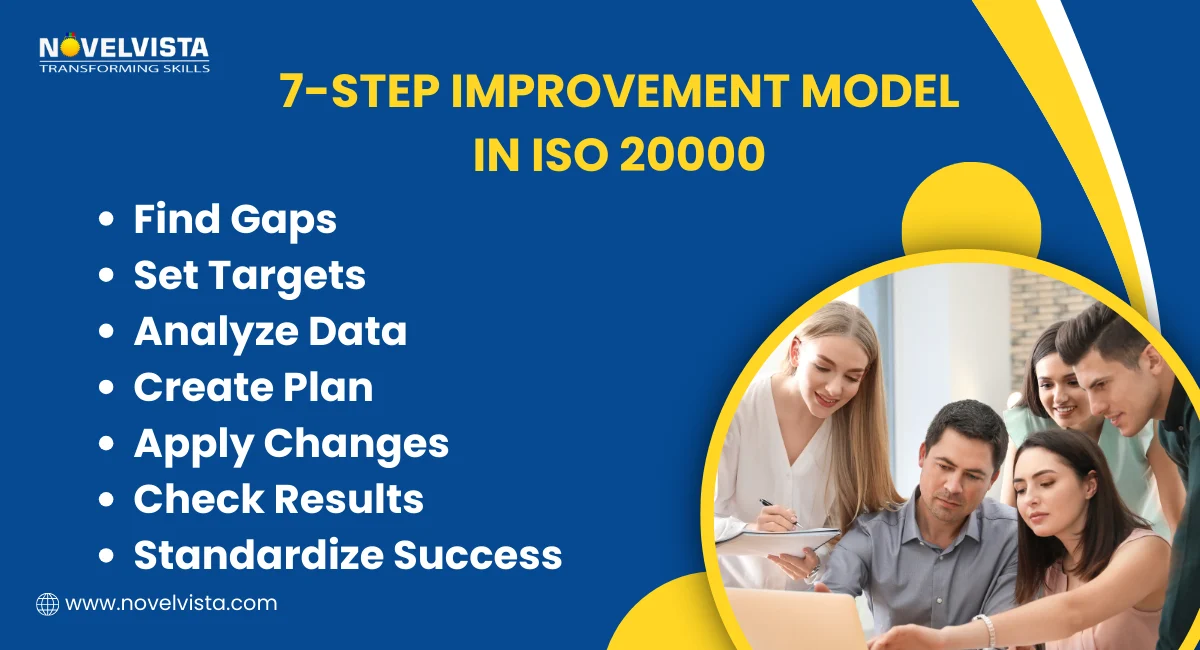
- Identify opportunities: Detect areas where services, processes, or workflows can be optimized. This includes spotting inefficiencies, recurring issues, or gaps between expected and actual performance.
- Set goals: Establish measurable objectives for each improvement initiative. Clear goals define what success looks like, ensuring all teams have a shared understanding of expected outcomes.
- Analyze current performance: Study existing processes and metrics to understand how services operate. Analysis highlights inefficiencies, resource gaps, and opportunities for significant enhancement.
- Plan updates: Design strategies and allocate resources for implementing improvements. Planning ensures that initiatives are feasible, cost-effective, and aligned with business priorities.
- Implement changes: Execute improvement actions according to the plan, monitoring progress closely to ensure minimal disruption and maximum effectiveness.
- Evaluate results: Compare outcomes with the set objectives, using metrics and KPIs to determine the effectiveness of implemented changes. Evaluation ensures accountability and learning.
- Standardize improvements: Incorporate successful changes into the SMS as standard practice. Standardization ensures that positive outcomes are consistent, repeatable, and scalable across the organization.
This method, combined with the PDCA cycle, ensures continual improvement is not an occasional activity but a structured, measurable, and repeatable process.
Key Sources That Drive Continual Improvement in ISO 20000
Improvement initiatives rely on real-world inputs that reveal how services perform and where enhancements are needed. Key sources include:
- Internal and external audits: Audits provide objective insights into compliance, process efficiency, and potential gaps, helping prioritize improvement actions.
- Service reviews: Regular reviews evaluate performance against targets, highlighting successes and areas needing refinement for optimal service delivery.
- Customer and employee feedback: Feedback captures experiences and expectations, offering practical insights that data alone may not reveal.
- Incident and problem reports: Recurring issues or service interruptions reveal weak points, guiding targeted corrective measures and preventive actions.
- Performance metrics and KPIs: Quantitative data tracks trends over time, identifies inefficiencies, and helps validate whether improvements achieve desired results.
By leveraging these sources, organizations can take informed, data-driven actions that improve service quality and operational effectiveness consistently.
Continual Improvement Idea Bank (50+ ITSM Improvements)
Get 50+ practical improvement ideas for Incident, Change, Problem, Capacity, and Availability Management, ready to
use instantly.
Improvement Policy and Objectives in ISO 20000
An improvement policy acts as a guiding framework for all enhancement activities. Clear objectives ensure that teams know what to achieve and how progress will be measured.
Key points include:
- Know what to aim for: Objectives provide a clear direction for improvement efforts, making it easier for teams to focus on high-impact actions.
- Track progress effectively: Measurable targets allow organizations to monitor improvement initiatives, ensuring accountability and timely adjustments.
- Align actions with business goals: Objectives connect operational enhancements with strategic priorities, ensuring that improvements contribute to overall business success.
A strong policy, backed by clear objectives, ensures that continual improvement is consistent, targeted, and measurable, forming the backbone of a mature SMS.
How ITIL CSI Supports Continual Improvement in ISO 20000
ITIL’s Continual Service Improvement (CSI) framework complements ISO 20000 by providing structured guidance to enhance service quality over time. It helps organizations align processes, reduce costs, and improve customer satisfaction consistently.
Key contributions include:
- Better service quality: CSI identifies performance gaps and improvement opportunities, ensuring that services are consistently refined, reliable, and aligned with user expectations.
- Reduced operational cost: By streamlining processes and eliminating inefficiencies, CSI reduces resource wastage, lowers operational expenses, and improves ROI on IT service management initiatives.
- Improved customer satisfaction: Continuous analysis of service performance allows teams to implement enhancements that meet customer needs, build trust, and strengthen long-term relationships.
ITIL CSI has been globally recognized as best practice for service improvement. We integrate ITIL guidance with ISO 20000 teaching, so learners gain both compliance knowledge and operational insights. Integrating ITIL CSI with ISO 20000 ensures that continual improvement is both systematic and outcome-focused, turning feedback into actionable enhancements.
Explore ITIL Continual Service Improvement for ITIL-specific practices and tips to enhance your service management processes.Benefits of Continual Improvement in ISO 20000 for Organizations
Implementing Continual Improvement in ISO 20000 brings tangible benefits across service delivery and organizational performance:
- Stronger service consistency: Continuous refinement ensures that services are predictable, reliable, and delivered according to defined standards, reducing downtime and service interruptions.
- Reduced operational issues: Regular monitoring and improvements help prevent recurring incidents, minimize errors, and maintain smooth service operations without unnecessary disruption.
- Improved risk control: By identifying gaps and weaknesses early, organizations can proactively address potential risks, ensuring compliance and minimizing negative business impact.
- Better alignment with business goals: Improvements are guided by strategic objectives, ensuring IT services support overall business priorities and contribute to measurable outcomes.
These benefits create a resilient, high-performing SMS that adapts to changing needs while maintaining service excellence.
Best Practices to Implement Continual Improvement in 2026
To make continual improvement effective, organizations should follow structured practices that prioritize impact, accountability, and learning:
- Use an improvement register: Maintain a centralized record of all improvement initiatives, tracking progress, outcomes, and responsible owners for better visibility and coordination.
- Prioritize high-value actions: Focus on improvements that deliver the greatest benefit in terms of efficiency, customer satisfaction, and alignment with business goals.
- Assign ownership: Clearly allocate responsibilities for each improvement activity to ensure accountability, timely execution, and consistent follow-through across teams.
- Track KPIs: Regularly measure and analyze key performance indicators to validate the effectiveness of improvements and make data-driven adjustments when necessary.
- Document lessons learned: Record successes, failures, and insights from each improvement initiative to inform future efforts and avoid repeating past mistakes.
- Link improvements to management reviews: Integrate improvement outcomes into regular management discussions to reinforce strategic alignment and support decision-making.
Following these best practices helps organizations build a disciplined, measurable, and effective continual improvement process.
Role of Lead Auditors in Supporting Continual Improvement
Lead auditors play a critical role in guiding continual improvement efforts within ISO 20000-compliant organizations. Their assessments highlight gaps and provide actionable insights to enhance service quality.
Key contributions include:
- Identifying improvement opportunities: Auditors review processes, KPIs, and records to pinpoint areas where enhancements can increase efficiency and effectiveness.
- Validating evidence: They verify that improvement initiatives are supported by accurate documentation and objective data, ensuring credibility and reliability of actions.
- Reviewing performance trends: Auditors analyze historical data and trends to detect recurring issues or potential risks, informing proactive improvement strategies.
- Ensuring effective implementation: They confirm that planned improvements are executed correctly and deliver the intended outcomes, supporting SMS maturity.
All insights shared in this blog come from 10+ years of accredited ISO 20000 Lead Auditor training, real-world case studies, and verified audit findings. Our approach ensures learners gain actionable knowledge they can trust to implement continual improvement effectively in any ITSM environment.
Why ISO 20000 Lead Auditor Skills Strengthen Improvement Efforts
Having ISO 20000 lead auditor knowledge empowers teams to manage ITSM more effectively and drive continual improvement:
- Enhanced understanding of ITSM processes: Lead auditors know what compliance and quality standards entail, enabling teams to improve processes systematically.
- Better audit-driven insights: Auditors can analyze findings to identify high-impact improvements, aligning operational changes with business objectives.
- Improved service quality and compliance: Knowledgeable auditors ensure services are delivered according to standards, enhancing reliability and reducing risk exposure.
- Support for measurable outcomes: Lead auditor skills enable organizations to track performance objectively, ensuring improvement initiatives are evidence-based and effective.
These skills make continual improvement structured, consistent, and aligned with organizational priorities.
Conclusion: Building Long-Term Improvement with ISO 20000
Continual improvement is the backbone of a mature SMS. By applying structured methods, leveraging audits, and tracking measurable outcomes, organizations can enhance service quality, reduce risks, and maintain alignment with business objectives.
An effective continual improvement process ensures services remain reliable, efficient, and ready to adapt to evolving demands. It’s not just about compliance, it’s about building a culture of excellence.

Next Step: Boost Your Expertise with ISO 20000 Lead Auditor Training
A well-designed improvement process works best when teams understand audits, evidence evaluation, and performance monitoring. NovelVista’s ISO 20000 Lead Auditor Certification equips professionals with the skills needed to assess, improve, and manage a mature SMS confidently.
By learning audit techniques, evaluation methods, and improvement strategies, you’ll be ready to drive continual improvement, enhance service quality, and contribute to long-term organizational success. This training is the perfect next step for anyone aiming to lead ITSM excellence.
Frequently Asked Questions
Author Details
Mr.Vikas Sharma
Principal Consultant
I am an Accredited ITIL, ITIL 4, ITIL 4 DITS, ITIL® 4 Strategic Leader, Certified SAFe Practice Consultant , SIAM Professional, PRINCE2 AGILE, Six Sigma Black Belt Trainer with more than 20 years of Industry experience. Working as SIAM consultant managing end-to-end accountability for the performance and delivery of IT services to the users and coordinating delivery, integration, and interoperability across multiple services and suppliers. Trained more than 10000+ participants under various ITSM, Agile & Project Management frameworks like ITIL, SAFe, SIAM, VeriSM, and PRINCE2, Scrum, DevOps, Cloud, etc.
Course Related To This blog
ISO 20000:2018 Lead Auditor
Confused About Certification?
Get Free Consultation Call