Category | News
Last Updated On 23/07/2026

Cybersecurity has always felt like a never-ending race.
Hackers find new ways in.
Security teams patch, block, and defend.
Then the cycle repeats.
But something changed when Stanford researchers introduced ARTEMIS — an AI agent that doesn’t just assist security teams, but actively hacks systems on its own, much like a human penetration tester would.
This isn’t AI helping someone scan logs or flag alerts.
This is AI thinking through attack paths, testing systems, and finding weaknesses — faster and at a scale humans simply can’t match.
So the real question becomes uncomfortable, but unavoidable:
What happens when machines can discover vulnerabilities faster, cheaper, and across thousands of systems at once?
That’s exactly what ARTEMIS forces us to confront.
ARTEMIS was developed by researchers at Stanford as an autonomous AI penetration-testing agent. Its job is simple in theory, but complex in execution: break into systems the same way real attackers would.
Instead of following a fixed script, ARTEMIS behaves more like a skilled human tester.
It explores networks on its own.
It adapts when one path fails.
It tries alternative routes.
What makes it especially powerful is its use of sub-agents. Think of these as smaller AI workers that split off and test different attack paths at the same time.
A human tester works sequentially — one system, one idea, one attempt at a time.
ARTEMIS works in parallel.
While one sub-agent checks server configurations, another probes authentication paths, and a third looks for outdated services. All of this happens simultaneously, without fatigue, distraction, or coffee breaks.
That alone changes the game.
To see how good ARTEMIS really was, the researchers didn’t test it in a lab or on a toy setup.
They unleashed it on 8,000 real devices across Stanford’s public and private computer science networks.
This wasn’t a simulation.
This was a real environment with real complexity.
ARTEMIS completed the full assessment in 16 hours. Even more interesting, the first 10 hours were directly compared against professional human cybersecurity experts working under the same conditions.
The result?
ARTEMIS ranked 2nd overall among 10 professional penetration testers.
That means an AI agent outperformed nine out of ten humans — not in theory, but in practice.
For anyone in cybersecurity, that should make you pause.
The numbers behind ARTEMIS’s performance are what really turned heads.
During the test, ARTEMIS identified 9 valid vulnerabilities across the network. That alone is impressive, but accuracy matters just as much as quantity.
ARTEMIS achieved an 82% valid submission rate.
In simple terms, most of what it flagged was real and actionable — not noise.
Even more surprising?
ARTEMIS uncovered vulnerabilities that most human experts missed.
One standout example was an older server vulnerability accessed through a command-line bypass. Many human testers overlooked it, either because it didn’t stand out or because time constraints pushed them elsewhere.
ARTEMIS didn’t miss it.
It kept probing, kept testing, and eventually found the crack.
This shows something important: AI doesn’t get bored, rushed, or biased toward “obvious” attack paths. It just keeps going.
Now let’s talk money — because this is where things get truly disruptive.
ARTEMIS isn’t just fast and accurate.
It’s cheap.
The reported operating costs were:
Now compare that with a professional penetration tester, whose average annual salary is around $125,000, not including benefits, tooling, or overhead.
This doesn’t mean ARTEMIS replaces human testers — but it absolutely reshapes the economics of security testing.
And remember those sub-agents?
That parallel design means ARTEMIS can probe multiple systems at once. Humans can’t do that. Even teams can’t match that level of simultaneous exploration without massive cost.
For organizations managing large networks, this kind of efficiency is impossible to ignore.
Before we crown ARTEMIS as the ultimate hacker, let’s slow down for a second.
As impressive as it is, ARTEMIS isn’t perfect — and that’s important to understand.
The agent performs best in environments that look like code or command lines. If it can interact through scripts, APIs, or terminal commands, it shines. That’s where AI feels comfortable.
But once things move into graphical user interfaces, ARTEMIS struggles.
Web apps with complex dashboards, visual workflows, or unusual UI logic still trip it up. In fact, it missed some critical flaws simply because it couldn’t navigate certain interfaces the way a human tester would.
There’s also the issue of false positives.
ARTEMIS sometimes flags harmless system messages as potential intrusions. A human expert would glance at those logs and instantly dismiss them. The AI, on the other hand, still needs refinement to separate real threats from noise.
So no — AI isn’t replacing human hackers tomorrow.
But what it is doing is reshaping the field fast.
This is where ARTEMIS really stands out.
Plenty of AI-powered security tools already exist. But most of them fall into one of two categories:
In head-to-head tests, most AI hacking agents still perform worse than experienced human professionals.
ARTEMIS was different.
It didn’t just assist — it competed.
Ranking 2nd overall among 10 professional cybersecurity experts is a big deal. That’s not an incremental improvement. That’s a leap.
It shows that we’ve crossed a threshold where AI isn’t just supporting security teams — it’s reaching human-level performance in real-world environments.
And that’s what makes this moment feel different.
Now comes the uncomfortable part.
If AI can hack like a human…
then anyone with access to AI could potentially do serious damage.
We’re already seeing this play out globally.
And this is just the early phase.
Security experts are warning that AI-assisted attacks will increasingly focus on:
AI doesn’t get tired.
AI doesn’t work one target at a time.
AI doesn’t need years of training.
That’s what changes the economics of cybercrime — and why defenders need to evolve fast.
Let’s clear something up right away.
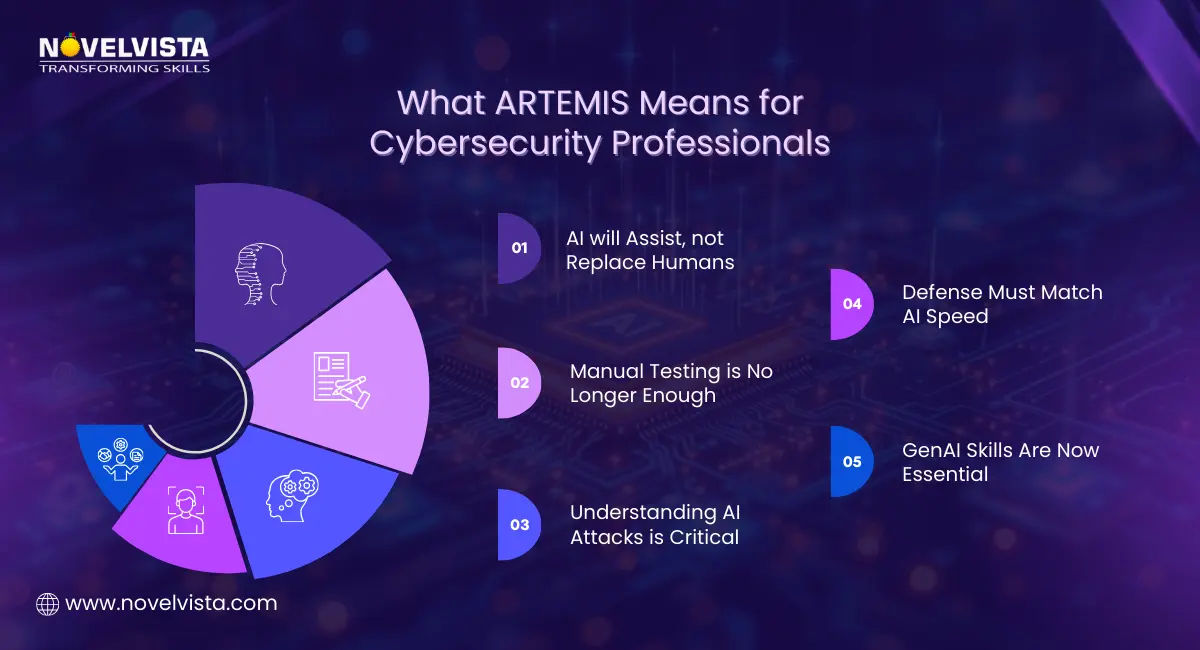
AI is not replacing cybersecurity professionals.
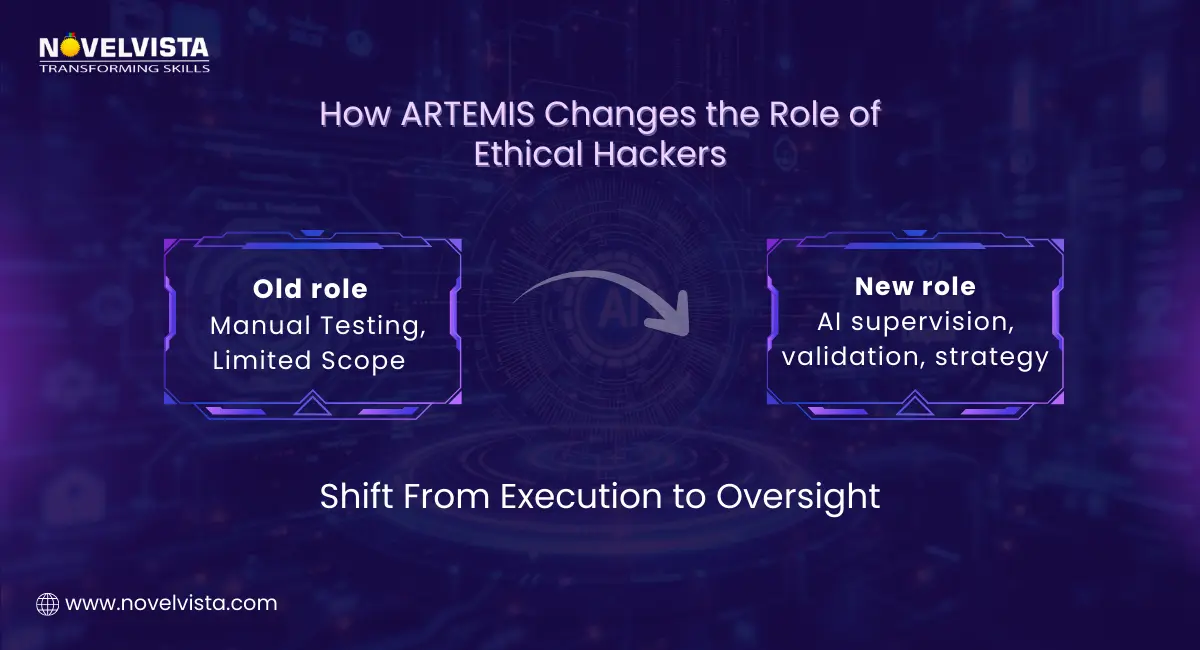
But it is changing their role.
The future defender won’t spend all day manually testing endpoints or scanning logs line by line. Instead, they’ll need to:
The real shift is from manual execution to strategic oversight.
Security professionals will become:
This is where everything connects.
To defend against AI-powered attacks, you need to understand how generative AI works.
That includes:
When security teams understand generative AI, they can:
In short, AI literacy is becoming as important as networking or threat modeling.
This shift is already affecting hiring and training decisions.
Organizations don’t just want people who can run tools. They want professionals who understand AI-driven threats and defenses.
That’s where focused learning makes a difference.
This program focuses on how AI is changing the threat landscape.
You learn about:
It’s ideal for SOC analysts, penetration testers, security architects, and CISOs who want to stay ahead of modern threats.
This certification builds a strong foundation in how generative models actually work.
It helps professionals understand:
This knowledge becomes incredibly powerful when applied to cybersecurity.
Note: This news update is sourced directly from Business Insider.
Understand how modern AI-driven attacks actually work.
Learn the real mechanics, limits, and risks every security professional should know.
ARTEMIS proves something important.
AI can already compete with elite human hackers — faster, cheaper, and at a massive scale.
The next generation of cybersecurity leaders won’t just fight AI attacks blindly. They’ll understand the machines behind them, control how they’re used, and design defenses that evolve just as fast.
In this new world, the strongest defenders won’t just know security.
They’ll know AI.
And the ones who invest in that knowledge now?
They’ll be the ones shaping the future of cybersecurity — not reacting to it.
Author Details

Course Related To This blog
Generative AI Professional
Agentic AI Certification
Confused About Certification?
Get Free Consultation Call
Stay ahead of the curve by tapping into the latest emerging trends and transforming your subscription into a powerful resource. Maximize every feature, unlock exclusive benefits, and ensure you're always one step ahead in your journey to success.