Category | News
Last Updated On 23/07/2026
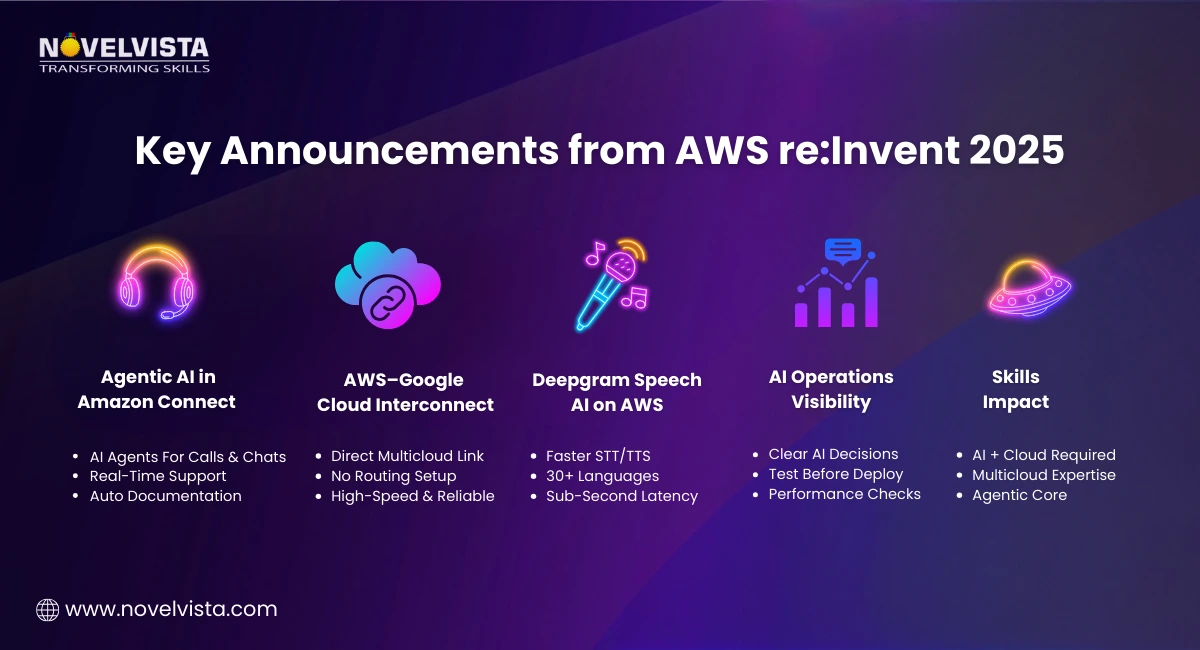
This year’s re:Invent didn’t just drop updates… it dropped bombs. And honestly, the cloud world needed this shake-up.
Every hallway conversation, every session, every keynote carried the same message:
AI is no longer an add-on in AWS… it is the platform now.
From agentic AI taking over customer service to multicloud becoming shockingly simple, AWS made it very clear that cloud engineers aren’t just building servers and pipelines anymore. They’re stepping into a world where AI is baked into every workflow, every API, every architecture decision.
And the numbers back it up.
Companies everywhere are asking for AI-ready cloud pros — people who understand how automation, LLMs, and agent-based systems work behind the scenes. After this week, the bar for AWS skills just shot up.
So let’s break down the announcements that are already creating waves for developers, architects, DevOps pros, and AI engineers.
Because these AWS AI updates aren’t just cool — they’re career-changing.
AWS didn’t just upgrade Amazon Connect this year…
They turned it into a full agentic AI powerhouse.
You could feel the excitement in the room when the demos rolled out — this wasn’t the usual “improved accuracy” or “faster model training” kind of update. Connect literally stepped into the future of customer service.
This is where everything gets wild.
Connect can now spin up AI agents that work across voice and messaging, and they don’t feel like chatbots at all. They act more like trained support staff who know your system, understand the conversation, and can take action in real time.
And Google isn’t the only one with fancy speech tech now.
AWS brought in:
So yes — your AI agent can speak naturally, understand accents, and switch languages without breaking a sweat.
But the biggest upgrade?
These AI agents can finally take on both simple and complex tasks.
Resetting passwords, checking orders, updating records, solving billing issues — all of it.
It feels like customer service has finally caught up with what users have been waiting for.
This is the “buddy-cop” style upgrade humans needed.
Connect now listens to live conversations, tracks sentiment, monitors intent, and steps in exactly when the agent needs help. Not after the call. During the call.
And the best part?
It can automatically handle backend tasks like:
So the human rep gets to focus on the human, while the AI handles the messy admin work.
Support teams basically get superpowers — higher capacity, better quality, and less burnout.
This one is a dream for sales and support teams.
Connect now uses:
…to recommend the right product or solution right inside the conversation.
Imagine:
“Hey, based on the customer’s past issue and current usage, offer this plan. It solves the problem and increases retention.”
This isn’t basic rule-based logic — it’s real AI-driven personalization designed to boost:
Your support team basically becomes your sales team without even trying.
AWS knew everyone would ask the same question:
“How do I trust the AI’s decisions?”
So they built full visibility into:
There’s even a testing sandbox so teams can validate flows before going live.
Plus automated performance scoring for both AI agents and human agents.
This is the missing piece that companies kept asking for.
Transparency + control = easier adoption.
This announcement got the loudest “Wait… WHAT?” reaction.
AWS and Google Cloud… in the same sentence… working together?
Yep.
Welcome to the new era of multicloud without pain.
AWS Interconnect now makes it stupidly easy to create high-bandwidth multicloud connections.
Right from the AWS Management Console or API, you can spin up a link to:
No manual routing.
No complex BGP drama.
No long paperwork.
AWS uses pre-built capacity pools, so the setup feels almost plug-and-play.
And they even published an open interoperability spec on GitHub, which is wild for an industry that loves vendor lock-in.
This move is going to change how architects design networks for years.
Here’s the reality:
Enterprises don’t want to be stuck with one vendor anymore — they want flexibility, resilience, and the ability to pick the best tool from each cloud.
This means engineers now need to understand:
If you’ve only learned AWS so far, this is your wake-up call.
Multicloud isn’t a future trend — it’s happening now.
Another huge win: Deepgram is now inside AWS.
This collaboration brings a whole new level of real-time speech intelligence across AWS services.
Deepgram now works natively with:
You get sub-second latency, which is perfect for:
The experience feels smoother, clearer, and 10x more natural than before.
Deepgram supports:
Plus, it became an AWS Generative AI Competency Partner and signed a Strategic Collaboration Agreement — meaning AWS is betting on it long-term.
This is AWS’s way of saying:
Voice AI isn’t just a feature… It's a core part of the future stack.
 If there’s one thing re:Invent 2025 made crystal clear, it’s this:
Cloud engineers are now AI engineers too — whether they planned for it or not.
Every service update, every keynote slide, every demo kept pointing to the same shift:
The job isn’t just about EC2, S3, and VPC anymore.
Now it’s about understanding how:
Roles like Cloud Developer, AWS Architect, AI Engineer, and DevOps Specialist are blending into one stack. The pros who learn to work with AI-driven systems will easily stay ahead.
Meanwhile, companies are actively hiring people who can:
The future AWS job description is already here — and these announcements prove it.
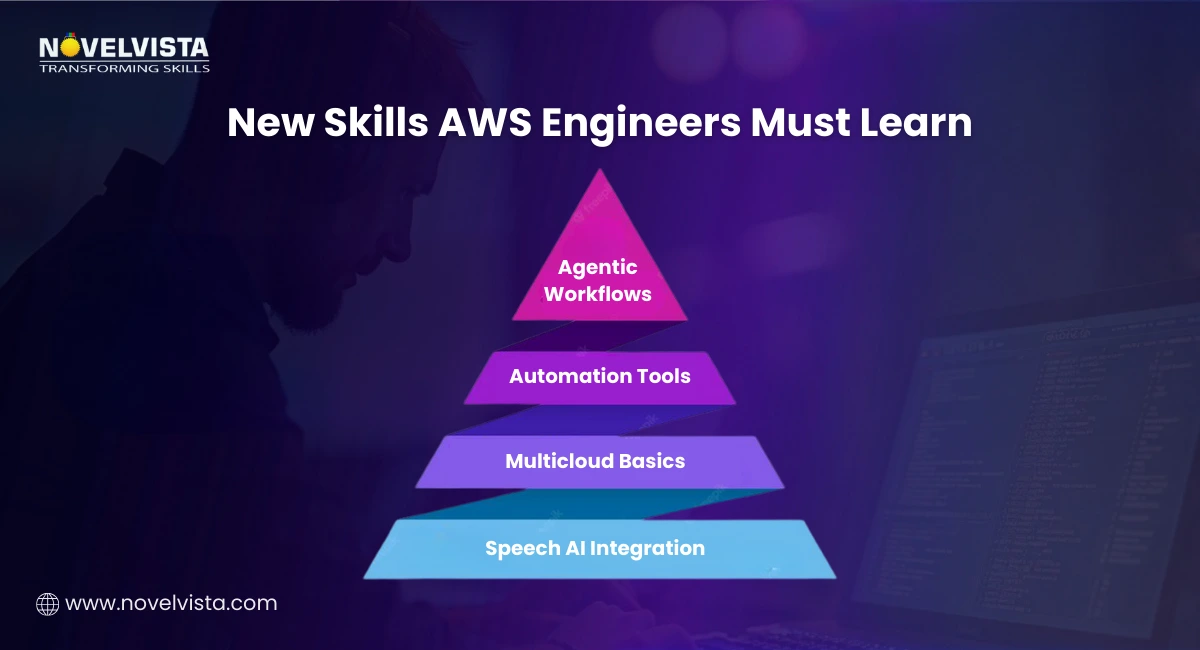 Here’s the truth many engineers don’t want to hear:
AWS is moving faster than most people’s skill sets.
And 2025 accelerated everything.
AI is now inside:
So if someone still relies on old-school AWS basics, they’re going to feel the gap widening.
Modern cloud engineers need to understand things like:
Companies are expecting cloud engineers to not just “use AI”…
But to understand how AI thinks — and how it makes decisions inside cloud infrastructure.
Without that understanding, projects become harder to deliver, and chances to lead bigger roles start slipping.
But the good news? The engineers who decide to upskill now will be the ones companies chase in 2026.
With all these changes happening at once, the smartest move is to follow a path that builds both AWS strength and AI strength.
Here’s the combination that fits perfectly with everything re:Invent 2025 just launched.
This one is still the most value-packed certification for cloud careers, and now it makes even more sense.
Why it fits the new landscape:
If someone’s aiming for roles like:
…this certification still provides the strongest foundation.
And with AWS adding agentic workflows everywhere, that foundation just became more important.
This one is the real game-changer.
Since Connect and other AWS services are now powered by agentic AI, engineers must understand:
This is no longer optional —
agentic systems are becoming the new automation layer inside cloud operations.
And companies need people who can build, manage, and troubleshoot these systems.
This certification is perfect for:
It teaches how AI works in the real world — not just the theory.
Put simply: AWS is going agentic.
Professionals who understand agentic AI will have a massive edge.
See the exact cloud + AI skills companies expect by 2026.
Identify your gaps, plan your upskilling, and stay ahead in an AI-first AWS job market.
 AWS re:Invent 2025 wasn’t just another event filled with feature updates.
It was a message — loud and clear — that the cloud is stepping into a new era where AI is baked into every corner of the ecosystem.
From Connect’s agentic workflows to multicloud networking to Deepgram-powered voice agents, AWS is building a future where cloud engineers don’t just deploy services… they design intelligent systems that think, act, and automate on their own.
And the professionals who learn these skills now will be the ones shaping the next wave of cloud innovation.
If you want to stay ahead, this is the right moment to explore the certifications that build those capabilities — AWS Solution Architect for cloud strength, and Agentic AI Professional for AI strength.
Because the future of cloud is already here. And it’s AI-first.
Author Details

Course Related To This blog
AWS Solution Architect Associates
Agentic AI Certification
Confused About Certification?
Get Free Consultation Call
Stay ahead of the curve by tapping into the latest emerging trends and transforming your subscription into a powerful resource. Maximize every feature, unlock exclusive benefits, and ensure you're always one step ahead in your journey to success.