Category | DevOps
Last Updated On 15/09/2026

If you’ve been exploring engineering career paths lately, you’ve probably noticed something interesting: the number of job postings mentioning reliability has grown by over 34% in the last three years, while demand for software engineers continues to remain strong across every major industry. And yet, most aspiring engineers struggle with one basic question — what’s the real difference between an SRE and an SWE?
That’s exactly why the conversation around SRE vs SWE has become so important. Many beginners, and even mid-level engineers, wonder:
If you’re a student, a fresher stepping into the tech world, a working professional planning a switch, or a leader trying to structure modern engineering teams, this guide will help you understand SRE vs SWE in the clearest, simplest way possible.
We’ll start by breaking down each role, then dive deeper into differences, overlaps, career paths, and how to choose the right trajectory for your future
An SRE (Site Reliability Engineer) sits at the intersection of software engineering and operations. Born out of Google’s engineering philosophy, SREs help teams maintain scalable, reliable, and highly available systems. While SWEs focus on building features, SREs make sure those features run smoothly in production, even under massive load.
A Software Engineer (SWE) is traditionally seen as the backbone of product development. They are the ones who design, build, and maintain software applications, ensuring that features function smoothly and deliver the right user experience.
SWE roles are usually more feature-focused and revolve around building the “what” in a product — what the user will see, what logic will run, and what problem the software solves.
This is where most people get confused, because both roles involve coding, architecture, problem-solving, and collaboration. But the mindset, purpose, and daily priorities of SRE vs SWE are different.
SWE owns the feature lifecycle.
SRE owns system health, resilience, efficiency, and reliability.
Throughout the tech industry, teams that understand sre vs swe distinctions are able to scale faster, ship features with more confidence, and maintain a reliable experience for millions of users.
Category |
SWE (Software Engineer) |
SRE (Site Reliability Engineer) |
Primary Focus |
A Software Engineer concentrates on designing and developing new features that directly enhance the product’s functionality and user experience. |
A Site Reliability Engineer focuses on ensuring that applications remain highly reliable, available, and resilient under real-world usage and production conditions. |
Core Responsibility |
SWEs build software components, write code, and improve functionality by implementing business requirements into working systems. |
SREs maintain production systems by automating operations, monitoring performance, and preventing outages through proactive reliability practices. |
Daily Work |
Their daily work primarily revolves around coding, debugging, feature planning, reviewing pull requests, and refining application logic. |
Their day-to-day tasks include managing on-call operations, tuning system performance, creating automation scripts, and handling incidents. |
Approach to Coding |
SWEs write code mainly to deliver features and ensure that new functionality meets user expectations and business goals. |
SREs write code to automate repetitive tasks, build tooling, improve system reliability, and reduce manual operational overhead. |
System Knowledge |
They require a good understanding of system design principles but usually focus more on the logical design of applications. |
They need a deep understanding of distributed systems, networks, containers, infrastructure, and how different components behave under load. |
Incident Handling |
SWEs participate in incident handling occasionally, usually when an issue is traced back to code they developed. |
SREs are responsible for structured incident response and are often the first to act when reliability issues affect users. |
Monitoring & Alerts |
Monitoring is generally a supporting activity for SWEs, used only when diagnosing issues or improving performance. |
Monitoring, alerting, dashboards, and reliability metrics are core elements of an SRE’s daily workflow. |
Infrastructure Involvement |
They interact with infrastructure mainly when their code needs specific environment support or configuration. |
They take ownership of infrastructure automation, capacity planning, performance tuning, and overall system scalability. |
Work Mindset |
SWEs think primarily in terms of feature delivery, system behavior, and product evolution. |
SREs think in terms of risk reduction, operational efficiency, system safety, and eliminating reliability gaps. |
Performance Focus |
Their performance improvements aim to make features run faster, smoother, or more efficiently for the end user. |
Their optimization efforts focus on maintaining system-level performance, reducing latency, and ensuring stable operations during peak loads. |
Tooling |
SWEs rely on IDEs, testing frameworks, version control, and CI/CD pipelines to ship clean and functional code. |
SREs work heavily with observability tools, automation frameworks, container orchestration platforms, and cloud management tools. |
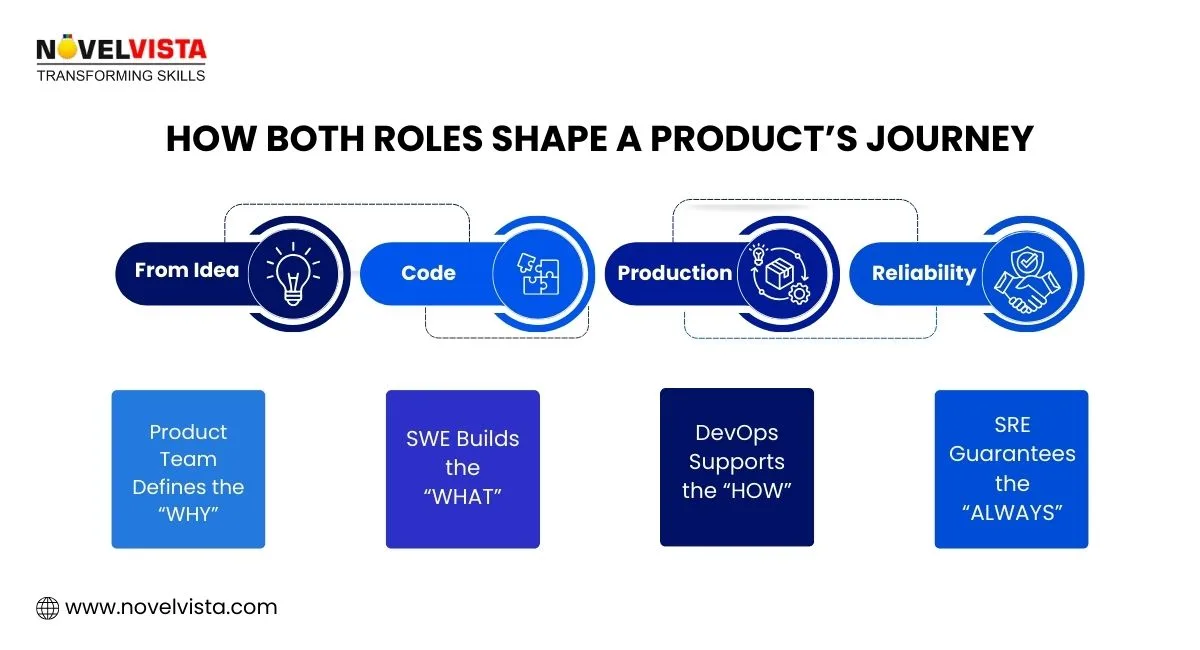
Even though SRE vs SWE roles are different, they are not competing; they are deeply complementary.
Modern engineering teams rely on SWE to build great products and on SRE to ensure those products consistently perform under real-world conditions. Understanding SRE KPI Metrics, like availability, latency, and error rates, helps bridge the gap between how software is built and how reliably it performs in production, reinforcing the core differences between SRE vs SWE.
This collaboration builds a strong DevOps culture, reduces friction, and speeds up releases without compromising reliability.
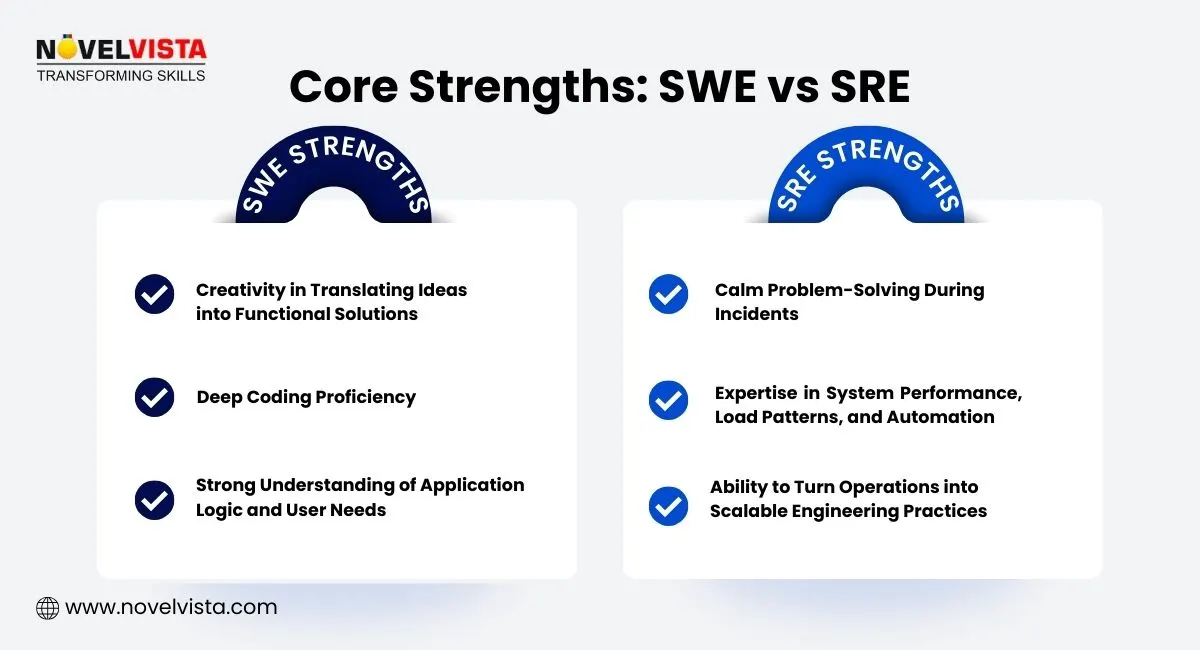
Choosing SRE vs SWE is easier when you evaluate your strengths:
Ask yourself:
No matter which route you choose, both swe vs sre paths offer exceptional opportunities.
Understanding SRE vs SWE isn’t just about comparing two job roles. It’s about recognizing how modern engineering teams function. SWE brings ideas to life. SRE keeps those ideas running at peak performance. Together, they create digital experiences that users trust.
If you’re exploring tech careers, take the time to identify your strengths, interests, and long-term goals. Whether you choose SWE vs SRE, both tracks offer growth, innovation, and the chance to build meaningful impact in the world of technology.
Join NovelVista’s SRE Foundation Certification Training and gain hands-on experience with SLOs, SLIs, automation practices, incident management, and modern reliability workflows. Designed for DevOps engineers, system administrators, and aspiring SREs, this program equips you with the real-world skills needed to build, maintain, and optimize highly reliable production systems.
Start your SRE journey today!

Author Details

Confused About Certification?
Get Free Consultation Call
Stay ahead of the curve by tapping into the latest emerging trends and transforming your subscription into a powerful resource. Maximize every feature, unlock exclusive benefits, and ensure you're always one step ahead in your journey to success.