Category | CLOUD and AWS
Last Updated On 05/02/2026
Cloud adoption is no longer a “future plan” it is the present reality. According to recent industry reports, global cloud spending is expected to cross $1 trillion annually by 2026, with AWS continuing to hold the largest market share. More than 90% of enterprises already use cloud services, and a significant portion of that workload runs on AWS. This rapid growth has created an undeniable shift in how IT careers evolve and at the center of it are AWS services.
So, who is this blog really for?
If you are a student planning a cloud career, a developer looking to move beyond traditional coding, an IT professional aiming to stay relevant, or even a manager trying to understand where cloud skills are headed, this guide is for you. With new services launching every year, knowing what to learn matters as much as knowing how to learn. Understanding which AWS services are trending in 2025–2026 can help you invest your time wisely and stay aligned with the AWS job market.
Let’s break it down in a way that’s practical, realistic, and grounded in what companies are actually using today.
The cloud landscape has matured. Organizations are no longer “experimenting” with AWS they are building mission-critical systems on it. From banking and healthcare to startups and government platforms, AWS has become core infrastructure. This is why AWS skills in demand are no longer limited to cloud engineers alone. Developers, security professionals, data analysts, and even auditors are expected to understand AWS technologies at a functional level.
Another major shift is the rise of automation, AI, and serverless architectures. Businesses want systems that scale automatically, recover quickly, and cost less to operate. AWS services are designed exactly for this purpose, which explains why job descriptions increasingly list multiple AWS tools as mandatory skills.
In short, learning AWS is no longer about “getting into cloud.” It’s about staying employable in a cloud-first world.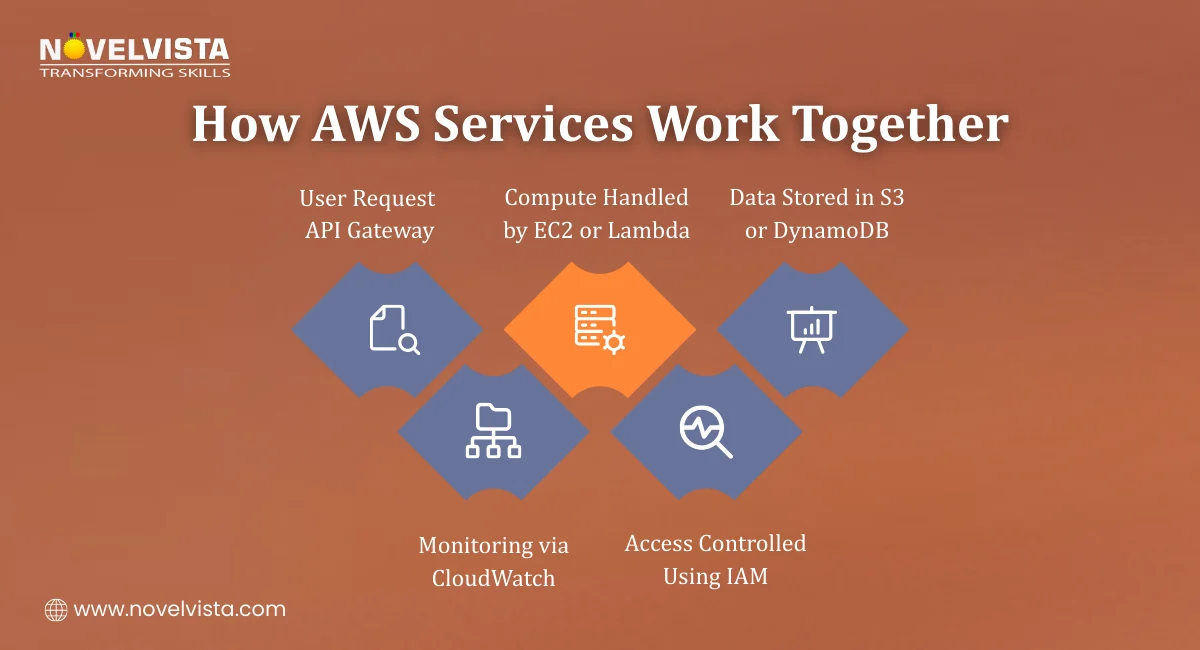
Not every AWS service becomes a must-learn skill. Some are niche, while others quietly fade away. The services that truly trend share a few common traits:
They solve real enterprise problems such as scalability, security, or cost optimization
They appear frequently in job descriptions
They integrate well with other AWS technologies
They support modern architectures like microservices, containers, and AI
The AWS services list for 2026 reflects how organizations are actually building systems not just what looks good on paper. This is why choosing the right AWS learning path is critical. Learning ten random services won’t help as much as mastering five that companies genuinely rely on.
Even after years of innovation, Amazon EC2 remains one of the most widely used AWS services. It forms the backbone of countless applications, especially where organizations need control over compute resources. Many enterprises still rely on EC2 for legacy workloads, custom environments, and high-performance applications.
For beginners, EC2 is often the first real exposure to how AWS works, including instances, security groups, storage, and networking. For experienced professionals, advanced EC2 concepts like auto scaling, load balancing, and cost optimization remain highly valuable. Regardless of your role, understanding EC2 is non-negotiable if you want strong AWS skills.
In 2026, EC2 expertise also means understanding AWS Graviton4 processors. Many organizations are actively migrating workloads to ARM-based instances because they deliver up to 40% better performance and significantly lower costs compared to traditional x86 instances. Knowing how to assess workload compatibility, plan migrations, and optimize applications for Graviton-based EC2 is now a top-tier cloud skill, showing mastery of cost-efficient, next-generation AWS infrastructure—not just legacy compute.
Serverless computing has moved from “interesting” to essential. AWS Lambda allows teams to run code without managing servers, which drastically reduces operational overhead. In 2025–2026, organizations are increasingly adopting event-driven architectures, and Lambda sits right at the center of this shift.
Developers love Lambda because it lets them focus purely on logic. Businesses love it because they only pay when code runs. This makes Lambda one of the most important AWS services for developers, especially for APIs, automation, and backend systems. While Lambda handles single tasks well, enterprise architectures in 2026 rely on AWS Step Functions to orchestrate multiple serverless workflows, with Lambda response streaming enabling real-time AI and event-driven results.
Amazon S3 might seem simple, but it is one of the most heavily used AWS services worldwide. From storing application assets to building massive data lakes, S3 plays a role in almost every cloud architecture.
As data volumes grow, S3 becomes even more critical. It integrates seamlessly with analytics, AI, and backup solutions. That’s why S3 consistently appears in every credible AWS services list for 2026. Understanding storage classes, lifecycle policies, and security settings adds serious depth to your AWS profile.
Databases remain at the heart of applications, but how they are managed has changed. Organizations increasingly prefer managed services like Amazon RDS and Aurora over traditional self-hosted databases. These AWS services handle backups, patching, and scaling automatically.
Professionals with database knowledge combined with AWS skills in demand are especially valuable. Whether you’re a developer or a cloud engineer, understanding how managed databases work in AWS significantly improves your ability to design reliable systems.
Containers are no longer reserved for large tech companies. Even mid-sized organizations are adopting Kubernetes for application deployment, and Amazon EKS makes this transition easier. EKS allows teams to run Kubernetes on AWS without managing the control plane.
As microservices architectures become standard, EKS skills are becoming a strong differentiator in the AWS job market. Developers and DevOps engineers who understand container orchestration are often preferred for modern cloud roles.
Security incidents continue to make headlines, and many of them are caused by misconfigured access controls. AWS Identity and Access Management (IAM) is one of the most critical yet underestimated AWS services.
Understanding IAM roles, policies, and permissions is essential for anyone working with AWS technologies. In 2026, security is no longer about firewalls but about identity-centric, Zero Trust architecture, making IAM the foundation of access control across AWS. As compliance and governance demands increase, IAM stands out as one of the most recession-proof cloud skills, not an optional add-on.
AI is no longer experimental in the cloud it is becoming operational. In 2026, the focus has moved from standalone AI models to AI agents that can reason, plan, and take action. Amazon Bedrock Agents enable organizations to build task-oriented AI systems that execute workflows, integrate with AWS services, and drive real business outcomes, not just answer questions. Alongside this, Amazon Q has emerged as the primary AI assistant for developers and architects, helping them troubleshoot, refactor, and optimize code directly within the AWS console. AI workloads are no longer add-ons; they are embedded into everyday cloud operations.
Professionals who combine AI awareness with cloud fundamentals stand out quickly. While not everyone needs to be an AI expert, familiarity with these AWS services signals future-ready thinking.
Not all professionals use AWS the same way. Developers often focus on services like Lambda, API Gateway, DynamoDB, and S3 to build applications quickly. Infrastructure and operations roles lean more toward EC2, VPC, IAM, and monitoring tools.
Understanding how AWS services connect across roles makes collaboration smoother and systems more resilient. This cross-functional knowledge is increasingly valued in the AWS job market. If you’re looking for a clear roadmap to AWS certification, understanding how these AWS services work together in real-world architectures is the first and most important step.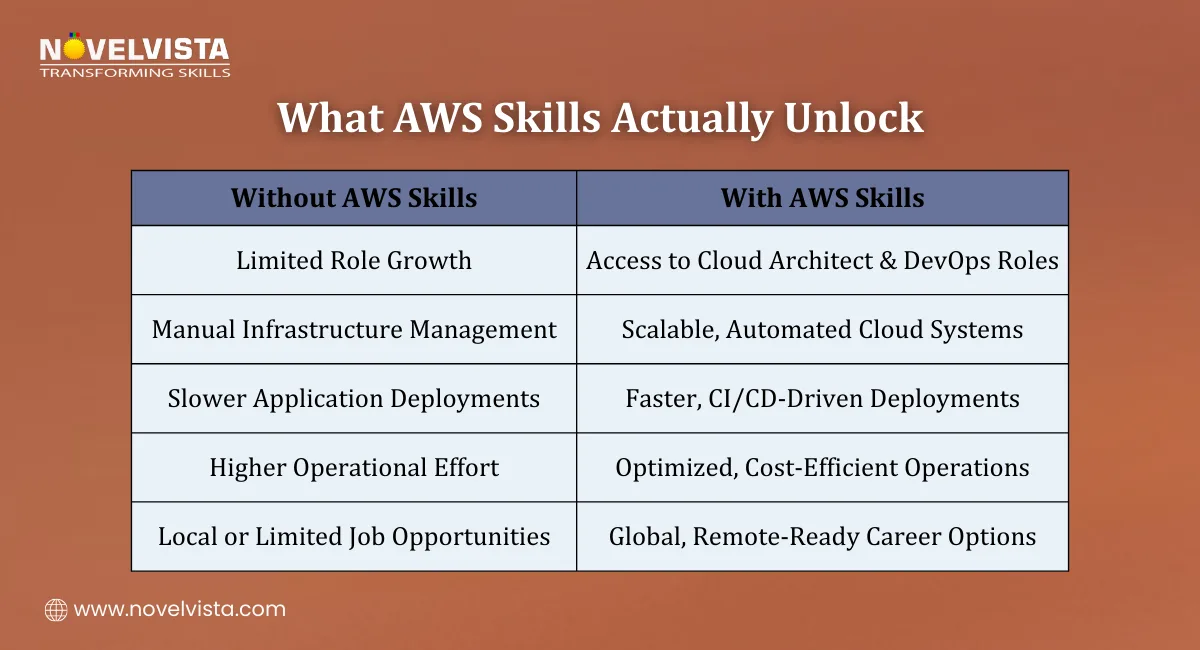
A common mistake is trying to learn everything at once. A better approach is to start with core AWS services: compute, storage, networking, and security, then move toward specialized areas like serverless, containers, or AI.
Hands-on practice matters more than theory. Real-world projects, labs, and troubleshooting experiences build confidence and make AWS skills truly usable. Certifications help, but only when paired with practical understanding. These evolving AWS services clearly reflect broader cloud computing trends, where scalability, automation, security, and AI-driven architectures are shaping how organizations build and operate modern systems.
Many learners jump straight into advanced AWS technologies without mastering the basics. Others rely too heavily on video content without practicing. Another frequent mistake is ignoring cost awareness, which is critical in real environments.
Avoiding these pitfalls helps you build skills that employers actually trust.
Sustainability is no longer a side conversation in cloud architecture; it is becoming a technical requirement. The Sustainability Pillar of the AWS Well-Architected Framework is now actively influencing design decisions across many enterprises. Teams are choosing services like Amazon S3 Glacier for long-term, energy-efficient storage and AWS Graviton-based instances for better performance per watt. These choices support Green IT and FinOps goals, helping organizations reduce both cloud costs and carbon footprints at the same time.
As we step into 2025–2026, one message stands out clearly: AWS services are shaping how modern technology careers are built, not just how systems are run. Organizations aren’t simply adopting AWS, they’re depending on it for scale, security, innovation, and speed. This is exactly why AWS skills are no longer a “nice to have,” but a long-term career asset.
Whether you’re entering cloud computing for the first time or sharpening your existing expertise, the choices you make in your AWS learning path will define your growth curve. The real advantage doesn’t come from knowing dozens of services it comes from mastering the AWS services that businesses actively use and trust.
Focus on depth over breadth. Build real-world experience. Understand how services work together, not in isolation. Do this consistently, and you won’t just keep up with the cloud landscape—you’ll stay ahead of it.
Ready to turn your AWS knowledge into real-world expertise?
If you’re serious about building strong, job-ready AWS skills, structured learning makes all the difference. NovelVista’s AWS Solutions Architect – Associate Certification Training is designed to help you understand core AWS services in depth, apply them to real architectural scenarios, and build hands-on experience that aligns with today’s AWS job market. Whether you’re starting your cloud journey or strengthening your existing skills, this course provides practical insights, industry-aligned training, and globally recognized credentials to support long-term career growth.
Start your AWS learning journey with confidence today.

Author Details

Course Related To This blog
AWS Solution Architect Associates
Confused About Certification?
Get Free Consultation Call
Stay ahead of the curve by tapping into the latest emerging trends and transforming your subscription into a powerful resource. Maximize every feature, unlock exclusive benefits, and ensure you're always one step ahead in your journey to success.