Category | CLOUD and AWS
Last Updated On 25/11/2025
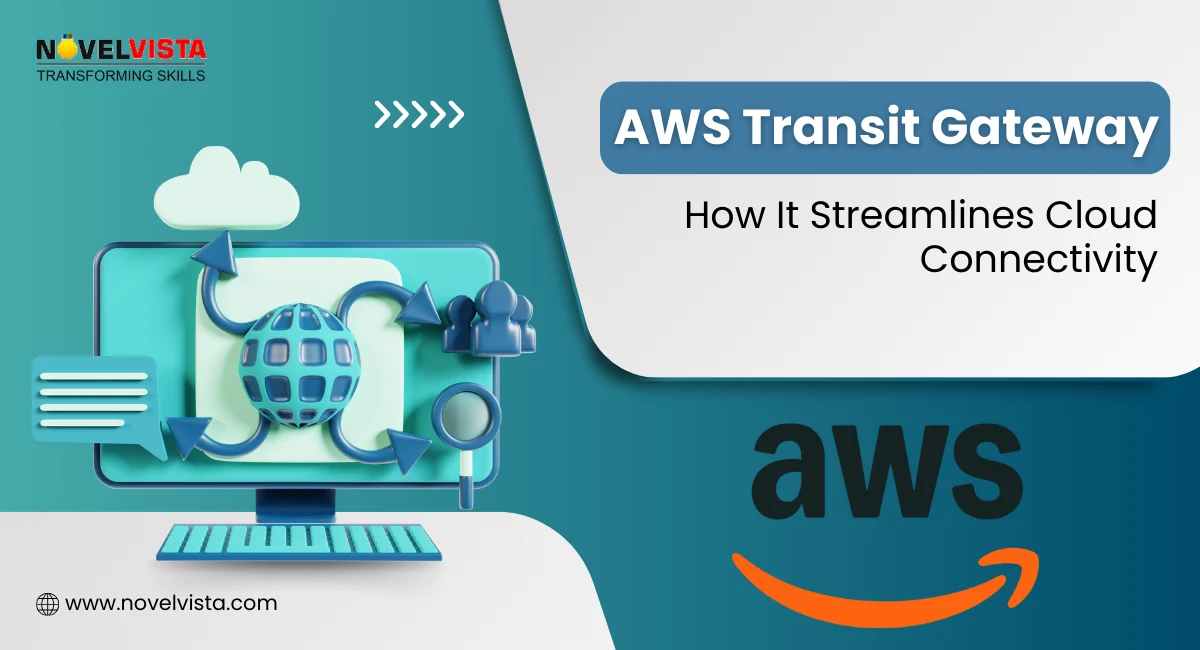
Managing multiple VPCs, connecting different AWS accounts, or linking on-premises networks can feel like untangling a web. That’s why understanding what is AWS Transit Gateway is a game-changer. AWS Transit Gateway (AWS TGW) acts as a central hub for your cloud network, letting VPCs, VPNs, and Direct Connect links communicate seamlessly without messy point-to-point peering.
For large-scale AWS networking, AWS Transit Gateway simplifies traffic flow, centralizes control, and gives platform teams better visibility. Whether you’re building multi-account environments or hybrid networks, this managed hub reduces complexity while improving reliability.
In this blog, we’ll explore Transit Gateway Architecture, why it’s a preferred VPC Peering Alternative, AWS Transit Gateway Best Practices, and how to configure AWS Transit Gateway effectively.
Traditional VPC peering works fine for small networks, but it quickly becomes a headache as you scale. Full-mesh connections are hard to manage, update, and secure. That’s where AWS TGW shines as a central hub and the go-to VPC Peering Alternative.
Here’s why teams prefer it:
Centralized Routing: All network traffic is routed through a single hub, eliminating complex point-to-point VPC peering. This ensures consistent, simplified routing policies across your cloud infrastructure.
Unified Policies: Routing, security, and inspection rules can be enforced centrally, reducing human error, saving administrative effort, and making policy updates much faster and more reliable.
Improved Visibility: Teams gain full insight into traffic patterns, latency, and bottlenecks across VPCs, accounts, and regions, enabling better monitoring, troubleshooting, and optimization decisions.
With AWS Transit Gateway, scaling networks no longer increases operational headaches and becomes far more manageable.
Choosing between Transit Gateway and traditional VPC peering depends on your network’s scale and complexity:
| Feature | Transit Gateway (TGW) | VPC Peering | Notes |
| Scalability | Handles hundreds of VPCs easily | Complex as VPCs grow | TGW suits large networks |
| Transitive Routing | Traffic flows between VPCs indirectly | Not supported | TGW allows centralized inspection |
| Multi-Account | Connects multiple accounts via one hub | Requires individual peering | Simplifies governance & monitoring |
| Centralized Inspection | Supports routing through inspection VPCs | Hard to manage | Easier security and compliance with TGW |
| Best Use | Large, multi-account, hybrid setups | Small, simple networks | TGW preferred for complexity |
For large estates, multi-account setups, or hybrid connectivity, AWS Transit Gateway is the preferred VPC Peering Alternative.
Also Read: Everything You Need to Know About Virtual Private Cloud (VPC)
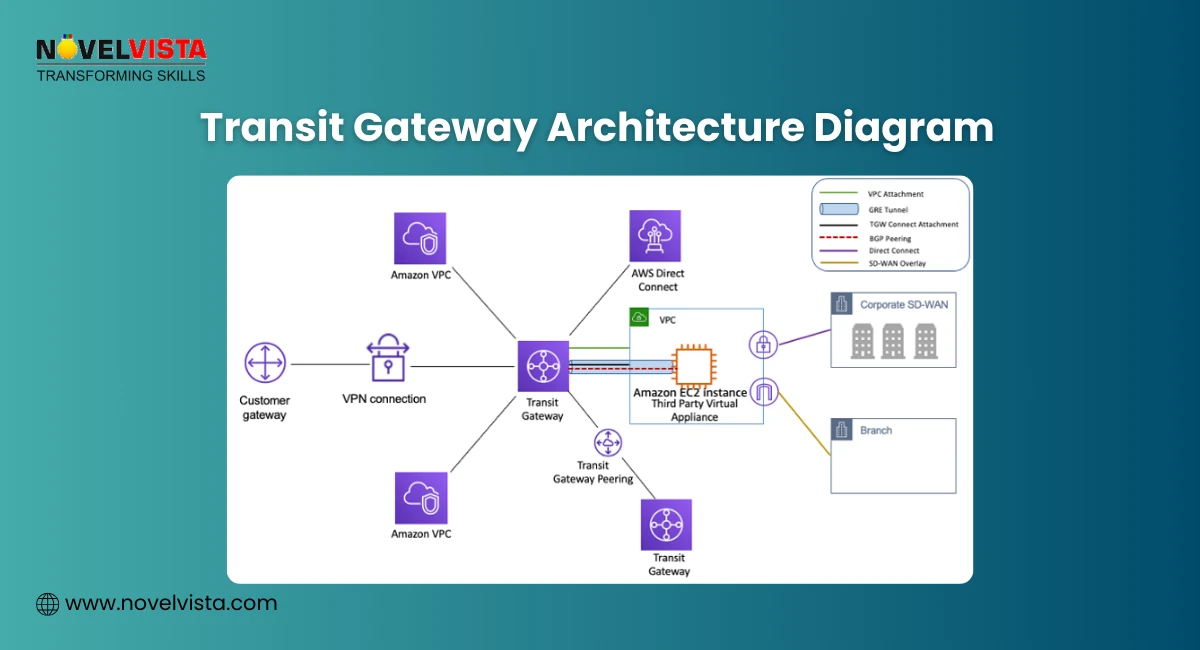 Understanding Transit Gateway Architecture is key to designing efficient and scalable cloud networks. Its main components include:
Attachments: Connect VPCs, VPNs, and Direct Connect links to the Transit Gateway. Attachments control which networks communicate and are associated with route tables for segmentation and isolation.
Route Tables: Transit Gateway Route Tables define how traffic flows between attachments, allowing granular control, segmentation, and propagation, making routing predictable across multiple VPCs and accounts.
Inter-Region Peering: Allows VPCs in different AWS regions to communicate seamlessly through the TGW, reducing latency and centralizing control across geographically distributed cloud deployments.
Cross-Account Sharing: Enables multiple AWS accounts to share the same AWS TGW, cutting down duplication and operational overhead while maintaining security and governance standards.
AWS Transit Gateway architecture aligns with AWS Well-Architected Framework guidelines for networking. AWS whitepapers highlight TGW’s ability to simplify transitive routing, support multi-region designs, and integrate hybrid connectivity securely. This makes it a recognized standard for large-scale cloud network deployments.
Extending your cloud network to on-premises or other cloud setups is straightforward with Hybrid Cloud Connectivity with Transit Gateway:
VPN Integration: Site-to-Site VPNs attach to AWS TGW, allowing secure connectivity for on-premises environments.
Direct Connect: High-bandwidth, low-latency connectivity with on-premises networks improves performance and reliability.
Global Designs: Multi-Region TGW peering enables scalable, cross-region architectures supporting hybrid and multi-cloud setups.
In multiple enterprise environments, integrating VPNs and Direct Connect with TGW significantly improved latency and reliability for hybrid applications. AWS’s own solution guides recommend these integrations, highlighting TGW as a key enabler for multi-region and multi-cloud architectures.
Managing multiple AWS accounts can get complicated fast. AWS Multi-Account Networking TGW simplifies this with central networking designs.
Central Networking Account: One account hosts the TGW and handles routing between all other accounts, reducing duplicated effort and improving visibility.
Shared-Services VPCs: Common services like DNS, logging, or security appliances are centralized, allowing every account to use them without complex peering.
Inspection VPCs: Security appliances or firewalls can inspect traffic passing between VPCs centrally, ensuring compliance and visibility.
Hub-and-Spoke Layout: Regional VPCs connect to a central hub, keeping architecture simple and scalable while maintaining segmented traffic flows.
This approach keeps multi-account AWS networking organized, secure, and easy to govern.
Learn how to set up multi-VPC connectivity
the easy way.
Follow clear steps to build a clean,
scalable AWS network without confusion.
Centralizing internet-bound traffic with TGW Centralized Egress simplifies management:
Central Egress VPC: Multiple VPCs forward outbound traffic through a single, controlled VPC for monitoring, inspection, or firewall enforcement.
Route Table Control: Transit Gateway Route Tables define which VPCs can use the egress and what policies apply, ensuring compliance and security.
Inspection Integration: Combine with security appliances for logging, threat detection, and traffic filtering without complex point-to-point configurations.
Centralized egress keeps security teams in control while reducing network complexity.
For complex networks, AWS TGW supports advanced scenarios:
Multi-Region Backbone: Peering TGWs across regions creates a global, high-availability network.
Middlebox Chaining: Route traffic through security, inspection, or logging appliances centrally.
Multicast Support: Enable multicast communication across VPCs for certain enterprise workloads.
Attachment Limits: Plan carefully to avoid exceeding TGW limits per region.
zoiAsymmetric Routing & MTU: Consider traffic symmetry and packet sizes for reliability and performance.
These advanced designs unlock full potential for enterprise-scale AWS networking.
Setting up AWS Transit Gateway doesn’t have to be complex. Here’s a step-by-step overview:
Create TGW: Launch a Transit Gateway in your desired region with the appropriate ASN.
Attach Networks: Connect VPCs, VPNs, and Direct Connect links as attachments.
Manage Route Tables: Create and configure Transit Gateway Route Tables, defining associations and propagations for each attachment.
Update VPC Routes: Ensure VPC route tables point to the TGW for correct traffic flow.
Validate & Monitor: Check connectivity, enable Flow Logs, and integrate with monitoring dashboards for visibility.
These steps align with AWS Transit Gateway Best Practices and keep multi-account, multi-VPC networks manageable.
Turning TGW setup into a stable operation requires structured workflows:
IaC Pipelines: Use Infrastructure as Code for repeatable, auditable deployments.
Tagging & Governance: Standardized tags and policies help track costs and enforce security.
CI/CD Integration: Automate changes to route tables and attachments alongside application deployment pipelines.
Account Onboarding: Establish clear rules for adding new VPCs, accounts, or regions.
Cost Monitoring: Track usage and optimize routing to avoid unnecessary traffic or duplicated resources.
Operationalization ensures your TGW environment scales safely and predictably.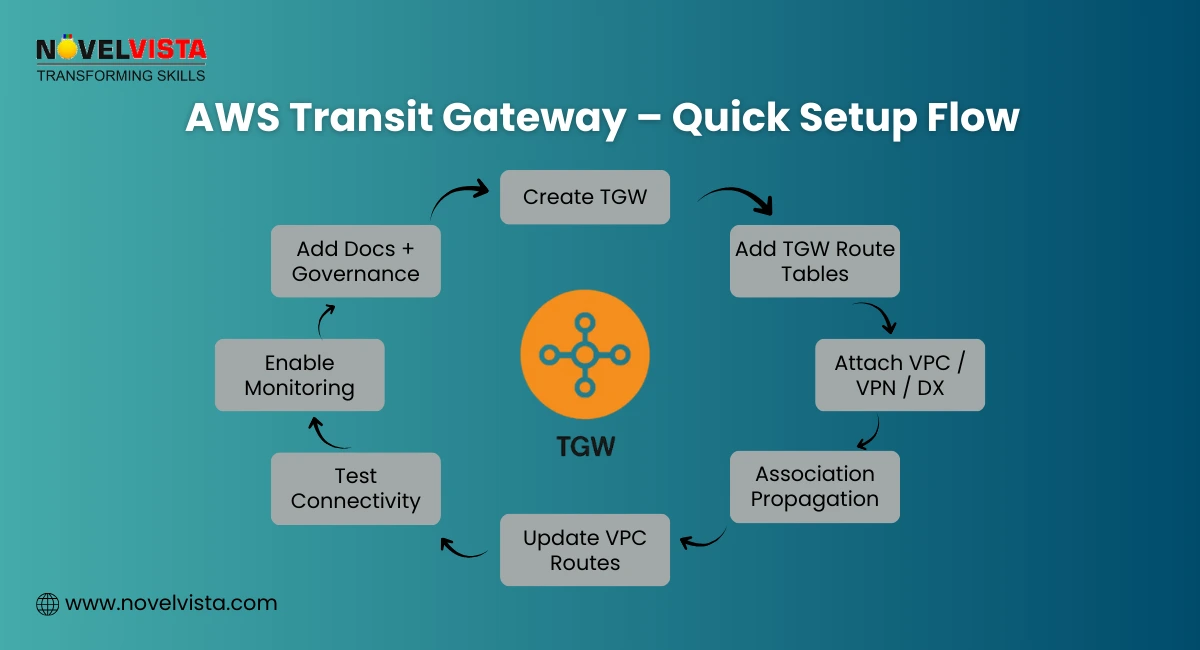
Following AWS Transit Gateway Best Practices ensures your network stays resilient, scalable, and manageable. Some key recommendations include:
Single TGW: Deploy one TGW per region to reduce complexity and improve operational efficiency. This helps teams manage routing and security centrally.
Minimal Route Tables: Limit the number of Transit Gateway Route Tables to reduce confusion and simplify traffic segmentation across attachments and accounts.
Unique ASNs: Assign unique ASNs for BGP connections to avoid conflicts and ensure smooth routing between on-premises networks and the cloud.
BGP with VPN/DX: Combine BGP with VPN or Direct Connect to ensure high availability and failover capabilities for hybrid connectivity scenarios.
Monitoring: Enable Flow Logs and CloudWatch to track traffic, detect anomalies, and maintain visibility into network performance.
Subnet & NACL Planning: Design subnets and NACLs thoughtfully to support security, redundancy, and predictable routing patterns across multiple VPCs.
Above these best practices is standard in professional cloud teams managing multi-account architectures. Implementing single TGWs per region, minimal route tables, and BGP-enabled hybrid connections has proven to reduce outages, simplify compliance, and make operational monitoring more reliable across global deployments.
AWS Transit Gateway transforms cloud networking by centralizing VPC connections, simplifying hybrid setups, and supporting multi-account environments. Its architecture, coupled with proper Transit Gateway Route Tables, advanced design patterns, and adherence to AWS Transit Gateway Best Practices, ensures networks are reliable, secure, and easy to manage.
By replacing complex full-mesh peering and enabling centralized egress, inspection, and routing, AWS TGW becomes the backbone of scalable AWS networking for modern enterprises.
Next Step
Take the next step in mastering AWS networking with NovelVista’s AWS Solution Architect Associate Certification. Learn to design, configure, and optimize AWS Transit Gateway, VPCs, and hybrid networks. Gain hands-on expertise, practical skills, and the confidence to architect secure, scalable cloud solutions, preparing you for real-world enterprise deployments and global certification recognition.

Author Details

Confused About Certification?
Get Free Consultation Call
Stay ahead of the curve by tapping into the latest emerging trends and transforming your subscription into a powerful resource. Maximize every feature, unlock exclusive benefits, and ensure you're always one step ahead in your journey to success.