Category | AI And ML
Last Updated On 16/12/2025
Salaries in tech don’t usually jump this fast, but highest paying generative AI jobs are breaking that pattern. Roles that barely existed a few years ago are now offering pay packages that compete with senior cloud and cybersecurity positions.
Companies are not experimenting anymore. They are building products, automating decisions, and redesigning workflows using Generative AI. To do that, they need people who can actually build, fine-tune, deploy, and scale AI systems, not just talk about them. That demand is directly pushing pay upward.
This blog gives you a clear view of:
Which highest paying generative AI jobs that exist today
How salaries differ by role, experience, and region
Why certifications and skills impact generative AI certification salary
How can your career grow long-term in this space
No hype, no buzzwords. Just real roles, real numbers, and real career paths.
Not all AI roles are paid equally. Some positions directly affect revenue, speed, and product quality, which is why they sit among the top generative AI job roles globally. Here’s how each role creates value and earns higher pay.
This role focuses on building and deploying GenAI models into real products, APIs, and platforms. Because they handle end-to-end implementation, companies reward them with strong compensation and growth opportunities.
Prompt Engineers design, test, and optimize prompts that control LLM behavior. Their work directly improves output quality, reduces errors, and lowers compute cost, making them valuable even without deep ML backgrounds.
Research scientists work on model architecture, training methods, and experimentation. Their role is crucial for innovation-heavy companies, which is why research positions often appear among the highest paying generative AI jobs.
AI Product Managers bridge business goals and AI systems. They decide how AI features are built, measured, and scaled, which makes their role central to revenue-driven AI products.
Consultants help enterprises adopt GenAI safely and effectively. They design use cases, governance models, and deployment strategies, often earning premium pay for their cross-domain expertise.
These professionals design scalable AI architectures across cloud platforms. Since poor design can mean massive cost overruns, companies pay well for architects who get it right the first time.
These roles reflect how companies structure real AI teams today. While training professionals across engineering, consulting, and product tracks, we consistently see higher compensation tied to roles that directly influence deployment speed, cost control, and AI output quality. These positions define the top generative AI job roles shaping salary trends worldwide.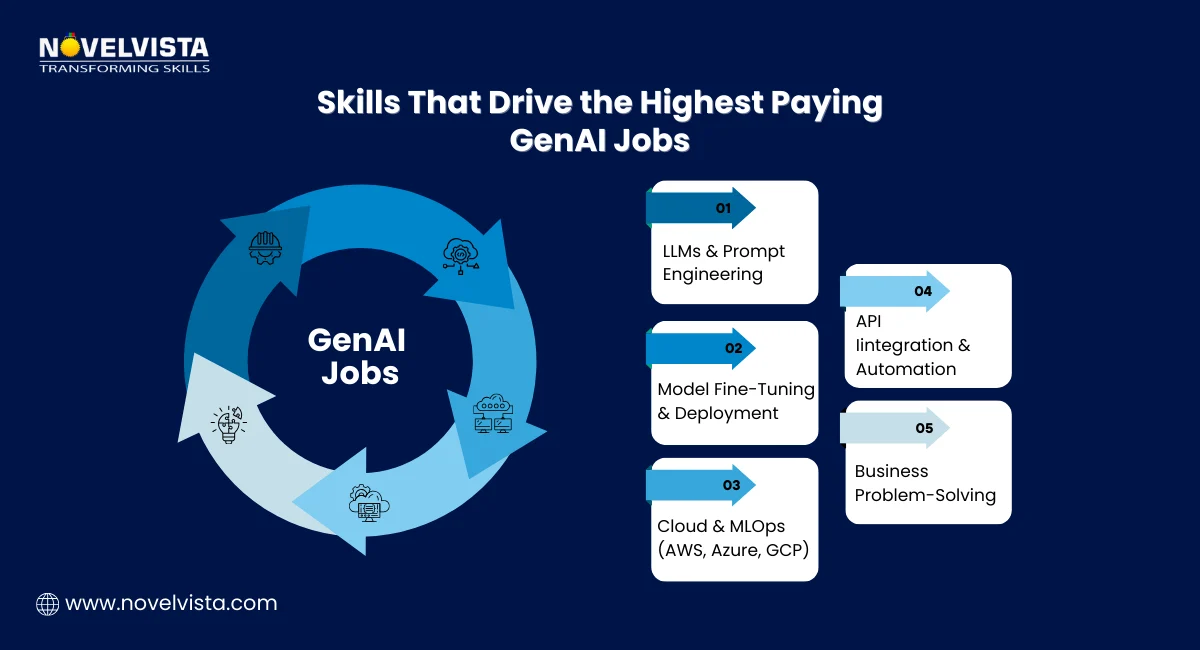
| Top Generative AI Job Roles | US Salary Range | India Salary (LPA) |
| AI Research Scientist | $130K-$489K (Meta) | ₹30-45L+ |
| Generative AI Engineer Salary (Principal/Lead) | $200K-$1M+ (FAANG) | ₹30-50L+ (₹1Cr+) |
| AI Product Manager | $182K-$360K | ₹25-45L |
| Data Science Manager (GenAI) | $250K+ | ₹112L avg |
| AI Solutions Architect | $150K-$300K | ₹22-35L |
Skills matter, but certifications act as proof. They shorten hiring cycles and directly influence generative AI certification salary, especially for professionals switching domains.
Here are some of the best generative AI certifications for high salary, based on industry demand and role alignment.
This certification builds a strong base in LLMs, prompt design, model deployment, and real-world use cases. Employers value it because it focuses on applied skills, not theory-heavy learning.
(Check Out the Certification Details)
Focuses on threat detection, anomaly analysis, and automated response using AI. This combination of AI and security places professionals in niche, high-paying roles with a limited talent supply.
(Check Out the Certification Details)
Covers AI-driven hiring, learning personalization, and content generation. Companies adopting AI-led HR platforms actively look for certified professionals who understand both people and technology.
(Check Out the Certification Details)
Helps professionals use AI for campaign creation, personalization, and customer insights. Revenue impact makes this certification attractive for leadership and consulting roles.
(Check Out the Certification Details)
Focuses on code generation, testing automation, and DevOps acceleration. This path is popular among developers aiming to move into higher-paying AI roles.
(Check Out the Certification Details)
Covers fraud detection, forecasting, and risk modeling. Finance-focused AI roles consistently rank among the highest paying generative AI jobs due to regulatory and accuracy demands.
(Check Out the Certification Details)
Domain-specific learning is why best generative AI certifications for high salary often outperform generic AI courses. We design these certification paths by mapping skills directly to hiring requirements, not just exam objectives. Employers increasingly shortlist candidates faster when certifications demonstrate applied GenAI skills such as prompt optimization, deployment workflows, and domain-specific use cases.
Once you complete a structured Generative AI program, the career path usually doesn’t jump overnight. It grows in clear, skill-based stages. This is what a realistic career after generative AI course looks like for most professionals.
Most learners begin with roles like Prompt Engineer or Junior Generative AI Engineer. At this stage, you apply prompts, work with APIs, and assist senior teams in building AI-powered features. These roles help you understand how models behave in real projects and client scenarios.
With hands-on experience, professionals move into Generative AI Engineer or AI Consultant roles. Here, you design workflows, fine-tune models, integrate AI with cloud systems, and solve business problems. This phase is where salary growth accelerates and responsibilities expand across teams.
Experienced professionals step into AI Solutions Architect or AI Product Lead roles. You decide how AI fits into products, manage performance, costs, and scalability, and guide teams. This stage often includes leadership responsibility along with higher compensation.
The final stage of a career after a generative AI course includes roles like AI Strategy Head, Chief AI Officer, or Domain-Specific AI Specialist. These roles focus on long-term AI vision, governance, and innovation, placing professionals among the highest paying generative AI jobs globally.
Know which skills will matter most as AI reshapes work.
Identify gaps, build the right mix of technical
and human skills, and stay future-ready.
Titles alone don’t decide pay. Skills do. Professionals who build great, practical skills consistently land the highest paying generative AI jobs, even faster than peers with only theoretical knowledge.
The skills highlighted here are validated through project-based learning, assessments, and real implementation scenarios used during training. This ensures professionals don’t just understand concepts but can apply them confidently in production environments.
The demand for AI talent isn’t limited to startups. Large enterprises and research-focused companies are actively offering premium compensation for the highest paying generative AI jobs.
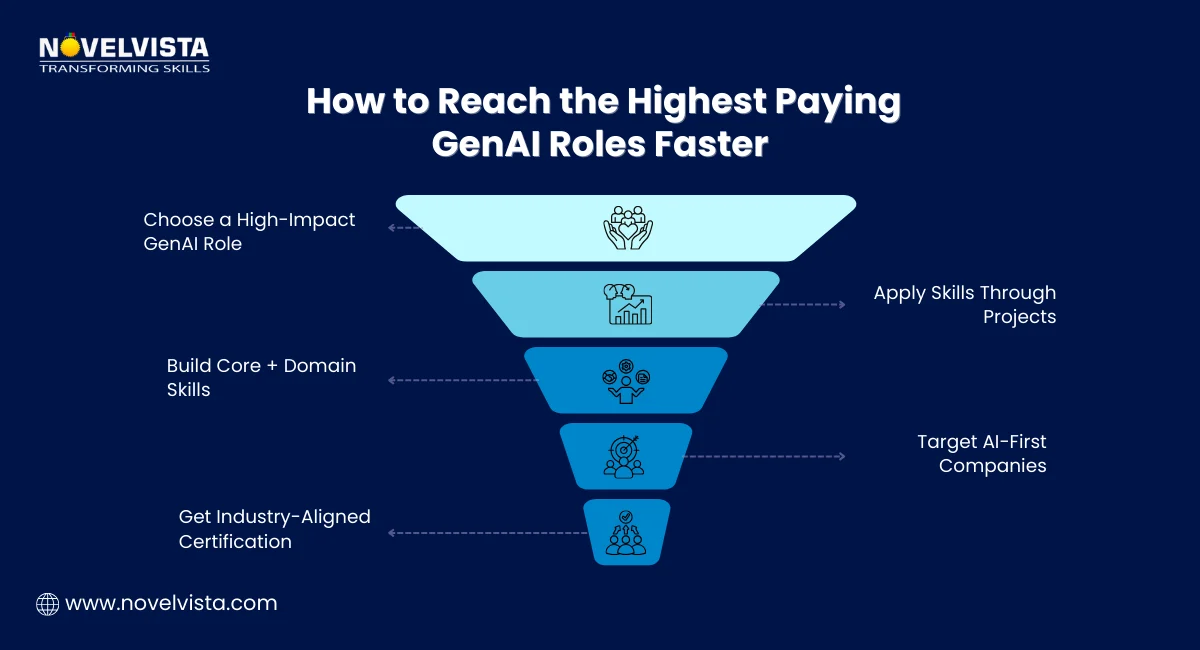
Generative AI adoption is still early. As more industries adopt AI, demand for skilled professionals will continue to rise well beyond 2026.
Professionals who invest now position themselves for leadership roles later, ensuring long-term career and income growth.
Generative AI is no longer just a trend. It’s a career path offering real growth, strong demand, and some of the highest paying generative AI jobs in the tech industry. With the right mix of skills, certifications, and hands-on experience, professionals can move faster into high-impact roles and long-term leadership positions.
This blog is built using insights from structured training delivery, industry-aligned curricula, and evolving hiring expectations across global markets. The intent is to provide realistic guidance professionals can rely on while planning long-term AI careers.
Next Step
If you want to fast-track your journey into high-paying AI roles, NovelVista’s Generative AI Professional Certification is a solid place to begin. The program focuses on real-world GenAI skills, hands-on projects, and industry-aligned learning. It helps you move beyond theory, build confidence, and prepare for roles companies are actively hiring for, turning AI knowledge into real career growth.
Author Details

Course Related To This blog
Generative AI Professional
Generative AI in Project Management
Generative AI in Risk & Compliance
Generative AI in Retail
Generative AI in Marketing
Generative AI in Finance and Banking
Generative AI for HR and L&D
Generative AI in Cybersecurity
Generative AI in Business
Generative AI in Software Development
Confused About Certification?
Get Free Consultation Call
Stay ahead of the curve by tapping into the latest emerging trends and transforming your subscription into a powerful resource. Maximize every feature, unlock exclusive benefits, and ensure you're always one step ahead in your journey to success.