Category | AI And ML
Last Updated On 26/02/2026
Artificial Intelligence has quietly moved from experimental labs into boardrooms and everyday business operations, becoming the strategic engine powering innovation, efficiency, and competitive advantage in the digital age. According to McKinsey & Company, AI could contribute from $2.6 trillion to $4.4 trillion annually to the global economy. Meanwhile, a report from Gartner predicts that by 2026, over 80% of enterprises will have used generative AI APIs or deployed generative AI-enabled applications.
But here’s the catch.
Despite massive adoption, many professionals still ask:
If you’re an IT professional, business leader, data analyst, student, or decision-maker trying to understand generative AI vs predictive AI, this guide is for you.
By the end of this article, you’ll clearly understand the difference between generative AI and predictive AI, when to use each, and how they can work together.
Let’s break it down step by step.
Before diving deep, we need context.
Artificial Intelligence broadly refers to systems that can perform tasks requiring human intelligence learning, reasoning, decision-making, and problem-solving.
Over time, AI has evolved into multiple branches:
Machine Learning (ML)
Deep Learning
Natural Language Processing (NLP)
AI Agents
Computer Vision
Generative Models
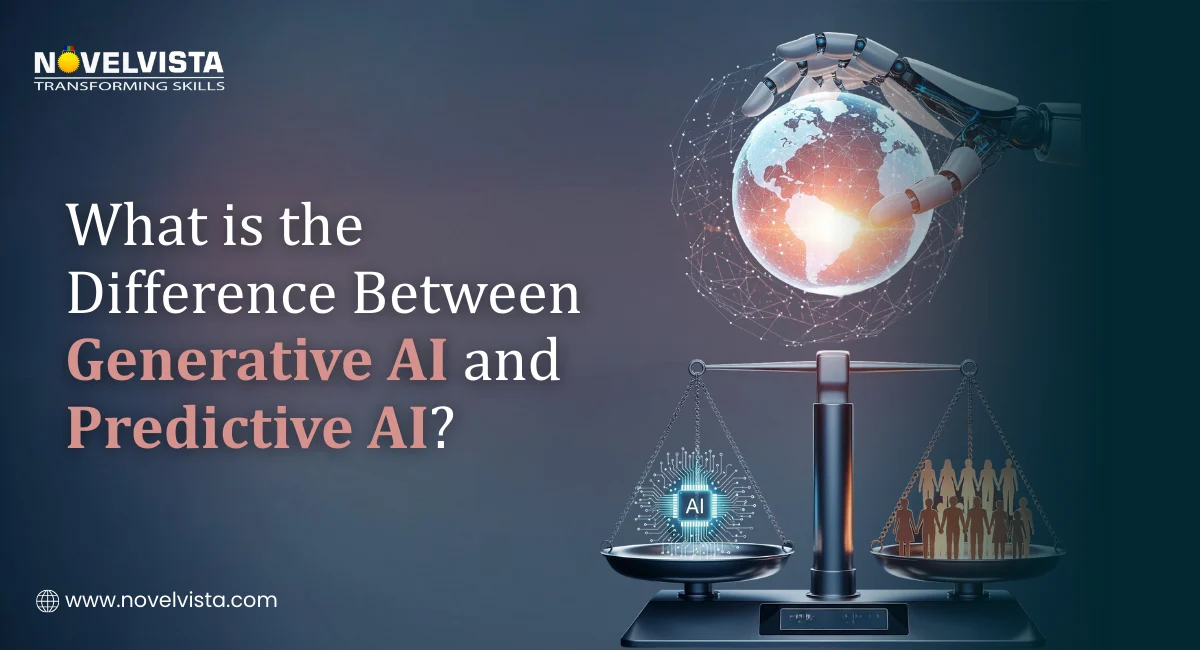
Within this ecosystem, predictive AI and generative AI serve two very different purposes.
Think of it like this:
Predictive AI forecasts outcomes.
Generative AI creates new content.
That simple distinction forms the foundation of the predictive vs generative AI debate.
Predictive AI is a type of artificial intelligence that analyzes historical data to forecast future outcomes.
In simple words:
It answers the question — What is likely to happen next?
How Predictive AI Works
Predictive AI uses:
Statistical models
Regression algorithms
Decision trees
Neural networks
Time-series forecasting
It identifies patterns in past data and applies them to predict future probabilities.
Supervised vs. Unsupervised Learning in Predictive AI
Supervised Learning uses labeled datasets (input + correct output) to train models for prediction tasks like fraud detection or churn prediction.
Unsupervised Learning works with unlabeled data to discover hidden patterns, segments, or anomalies, often used in customer segmentation and anomaly detection.
In short, predictive AI leverages both supervised and unsupervised machine learning techniques to analyze past data and generate future probabilities — a core concept frequently tested in certification exams.
Real-World Examples of Predictive AI
Credit risk scoring in banks
Demand forecasting in retail
Fraud detection systems
Customer churn prediction
Predictive maintenance in manufacturing
For example, e-commerce platforms use predictive AI to estimate which customers are likely to abandon their carts.
So when comparing predictive AI vs generative AI, remember: predictive AI is analytical and probability-driven.
Generative AI is designed to create new content — including text, images, audio, code, and video by learning patterns from vast training data. Unlike predictive systems that forecast outcomes or numbers, generative AI produces entirely new outputs, making it a powerful tool for content creation, automation, and creative innovation.
How Generative AI Works
Generative AI relies on:
Large Language Models (LLMs) for text generation and reasoning
Transformer architectures that enable contextual understanding at scale
Diffusion Models primarily used for high-quality image generation
Foundation Models trained on massive, diverse datasets
Multimodal Models capable of processing and generating text, images, audio, and video simultaneously
In 2026, Generative AI is no longer limited to chatbots or written content. It is about multimodal intelligence systems that can interpret an image, generate a caption, create a related video, and synthesize matching audio in one workflow.
A well-known example is OpenAI, which has developed models capable of generating human-like text, realistic images, and multimodal outputs.
This evolution makes Generative AI not just a content generator, but a comprehensive creative and cognitive engine for modern enterprises.
Real-World Examples of Generative AI
AI chatbots
Automated content creation
Image generation tools
Code generation assistants
Personalized marketing copy
Unlike predictive AI, generative AI doesn’t just analyze — it creates.
This is where the difference between generative AI and predictive AI becomes obvious. Explore high-demand Generative AI Jobs and discover how the right skills can unlock exciting career opportunities in AI-driven innovation and automation.
Now let’s directly address what is the difference between generative AI and predictive AI in a structured way.
| Aspect | Predictive Ai | Generative Ai |
| Primary Goal | Forecast Outcomes | Create New Content |
| Output | Probabilities, Scores, Trends | Text, Images, Audio, Code |
| Data Usage | Historical Structured Data | Massive Structured & Unstructured Data |
| Business Focus | Risk Reduction & Optimization | Innovation & Automation |
| Example | Sales Forecasting | Ai Writing Tools |
1. Purpose
In forecasting models vs. synthetic models, the purpose differs fundamentally.
Predictive AI answers:
What will happen?
Generative AI answers:
What can I create?
2. Output Type
Predictive AI gives numerical outputs and probabilities.
Generative AI produces human-like content.
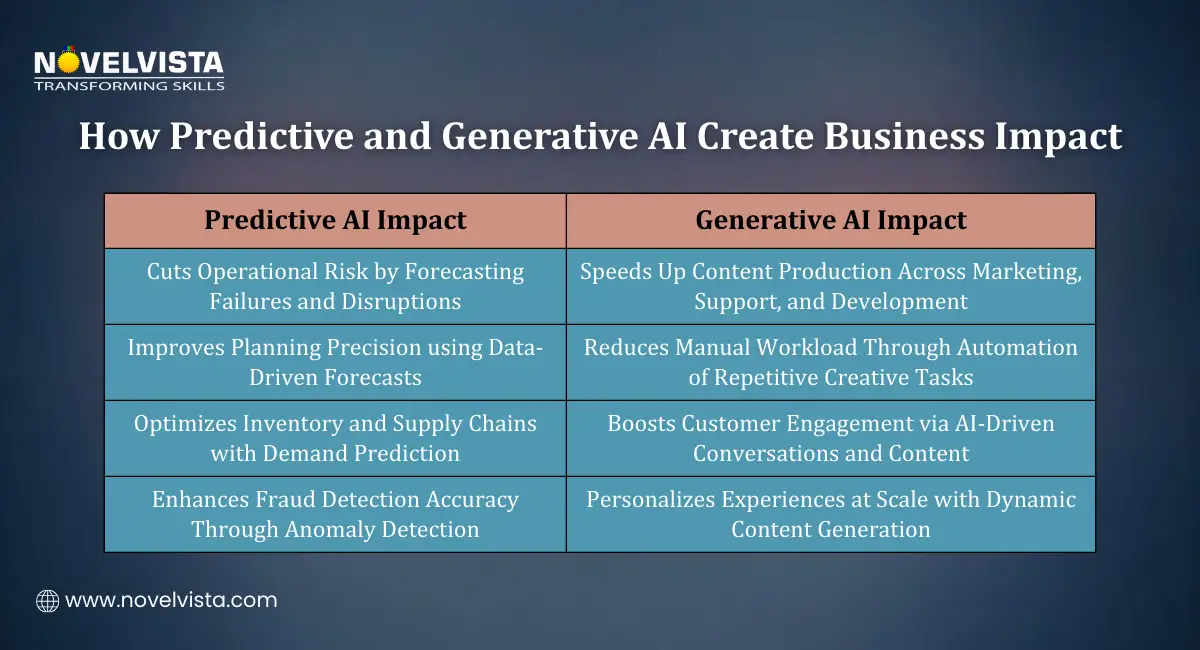
3. Business Impact
Predictive AI improves decision-making accuracy.
Generative AI enhances productivity and creativity.
This clarifies the difference between generative AI and predictive AI in business strategy.
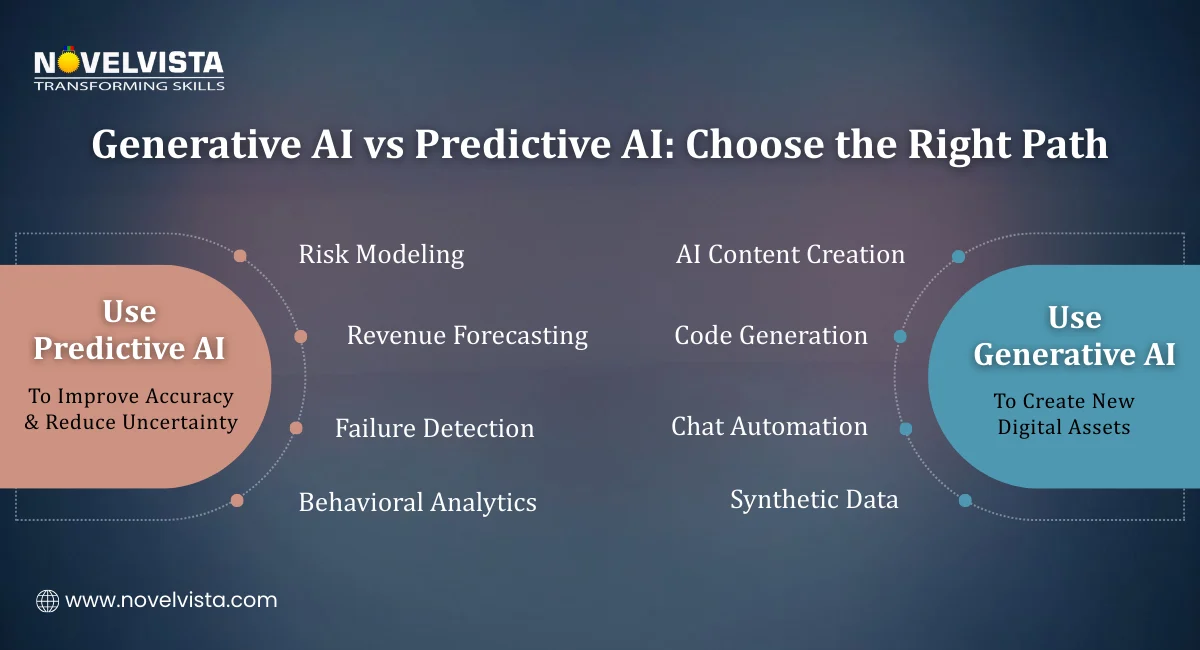
Choosing between predictive and generative AI depends on your objective.
You need forecasting
You want risk modeling
You are optimizing supply chains
You are improving financial planning
You need automated content
You want AI-driven customer interaction
You require synthetic data generation
You aim to enhance creative workflows
Understanding analytical AI vs. creative AI ensures you invest in the right solution.
Yes — and this is where AI becomes powerful.
Modern enterprises increasingly combine predictive AI and generative AI.
This hybrid model blends analytics with creativity — but what makes it enterprise-ready today are advanced techniques like Retrieval-Augmented Generation (RAG) and Reinforcement Learning from Human Feedback (RLHF).
Together, these technologies enable predictive insights to seamlessly trigger intelligent content generation safely and contextually. The predictive vs generative AI debate is no longer about competition; it’s about strategic collaboration powered by modern AI architectures.
The predictive vs generative AI debate is not about competition — it’s about collaboration.
✔ Know when to predict and when to generate
✔ Apply practical AI frameworks with confidence
✔ Turn AI strategy into measurable results
No AI model is perfect.
Understanding the difference between generative AI and predictive AI also means recognizing their limitations.
If your organization prioritizes operational efficiency and risk mitigation, predictive AI can deliver measurable ROI through accurate forecasting and data-driven decisions. On the other hand, if your focus is innovation, automation, and enhanced customer engagement, generative AI becomes truly transformative. The real advantage comes from understanding what is the difference between generative AI and predictive AI and strategically aligning both with your overall business goals. Bridge the gap between theory and implementation. Master the technical domains required for the 2026 AI Certification landscape with our generative AI certification exam guide.
So, what is the difference between generative AI and predictive AI? In essence, predictive AI forecasts outcomes using historical data and supports analytical, data-driven decision-making, while generative AI creates entirely new content and enhances creative automation across functions. However, the difference between generative AI and predictive AI is not just technical — it is deeply strategic. Organizations that clearly understand generative AI vs predictive AI are better positioned to make smarter investments, reduce operational risk, and unlock innovation. In today’s evolving AI landscape, success will not come from choosing one over the other, but from using both technologies wisely and aligning them with business objectives.
Ready to build real-world expertise in Generative AI and move beyond theory?
Join NovelVista’s Generative AI Professional Training and gain practical skills in LLMs, prompt engineering, AI automation, and enterprise AI implementation. Designed for IT professionals, developers, and business leaders, this course equips you with hands-on project experience and industry-relevant knowledge to confidently apply generative AI in modern digital environments.
Start your Generative AI professional journey today!
Author Details

Course Related To This blog
Generative AI Professional
Generative AI in Project Management
Generative AI in Risk & Compliance
Generative AI in Retail
Generative AI in Marketing
Generative AI in Finance and Banking
Generative AI for HR and L&D
Generative AI in Cybersecurity
Generative AI in Business
Generative AI in Software Development
Confused About Certification?
Get Free Consultation Call
Stay ahead of the curve by tapping into the latest emerging trends and transforming your subscription into a powerful resource. Maximize every feature, unlock exclusive benefits, and ensure you're always one step ahead in your journey to success.