Category | AI And ML
Last Updated On 12/12/2025
Let’s start with something most people don’t talk about openly: the tools we use every day, like AI chatbots, image generators, and coding assistants, don’t run on magic. They run on electricity, water, hardware, and huge data centers that never sleep. And that means the generative AI’s environmental impact is becoming a real issue for anyone who cares about tech, innovation, or the planet.
This blog gives you a simple and clear look at how Generative AI affects energy, water, carbon emissions, hardware waste, and long-term sustainability. You’ll also learn what organisations and developers can do to reduce the environmental impact of Generative AI while still using it to build better solutions.
To understand the bigger picture, it helps to break down how a model runs from start to finish. Generative AI systems consume resources during:
This full lifecycle creates constant pressure on energy grids, water supplies, and manufacturing systems. And when large models scale, the generative AI environmental impact grows with them. During our workshops, we break down this lifecycle step-by-step, and teams usually realize how training, inference, storage, and deployment stack up to form a heavy footprint. When professionals understand this full flow, they make smarter choices around model size, resource planning, and long-term AI adoption.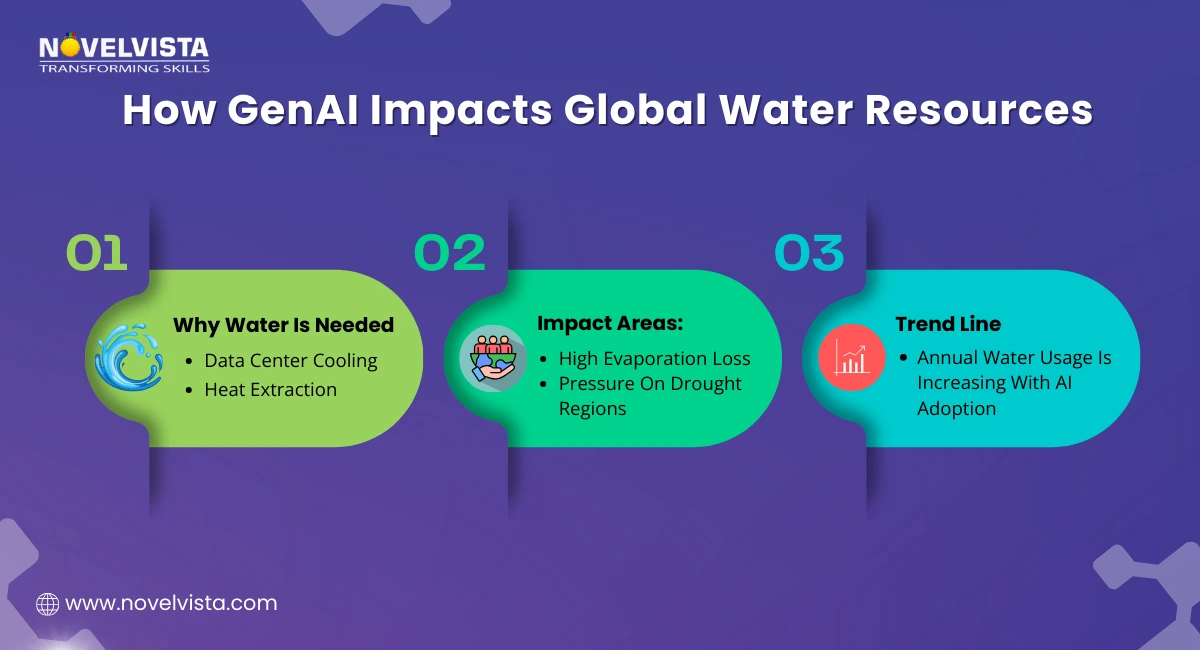
The energy consumption of LLMs is one of the biggest factors shaping the generative AI environmental impact. Every model needs computation. More computation means more electricity, and more electricity means more emissions unless the source is renewable.
Here’s how energy use builds up:
Training massive AI models requires thousands of GPUs running for weeks or months. Studies estimate that some global training runs emit CO₂ equivalent to several flights around the world.
Even after training, every prompt you type triggers calculations inside a data center. Multiply that by millions of people, and the energy consumption of LLMs becomes a constant drain.
Bigger models aren’t just smarter; they consume more power, use more hardware, and increase the Generative AI carbon footprint with every upgrade.
These hidden energy layers make sustainability a real concern, especially when AI adoption is growing faster than green infrastructure.
Electricity isn’t the only resource AI demands. Water plays a huge role, too.
Data centers use water, either directly or indirectly, for cooling. Large AI workloads generate heat, and cooling systems rely heavily on evaporation. That means:
Many global sustainability reports now highlight water usage as a key factor in AI infrastructure planning. Regions with stressed water reserves feel the impact faster, and industry bodies encourage companies to monitor water consumption more transparently. These guidelines are now part of most sustainability-aligned tech curricula.
According to EESI, A mid-sized data center can use nearly 110 million gallons of water each year just to keep its cooling systems running. This often goes unnoticed, but it’s a major part of the Environmental impact of Generative AI.
The Generative AI carbon footprint isn’t only tied to energy and water. It also comes from the hardware that powers everything.
Here’s where the environmental load comes from:
GPU and TPU manufacturing: Producing advanced chips involves rare earth metals, chemical processing, and high-temperature fabrication, all major sources of emissions.
Mining for rare materials: AI hardware depends on minerals like cobalt and lithium. Mining these contributes to soil pollution, water contamination, and worker risk.
Short hardware upgrade cycles: Data centers replace hardware often, sometimes every 2–3 years, leading to massive amounts of untracked e-waste.
Growing server demand: More AI means more racks, more cooling, and more infrastructure, amplifying the generative AI environmental impact across the entire supply chain.
Learn how to use AI responsibly while reducing its
Environmental footprint. Follow clear steps to avoid misuse,
Cut hidden risks, and support sustainable AI practices.
It’s easy to talk only about the problems, but there’s also a side of AI that genuinely helps the planet. When used smartly, generative models support cleaner operations, faster decisions, and greener choices.
Here’s where AI actually helps sustainability efforts:
1. Better renewable energy planning
AI models can predict sunlight, wind behavior, and energy demand with high accuracy. This helps solar and wind farms balance supply and avoid waste. It also supports grid operators who want greener energy stability.
2. Climate monitoring and early warnings
Generative models help researchers track storms, drought patterns, floods, and changes in forests. This supports governments and climate teams who want faster reactions and data-backed disaster planning.
3. Smarter supply chain operations
AI reduces fuel use, avoids empty trips, and improves route planning. This lowers emissions across transport and manufacturing activities, making global trade cleaner and more efficient.
4. Waste reduction through prediction
AI tools can estimate stock levels, identify faulty items, and support recycling units. This prevents unnecessary waste and supports circular economy goals.
Industry research continues to show that AI-driven forecasting and optimization tools help companies reach sustainability milestones faster. Many global climate bodies encourage this balanced approach, reducing AI’s footprint while using AI itself to support cleaner systems. These insights are widely used in advanced AI training programs.
This is the part most teams want: real, doable ideas that help reduce the overall Environmental impact of Generative AI without slowing innovation.
1. Smarter and lighter model design
Techniques like pruning, compression, and using smaller architectures can reduce training needs drastically. Lighter models still deliver accurate results, but with far less energy use and a much smaller Generative AI carbon footprint.
2. Choosing greener data centers
Companies can shift workloads to cloud regions that run on renewable energy. Many providers now offer dashboards showing carbon emissions per region, making it easier to pick cleaner options.
3. Using renewable energy for training
Some AI labs already train models using solar or wind-powered clusters. This cuts down the Energy consumption of LLMs and reduces pressure on traditional power grids.
4. Shared cloud foundations
Not every business needs its own massive GPU farm. Shared foundations, pooled cloud resources, and optimized scheduling help balance workloads and reduce unnecessary hardware use.
5. Circular hardware practices
This includes repairing, recycling, and reselling data center components instead of discarding them early. It also supports responsible e-waste handling, which directly lowers the Generative AI carbon footprint of large deployments.
These ideas don’t fix everything overnight, but they move the needle toward better AI sustainability — something every industry will eventually need.
Regulations are slowly catching up with the speed of AI adoption. Many governments and industry groups are now focusing on reducing the generative AI environmental impact through structured policies.
EU’s 2030 climate-neutral data center target: Data centers operating in the EU must move toward low-emission or zero-emission operations. This includes energy reporting, water usage disclosures, and renewable energy alignment. (Source: Climate Neutral Data Center)
Mandatory transparency reports: Some regions now ask companies to reveal how much energy and water their AI systems consume. This helps organizations measure the Environmental impact of Generative AI more clearly.
Emission-scoped AI development guidelines: These focus on lifecycle emissions — from model training to hardware disposal — ensuring sustainability isn’t handled as an afterthought.
These policy trends align with the standards promoted by major tech associations and environmental committees. Global frameworks are pushing companies toward transparent reporting and cleaner infrastructure. Many of these guidelines are already part of sustainability-focused AI training and governance programs.
Even with the momentum toward greener systems, real barriers still exist. AI growth is fast, but green infrastructure isn’t keeping up.
These barriers don’t stop progress but show that technology and infrastructure must evolve together.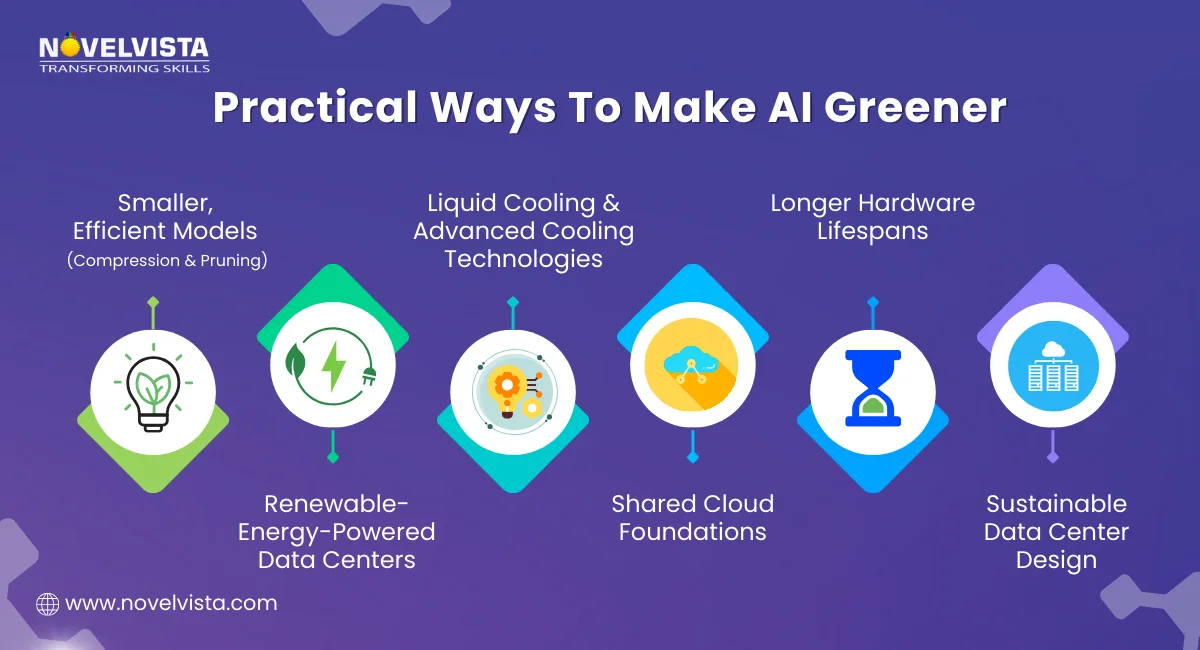
Sustainability isn’t only a planetary concern — it’s a business advantage. Companies that manage the Environmental impact of Generative AI smartly see real benefits.
Lower operating costs: Efficient models reduce electricity spending and hardware upgrades. This directly saves money while reducing the Generative AI carbon footprint.
Stronger compliance and ESG scores: Governments and investors increasingly watch how companies handle energy, water, and waste. Clean AI usage supports long-term brand trust.
Stable long-term infrastructure: Reduced strain on data centers increases system reliability and lowers risks of outages.
Better reputation with customers and partners: A responsible AI strategy shows that a company thinks long-term, not just short-term performance.
Sustainable AI isn’t optional anymore — it’s part of the future of digital operations.
While talking about environmental impact, it’s impossible to ignore how process improvement frameworks help. Lean Six Sigma supports AI sustainability by removing waste, improving efficiency, and encouraging cleaner workflows.
Supports efficient processes that reduce redundant training or overuse of hardware.
Promotes data-driven decisions that align performance with environmental goals.
Helps teams identify bottlenecks, allowing AI systems to run smoothly and more efficiently.
Want to explore Lean Six Sigma deeper?
Check out a detailed guide that breaks down how Lean Six Sigma works and why it matters for future-ready teams.
Generative AI can help the world, but it also comes with real environmental responsibilities. When teams understand energy use, water impact, hardware cycles, and better design choices, they can reduce the generative AI environmental impact without slowing innovation. A greener AI future is possible when technology, people, and processes grow together.
The insights shared here come from hands-on training experience, discussions with industry professionals, and guidance from leading sustainability and AI bodies. By combining structured learning with real-world examples, our goal is to help teams adopt AI responsibly while staying aligned with global best practices.
Next Step
If you want to build greater skills in AI sustainability, automation, and real-world AI workflows, NovelVista offers two helpful learning paths. The Generative AI Professional Certification helps you understand AI models, risks, and responsible development. If you also want to improve your process thinking, the Lean Six Sigma Yellow Belt Certification gives you a strong foundation in waste reduction and efficiency. Both programs help you build future-ready skills that matter today.
Author Details

Course Related To This blog
Generative AI Professional
Generative AI in Project Management
Generative AI in Risk & Compliance
Generative AI in Retail
Generative AI in Marketing
Generative AI in Finance and Banking
Generative AI for HR and L&D
Generative AI in Cybersecurity
Generative AI in Business
Generative AI in Software Development
Confused About Certification?
Get Free Consultation Call
Stay ahead of the curve by tapping into the latest emerging trends and transforming your subscription into a powerful resource. Maximize every feature, unlock exclusive benefits, and ensure you're always one step ahead in your journey to success.