
SRE Certification Training Course | Site Reliability Engineering Foundation
Master Site Reliability Engineering with our globally accredited SRE Certification Training Course. Learn SLOs, error budgets, incident management, monitoring, and automation through hands-on labs and real-world case studies. Delivered by a trainer with 23+ years of industry experience, this SRE Foundation course prepares you for the exam and real production environments. Join 9,000+ professionals who've advanced their careers with NovelVista's SRE Training.
- In-detailed Learning Materials
- Real World Application Via Case Studies
- Global Recognition for IT Services.
- Important IT Service Management Practices.

SRE Certification Course Overview
This SRE Foundation Course equips IT professionals with the knowledge and practical skills to implement Site Reliability Engineering (SRE) effectively within modern IT environments. This SRE certification training covers essential concepts and practices that ensure system reliability, scalability, and operational efficiency.
Participants will learn how to define and measure Service Level Objectives (SLOs), manage error budgets, automate repetitive tasks to reduce operational toil, monitor systems proactively, and handle incidents efficiently using structured incident response techniques. The SRE course also emphasizes conducting blameless postmortems to learn from failures and continuously improve system performance.
This SRE training is ideal for DevOps Engineers, Cloud Engineers, System Administrators, IT Operations staff, and Software Engineers seeking to build practical SRE expertise. Completing SRE Certification Course prepares participants to take on roles such as Site Reliability Engineer, Cloud Reliability Specialist, or DevOps Expert, with the confidence to implement SRE practices that align reliability objectives with business goals.
Delivered by a trainer with 23+ years of industry experience, the program combines expert instruction with hands-on labs, case studies, and mock exams to reinforce learning. Accredited by the DevOps Institute and GSDC (Global Skill Development Council), the SRE Foundation certification provides globally recognized credentials and ensures participants gain practical, actionable skills to implement reliability engineering successfully. By the end of SRE Training Course, participants will be able to apply SRE principles in real-world scenarios, optimize system performance, minimize downtime, and contribute to the overall operational excellence of their organizations.
What You Will Get?

Learning Outcome: SRE Foundation Certification
After the completion of the course, the participants would be able to:
Training Calendar
English
- Self paced videos, assessments, recall quizzes, more
- For more details, reach us at training@novelvista.com
Includes Training, Exam & Certification
Lifetime Access
- Self paced videos, assessments, recall quizzes, more
- For more details, reach us at training@novelvista.com
Includes Training, Exam & Certification
SRE Course Curriculum
Introduction+
Welcome to our Site Reliability Engineering (SRE) training program!
If you want to build your skills and grow in this field, you're in the right place. Our SRE course is well-structured and gives you the knowledge and hands-on practice you need to succeed in today's tech world. Whether you're new to SRE, an experienced IT professional, or a manager looking to improve your team's performance, this SRE Certification is designed for you. You'll learn by doing, with real-world examples to help you solve problems, build reliable systems, and scale applications.
The SRE Foundation course teaches the basics, including how to respond to incidents, monitor services, and work well with your team. Getting SRE certified can open up great job opportunities and help you make a real impact at work.
So why wait? Start your journey into Site Reliability Engineering today and build strong, reliable digital systems with us.
Module 1: SRE Overview+
Build a strong foundation in Site Reliability Engineering principles, history, and production operations from an SRE perspective.
- Introduction to Site Reliability Engineering: Learn what Site Reliability Engineering means, why it emerged, and how it improves reliability, scalability, and operational excellence.
- Origins of SRE at Google: Understand how Google pioneered SRE practices to manage complex systems through engineering-driven operations models.
- Production Environment from an SRE Viewpoint: Learn how SRE teams evaluate production systems, dependencies, risks, and service behavior in real environments.
- Mapping Your Production Environment: Explore practical methods to map services, components, dependencies, and critical workflows for better operational visibility.
- SRE and DevOps Relationship: Understand how SRE complements DevOps through measurable reliability goals, automation, and shared ownership practices.
Module 2: Toil Management+
Learn how repetitive operational work impacts teams and how SRE reduces it through engineering solutions.
- Understanding Toil in Operations: Learn what toil is, how repetitive manual tasks slow teams, and why it reduces innovation capacity.
- Identifying Sources of Toil: Understand how alerts, manual deployments, repetitive support work, and unstable systems create operational burden.
- Business Impact of Excessive Toil: Explore how unmanaged toil increases costs, burnout, errors, and slower delivery across teams.
- Strategies to Reduce Toil: Learn how automation, better tooling, and process redesign can reduce repetitive operational work effectively.
- Toil Assessment Techniques: Understand how teams measure toil levels and prioritize high-impact improvements.
Module 3: SLOs, SLIs, and Error Budgets+
Develop practical knowledge of reliability metrics used to guide operational decisions.
- Service Level Objectives Fundamentals: Learn how SLOs define expected reliability targets that align technical performance with business expectations.
- Service Level Indicators Explained: Understand how SLIs measure latency, availability, throughput, and quality from user experience perspectives.
- Error Budgets and Risk Balance: Learn how error budgets balance innovation speed with reliability commitments in production systems.
- Using Metrics for Better Decisions: Explore how teams use SLO and SLI data to prioritize engineering work.
- Assessment of Reliability Targets: Understand how organizations review targets and refine reliability commitments over time.
Module 4: Monitoring and Service Level Indicators+
Learn how observability and monitoring support proactive service reliability management.
- Modern Monitoring Fundamentals: Learn why monitoring is essential for detecting issues early and maintaining dependable services.
- Logs, Metrics, and Traces: Understand how observability data helps diagnose incidents and optimize system performance.
- Designing Effective Alerts: Learn how meaningful alerts reduce noise and improve incident response efficiency.
- Monitoring User Experience Signals: Explore how user-centric indicators improve service quality and business outcomes.
- Assessment of Monitoring Practices: Understand how teams review monitoring maturity and improve operational visibility.
Module 5: Managing Incidents+
Learn how structured incident response minimizes downtime and restores services quickly.
- Incident Management Fundamentals: Learn how incident management processes help teams detect, respond, and recover from service disruptions efficiently.
- Incident Roles and Responsibilities: Understand the responsibilities of responders, coordinators, communicators, and technical leads during critical incidents.
- Communication During Incidents: Learn how clear internal and external communication reduces confusion and maintains stakeholder confidence.
- Escalation and Prioritization Models: Explore how severity levels and escalation paths improve faster decision-making during incidents.
- Post-Incident Reviews: Understand how retrospectives identify lessons learned and prevent repeat failures.
Module 6: Anti-Fragility and Learning from Failure+
Build resilience by treating failures as opportunities for improvement and stronger systems.
- Understanding Anti-Fragility Concepts: Learn how systems can improve through stress, disruption, and controlled failure learning practices.
- Learning from Operational Failures: Understand how blameless analysis helps teams uncover causes and strengthen reliability.
- Chaos Engineering Fundamentals: Learn how controlled experiments test resilience and reveal hidden weaknesses in systems.
- Failure Testing Approaches: Explore techniques for simulating outages, dependency failures, and degraded conditions safely.
- Continuous Improvement Through Learning: Understand how repeated learning cycles improve systems and team readiness.
Module 7: Organizational Impact of SRE+
Understand how adopting SRE transforms teams, culture, and enterprise delivery performance.
- Business Value of SRE Adoption: Learn how SRE improves uptime, customer trust, release velocity, and operational efficiency.
- Cultural Shift Toward Reliability Ownership: Understand how shared accountability strengthens collaboration between development and operations teams.
- Building SRE Capability in Organizations: Learn how companies establish teams, skills, and operating models for SRE success.
- SRE for Digital Transformation: Explore how SRE supports cloud modernization and enterprise digital reinvention journeys.
- Gamification and Mindset Change: Understand how engagement methods encourage reliability-focused behaviors across teams.
Module 8: SRE Tools and Automation+
Learn how automation and tools reduce manual effort and improve service reliability at scale.
- Value of Automation in SRE: Learn how automation reduces toil, increases consistency, and improves operational speed.
- Infrastructure and Deployment Automation: Understand how automated provisioning and releases improve reliability and scalability.
- Monitoring and Incident Toolchains: Learn how integrated tools support observability, alerts, and response workflows.
- Security in SRE Tooling: Explore why secure tooling, access controls, and governance matter in automation environments.
- Assessment of Automation Maturity: Understand how teams evaluate current tooling maturity and prioritize next improvements.
Course Details
What Will You Get?+
This SRE Training provides a complete, practical learning experience designed to help you build reliability engineering expertise and achieve the SRE certification with confidence.
- Engaging digital learning videos
- Access to expert-led sessions and case studies
- Downloadable resources and reference templates
- AI-based roleplay and simulation exercises
- Practice exams and mock tests
- SRE Certification exam voucher
- Two exam attempts
- Hands-on learning with real-world scenarios
- Interview preparation support
- Globally recognized SRE certification
Eligibility+
This SRE course is designed for professionals who want to build expertise in reliability, automation, and modern operations practices.
- IT operations professionals
- DevOps engineers and practitioners
- Cloud engineers and administrators
- System administrators and infrastructure teams
- Software engineers working with production systems
- Incident management and support professionals
- Students and fresh graduates interested in SRE careers
- Anyone looking to build a career in Site Reliability Engineering
Pre-requisites+
There are no strict mandatory requirements for this SRE training course. However, having basic knowledge will help you learn more effectively.
- Basic understanding of IT systems and infrastructure
- Familiarity with software development or operations concepts
- Awareness of cloud, DevOps, or monitoring concepts is helpful
- Basic analytical and problem-solving skills
- Interest in automation, reliability, and scalable systems
Training Delivery Style+
This Site Reliability Engineering Training is available in flexible learning formats, allowing you to choose self-paced study or live instructor-led sessions with recordings.
- Self-paced online learning option
- Live instructor-led SRE training option
- Session recordings available for revision
- Anytime access to learning materials
- Structured digital learning modules
- Practice tests and mock exams
- Downloadable resources and templates
- Flexible learning for working professionals
Benefits of This SRE Course+
This Site Reliability Engineering Foundation Certification helps you build practical reliability skills, improve system performance, and strengthen your career in modern operations and cloud environments.
- Build Strong SRE Foundations: Learn core Site Reliability Engineering principles, practices, and operating models used by high-performing technology organizations.
- Improve Service Reliability: Understand how to increase uptime, availability, and consistency through measurable reliability engineering approaches.
- Master SLOs, SLIs, and Error Budgets: Gain practical knowledge of key reliability metrics that balance user experience, risk, and delivery speed.
- Reduce Operational Toil: Learn how automation and better workflows eliminate repetitive manual tasks and improve team productivity.
- Strengthen Incident Response Skills: Understand structured incident management practices that reduce downtime and speed service recovery.
- Enhance Monitoring and Observability: Learn how logs, metrics, tracing, and alerting help teams detect issues early and maintain healthy systems.
- Develop Resilience Through Failure Learning: Build stronger systems using post-incident reviews, anti-fragility principles, and continuous improvement methods.
- Increase Career Opportunities: Strengthen your professional profile for roles in SRE, DevOps, cloud operations, and platform engineering.
- Gain Practical Industry Knowledge: Learn through scenarios, case studies, and hands-on concepts relevant to real production environments.
- Earn a Globally Recognized SRE Certification: Validate your expertise with a certification that demonstrates foundational skills in Site Reliability Engineering.
Duration+
- 3 Days of live, interactive sessions led by industry experts.
- 8 hours per day, including interaction, practical exercises, and mock exams.
- Complete coverage of topics coordinated with the SRE exam.
Delivery Format+
- Live Instructor-Led Virtual Sessions with recordings for revision.
- Real-world case studies and hands-on labs for applied learning.
- Access to mock exams customized to the actual SRE pattern.
- Well-planned curriculum crafted to deliver an end-to-end SRE experience.
Key Features Summary+
- Official content coordinated with global SRE standards.
- Real-time projects and tool-based exercises for experiential learning.
- A dedicated mock test engine to simulate the actual SRE exam.
- Post-training support and career mentoring included.
- Curriculum shaped by industry leaders in SRE training.
SRE Certification Exam Format
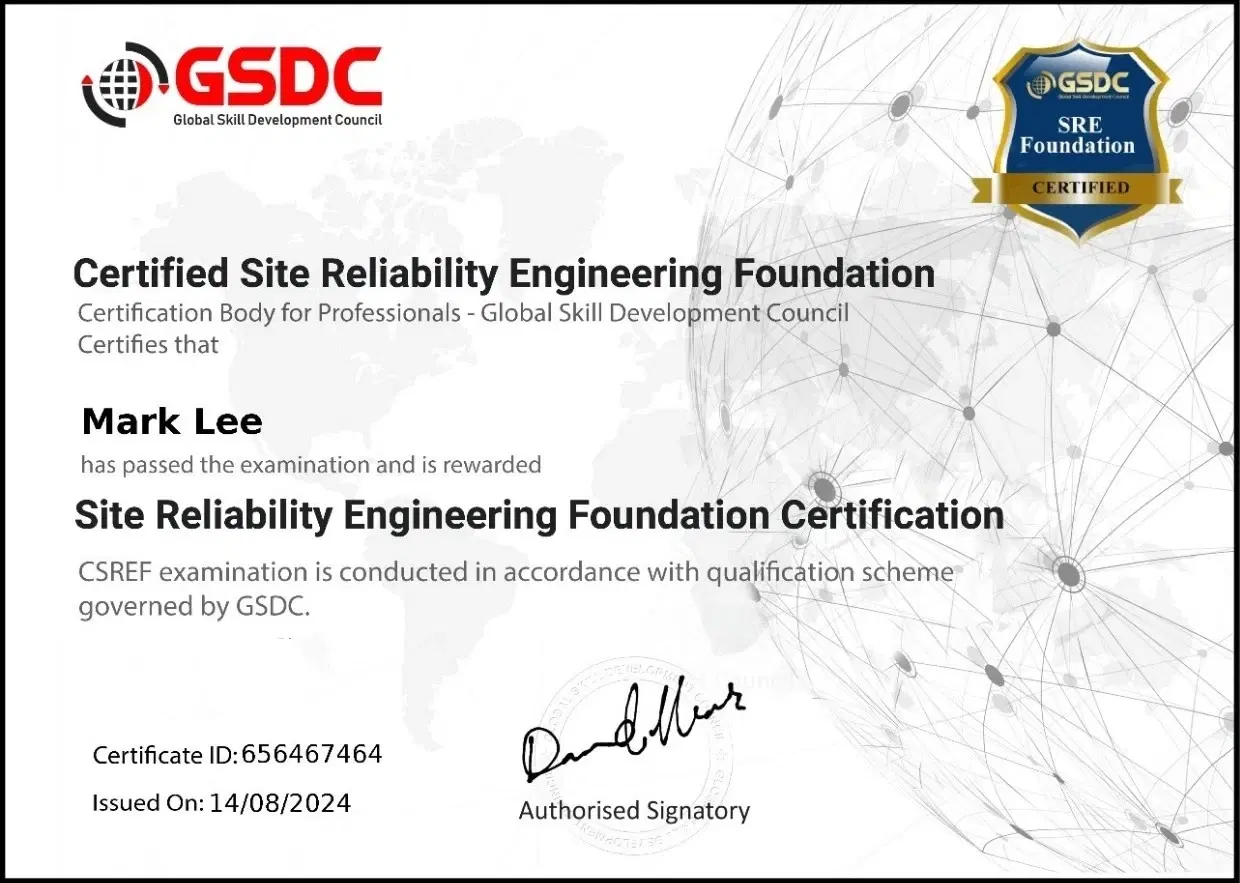
Exam Format - Objective Type, Multiple Choice
Exam Duration - 90 Minutes
No. of Questions - 40 (multiple-choice questions)
Passing Criteria - 65%
Certificate - Within 5 business days
Result - Immediately after the exam
SRE Certification Path