

Lean Six Sigma Green belt Certification Training & Course
This Six Sigma Green Belt Certification by NovelVista is designed to help professionals build practical skills in process improvement, quality management, and data-driven decision-making. This Six Sigma Green Belt Course enables you to apply Lean Six Sigma principles to improve efficiency and drive measurable business results.
- Industry Expert Trainers
- Online learning session
- Accredited Trainer
- Exam fee included

Lean Six Sigma Green belt Course Overview
The Lean Six Sigma Green Belt Certification is designed to help professionals build practical expertise in process improvement, quality management, and data-driven problem solving. This Six Sigma Green Belt Training focuses on applying Lean and Six Sigma principles to identify inefficiencies, reduce defects, and improve overall business performance.
This Six Sigma Green Belt Course covers key areas such as DMAIC methodology, Lean fundamentals, process mapping, statistical analysis, and performance measurement. Through this Six Sigma Green Belt Certification Course, learners gain the ability to analyze processes, identify root causes, and implement effective solutions that drive continuous improvement.
Delivered by NovelVista, this Sigma Green Belt Training Certification follows a practical learning approach with real-world scenarios, case studies, and hands-on exercises. By completing this program, professionals will be prepared to lead process improvement initiatives, enhance operational efficiency, and advance their careers in quality and project management.

What You Will Get?
Learning Outcome
After the completion of the course, the participants would be able to:
Training Calendar
English
- Self paced videos, assessments, recall quizzes, more
- For more details, reach us at training@novelvista.com
Includes Training, Exam & Certification
Lifetime Access
- Self paced videos, assessments, recall quizzes, more
- For more details, reach us at training@novelvista.com
Includes Training, Exam & Certification
Course Curriculum
This Six Sigma Green Belt Course is designed to build your expertise step by step, covering Lean principles, Six Sigma methodologies, and practical tools used in real-world process improvement projects.
Module 1: Introduction to Six Sigma and Its Strategic Importance+
Understand the foundation of Six Sigma and how it drives quality improvement, efficiency, and business performance across industries.
- Origins and Evolution of Six Sigma: Learn how Six Sigma evolved as a quality management approach and how organizations use it today to improve processes, reduce defects, and enhance operational efficiency.
- Key Performance Parameters and Metrics: Understand important performance metrics used in Six Sigma, including defect rates, process capability, and efficiency indicators that help measure and improve process quality.
- Overview of the DMAIC Framework: Explore the DMAIC methodology and how its structured phases help organizations solve problems, improve processes, and maintain consistent performance outcomes.
- Enhancing Speed, Productivity, Quality, and Profitability: Learn how Six Sigma improves organizational performance by optimizing processes, reducing waste, and enhancing productivity, quality, and overall business profitability.
- Continuous Improvement vs Breakthrough Improvement: Understand the difference between continuous improvement and breakthrough improvements, and how both approaches contribute to long-term process excellence and innovation.
Module 2: Foundations of Lean Methodology+
Learn how Lean principles complement Six Sigma to eliminate waste and improve process flow and efficiency.
- Core Principles of Lean Thinking: Understand the fundamental principles of Lean thinking and how they focus on maximizing value while minimizing waste across processes and operations.
- Strategic Approaches to Implementing Lean: Learn how organizations implement Lean strategies effectively by aligning process improvements with business goals and ensuring long-term sustainability.
- Key Lean Metrics and Measurement Systems: Explore important Lean metrics used to measure efficiency, identify waste, and track improvements in process performance across different operational environments.
- Roadmap for Successful Lean Deployment: Understand the step-by-step approach to deploying Lean initiatives within organizations, ensuring structured implementation and measurable business impact.
- Progress Tracking and Impact Evaluation in Lean Transformation: Learn how to track Lean initiatives, measure their effectiveness, and evaluate their impact on business performance and operational efficiency.
Module 3: Essential Six Sigma Terminology and Metrics+
Build a strong understanding of key Six Sigma terms, concepts, and measurement techniques used in process improvement.
- Defects per Million Opportunities (DPMO): Learn how to calculate and interpret DPMO to measure process performance and identify the level of defects within a given process.
- Types and Sources of Variation: Understand different types of variation in processes and how identifying these variations helps in improving consistency and reducing defects.
- Measuring Process Capability and Performance: Learn how to assess process capability using statistical methods to determine whether processes meet required performance standards and specifications.
- Understanding and Calculating Yield: Explore how yield is calculated and how it reflects process efficiency by measuring the percentage of defect-free outputs produced.
Module 4: Define Phase – Framing the Right Project+
Learn how to clearly define process improvement projects and set a strong foundation for successful implementation.
- Selecting and Scoping a Lean Six Sigma Project: Understand how to identify suitable projects, define scope, and align improvement initiatives with business priorities and organizational goals.
- Developing a Comprehensive Project Charter: Learn how to create a detailed project charter that outlines objectives, scope, stakeholders, timelines, and expected outcomes for successful project execution.
- Creating Current State Process Maps: Explore how to map existing processes to identify inefficiencies, bottlenecks, and opportunities for improvement using visual representation techniques.
- Applying the Kano Model to Identify Customer Expectations: Learn how to use the Kano model to understand customer needs and prioritize features that enhance satisfaction and deliver greater value.
- Conducting Stakeholder Analysis and Engagement: Understand how to identify stakeholders, assess their influence, and engage them effectively to ensure project support and success.
- Voice of the Customer (VoC) and CTQ Tree Development: Learn how to capture customer requirements and translate them into measurable quality parameters using Voice of the Customer and CTQ frameworks.
Module 5: Measure Phase – Capturing Reliable Data+
Learn how to collect accurate data and measure process performance to establish a strong baseline for improvement.
- Designing an Effective Data Collection Plan: Learn how to design structured data collection plans that ensure accuracy, reliability, and consistency for meaningful analysis and informed decision-making in process improvement initiatives.
- Process Mapping for End-to-End Analysis: Understand how to map complete processes to visualize workflows, identify inefficiencies, and analyze activities from start to finish for better improvement opportunities.
- Prioritization Matrix for High-Impact Areas: Learn how to use prioritization matrices to identify and focus on critical areas that offer the highest potential impact on process improvement and business performance.
- Sampling Methods for Data Collection: Understand different sampling techniques used to collect representative data, ensuring accurate analysis and reliable insights for process evaluation and improvement.
- Failure Mode and Effects Analysis (FMEA): Learn how to apply FMEA to identify potential risks, evaluate their impact, and prioritize corrective actions to improve process reliability and reduce failures.
- Value Stream Mapping (VSM) and Analysis: Explore how to create and analyze value stream maps to identify waste, optimize workflows, and improve overall process efficiency.
- Assessing Process Capability and Process Sigma: Learn how to evaluate process capability and calculate sigma levels to measure performance and identify opportunities for improvement.
Module 6: Analyze Phase – Discovering Root Causes+
Develop the ability to analyze data and identify root causes of process issues using statistical and analytical tools.
- Brainstorming Techniques for Cause Identification: Learn structured brainstorming methods to generate ideas, identify potential causes, and encourage collaborative problem-solving within process improvement teams.
- Cause-and-Effect (Ishikawa) Diagram Analysis: Understand how to use Ishikawa diagrams to systematically identify and categorize root causes affecting process performance and quality outcomes.
- Control Charts and Frequency Plots: Learn how to use control charts and frequency plots to monitor process variation, identify trends, and detect abnormalities in process performance.
- Process Capability Analysis: Understand how to analyze process capability using statistical methods to determine whether processes consistently meet required specifications and standards.
- Pareto Chart Analysis: Learn how to use Pareto charts to identify major contributing factors in process problems and prioritize improvement efforts effectively.
- Hypothesis Testing for Process Validation: Explore hypothesis testing techniques to validate assumptions, confirm root causes, and support data-driven decision-making in process improvement.
- Regression Analysis for Variable Relationships: Learn how regression analysis helps identify relationships between variables and supports prediction and optimization of process performance.
- Root Cause Analysis Techniques: Understand systematic approaches to identify underlying causes of problems and develop targeted solutions for long-term process improvement.
Module 7: Improve Phase – Designing Effective Solutions+
Learn how to develop, test, and implement solutions that improve process performance and eliminate inefficiencies.
- Identifying Improvement Opportunities: Learn how to identify areas for improvement by analyzing data, process gaps, and inefficiencies to create effective and targeted solutions.
- Brainstorming and Solution Development Techniques: Understand how to generate and evaluate potential solutions using collaborative brainstorming and structured problem-solving methods.
- Weighted Criteria Matrix for Solution Selection: Learn how to evaluate and prioritize solutions based on defined criteria to select the most effective and feasible improvement options.
- Gantt Chart for Implementation Planning: Understand how to plan and schedule improvement initiatives using Gantt charts to ensure the timely and organized execution of projects.
- Design of Experiments (DOE): Learn how to apply DOE techniques to test variables, validate improvements, and optimize process performance through controlled experimentation.
- Mistake Proofing (Poka-Yoke): Understand how to implement mistake-proofing techniques to prevent errors and ensure consistent quality in processes and outputs.
- Tools for Sustainable Improvement: Explore additional tools and techniques that help maintain improvements and ensure long-term process stability and efficiency.
Module 8: Capstone Tools, Certification Prep, and Case-Based Learning+
Apply your knowledge through practical exercises, tools, and real-world scenarios to strengthen your understanding and prepare for certification.
- Certification Exam Preparation Resources: Access structured materials, mock tests, and guidance that help you prepare effectively for the Six Sigma Green Belt Certification exam.
- DMAIC Templates and Checklists: Learn how to use ready-to-use templates and checklists to support project execution and ensure consistency across all DMAIC phases.
- Real-World Case Studies Across Industries: Explore case studies from manufacturing, services, and healthcare to understand how Six Sigma is applied in different business environments.
- Practical Exercises and Simulations: Engage in hands-on exercises and simulations that reinforce concepts and improve your ability to apply learning in real-world scenarios.
- Digital Toolkits for Process Improvement: Learn how to use digital tools for data collection, process mapping, and control planning to enhance efficiency and effectiveness.
- Lessons Learned from Six Sigma Projects: Understand key insights and best practices from completed projects to avoid common mistakes and improve future process improvement initiatives.
Course Details
What Will You Get?+
This Six Sigma Green Belt Certification provides a complete, practical learning experience designed to help you build expertise in process improvement and achieve certification with confidence.
- Engaging digital learning videos
- Access to expert-led sessions and case studies
- Downloadable resources and reference templates
- AI-based roleplay and simulation exercises
- Practice exams and mock tests
- Certification exam voucher
- Two exam attempts
- Capstone project and practical exercises
- Interview preparation support
- Globally recognized certification
Eligibility+
This Six Sigma Green Belt Course is designed for professionals who want to build expertise in process improvement, quality management, and data-driven decision-making.
- Quality and process improvement professionals
- Project managers and team leads
- Operations and production managers
- Business analysts and consultants
- Engineers and technical professionals
- IT and service management professionals
- Fresh graduates interested in Six Sigma careers
- Anyone looking to build a career in quality and process improvement
Pre-requisites+
There are no strict mandatory requirements for this Six Sigma Green Belt Course. However, having basic knowledge will help you learn more effectively.
- Basic understanding of business processes and operations
- Familiarity with data and analytical thinking
- Basic knowledge of quality management concepts is helpful
- Interest in process improvement and problem-solving
- Willingness to learn and apply Six Sigma methodologies
Training Delivery Style+
This Six Sigma Green Belt Training is delivered in a flexible self-paced format, allowing you to learn at your own pace and convenience.
- Fully self-paced online learning
- Anytime, anywhere access
- Structured digital learning modules
- On-demand expert-led video sessions
- Practice tests and mock exams
- AI-based roleplay and simulations
- Downloadable resources and templates
- Lifetime access to course content
Key Benefits+
This Six Sigma Green Belt Certification helps you build practical skills in process improvement, enhance decision-making, and advance your career in quality and operations roles.
- Build Strong Process Improvement Skills: Learn how to identify inefficiencies, reduce defects, and improve processes using structured Six Sigma methodologies and proven problem-solving techniques.
- Apply Data-Driven Decision Making: Gain the ability to analyze data, interpret results, and make informed decisions that improve process performance and business outcomes.
- Master DMAIC Methodology: Develop expertise in the DMAIC framework to systematically define, measure, analyze, improve, and control processes for consistent and sustainable improvements.
- Improve Operational Efficiency: Learn how to streamline workflows, eliminate waste, and optimize resources to enhance productivity and overall operational performance.
- Enhance Problem-Solving Capabilities: Build strong analytical thinking skills to identify root causes of issues and implement effective, long-term solutions across business processes.
- Gain Practical Industry Knowledge: Understand how Lean Six Sigma is applied across industries such as manufacturing, healthcare, and services to drive measurable improvements.
- Increase Career Opportunities: Strengthen your professional profile with in-demand Six Sigma skills that open opportunities in quality management, operations, and project management roles.
- Contribute to Organizational Growth: Learn how to lead or support process improvement initiatives that enhance business performance, reduce costs, and improve customer satisfaction.
- Work on Real-World Scenarios: Apply concepts through practical exercises, case studies, and simulations that prepare you for real business challenges and project execution.
- Earn a Globally Recognized Certification: Validate your expertise with a certification that demonstrates your ability to apply Six Sigma principles and deliver measurable business impact.
Lean Six Sigma Green belt Exam Format
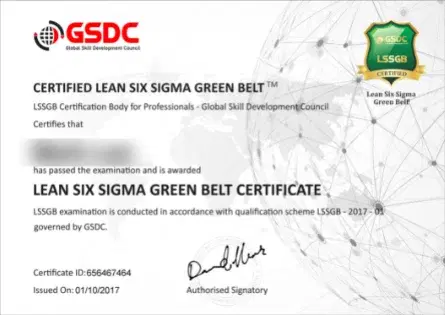
Exam Format - Objective Type, Multiple Choice
Exam Duration - 90 Minutes
No. of Questions - 50 (multiple-choice questions)
Passing Criteria - 35 out of 50 (70%)
Certificate - Within 5 business days
Result - Immediately after the exam
Open Book - Yes