

Context Engineering Certification | Context Engineering Course & Training
NovelVista’s Context Engineering Certification helps professionals develop practical skills in designing, structuring, managing, and optimizing context for AI systems. This Context Engineering Course focuses on how instructions, user intent, conversation history, retrieved knowledge, tools, and metadata work together to improve the reliability and effectiveness of AI applications. The program is designed for professionals who want to move beyond basic prompt engineering and understand how to build context-aware AI applications, copilots, retrieval systems, and AI agents.
- In-detailed Learning Materials
- Important IT Service Management Practices.
- Real World Application Via Case Studies
- Global Recognition For IT Services.

Context Engineering Course Overview
The Context Engineering Course by NovelVista is designed to help professionals understand how AI systems use information to generate responses, make decisions, interact with tools, and complete tasks. It focuses on engineering the complete context surrounding an AI model rather than relying only on individual prompts.
While prompt engineering focuses primarily on how instructions are written, context engineering considers the broader information environment in which an AI system operates. This includes system instructions, user intent, conversation history, retrieved knowledge, available tools, metadata, and workflow requirements.
Through this Context Engineering Certification, participants explore how to organize relevant information, design effective context structures, manage retrieval and memory, control outputs, and evaluate AI system behavior. The program also covers Context Engineering for AI agents, helping learners understand how context supports planning, tool use, multi-step execution, and reliable task completion.
By completing this training, professionals develop a structured understanding of AI Context Design, retrieval systems, memory, token efficiency, safety controls, evaluation, and production implementation.

What You Will Get?
Learning Outcomes of Certified Context Engineer
After the completion of the course, the participants would be able to:
Training Calendar
English
- Self paced videos, assessments, recall quizzes, more
- For more details, reach us at training@novelvista.com
Includes Training, Exam & Certification
Lifetime Access
- Self paced videos, assessments, recall quizzes, more
- For more details, reach us at training@novelvista.com
Includes Training, Exam & Certification
Certified Context Engineer Course Curriculum
This Context Engineering Training is structured around eight learning modules covering context fundamentals, information architecture, retrieval, memory, agentic workflows, security, evaluation, and production implementation.
Module 1: Context Engineering Fundamentals+
This module introduces Context Engineering and its role in building effective AI applications. Learners explore how context influences AI outputs and how relevant information, instructions, and supporting data can help AI systems respond more accurately to user requests.
Context Engineering Fundamentals
Understand the core concepts of Context Engineering and how it differs from basic prompt writing in AI applications.
Context and Large Language Models
Explore how large language models use instructions, information, and surrounding context to generate relevant responses.
Context Components
Learn about the different elements of context, including system instructions, user inputs, retrieved information, conversation history, and supporting data.
Context Quality and Relevance
Understand how the quality, relevance, and completeness of context influence AI response quality.
Context Engineering Use Cases
Explore applications of Context Engineering in AI assistants, knowledge-based systems, workflow automation, and AI-powered applications.
Module 2: Context Design and Structuring+
This module focuses on designing and organizing context to improve the effectiveness of AI applications. Learners explore how information can be structured, prioritized, and presented to help AI systems understand tasks and generate useful responses.
Context Design Principles
Understand the fundamental principles of designing context for AI applications based on task requirements and expected outputs.
Context Structuring Techniques
Explore how instructions, reference materials, conversation history, and supporting information can be organized into a coherent context.
Instruction and Information Hierarchy
Learn how to prioritize instructions and information so AI systems can identify the most relevant details for a given task.
Context Formatting and Organization
Understand how structured formats and clear information organization can support consistent AI processing.
Context Design Use Cases
Explore context design applications in AI assistants, document analysis, enterprise knowledge systems, and task-oriented AI workflows.
Module 3: Context Management for AI Applications+
This module introduces the processes involved in managing context throughout AI interactions. Learners explore how context can be maintained, updated, and organized to support continuity and relevance across different tasks and conversations.
Context Management Fundamentals
Understand the importance of managing context to maintain relevant information across AI interactions.
Conversation History Management
Explore how previous messages and interaction history can provide useful context for ongoing conversations.
Context Updates and Maintenance
Learn how context can be updated as new information becomes available or task requirements change.
Context Relevance and Prioritization
Understand how to identify important information and reduce irrelevant details that may affect AI responses.
Context Management Use Cases
Explore context management in conversational AI, virtual assistants, multi-step workflows, and enterprise AI applications.
Module 4: Context Window and Token Optimization+
This module explores how context windows and token limits affect AI application performance. Learners understand how to manage available context efficiently while retaining the information needed to complete a task.
Context Window Fundamentals
Understand context windows and their role in determining how much information an AI model can process at a time.
Tokenization and Token Limits
Explore how text is converted into tokens and how token limits influence the amount of context available to an AI model.
Context Compression Techniques
Learn how summarization and information reduction can help preserve essential details while reducing unnecessary context.
Context Prioritization and Optimization
Understand how to prioritize relevant information and use available context efficiently to support task completion.
Context Optimization Use Cases
Explore context optimization in long conversations, document processing, knowledge retrieval, and cost-conscious AI application design.
Module 5: RAG-Powered Knowledge Automation+
This module introduces Retrieval-Augmented Generation (RAG) and its role in knowledge-based automation. Learners explore how AI systems can retrieve relevant information from organizational knowledge sources to generate more contextually grounded responses.
RAG Fundamentals
Understand how Retrieval-Augmented Generation combines information retrieval with language generation to support knowledge-based applications.
Knowledge Source Integration
Explore how documents, knowledge bases, and other information sources can be connected to AI-powered automation workflows.
Information Retrieval
Learn how relevant information can be retrieved from knowledge sources based on user queries or workflow requirements.
Context-Aware Response Generation
Understand how retrieved information can provide context for AI-generated responses and support tasks requiring organization-specific knowledge.
RAG Automation Use Cases
Explore applications such as knowledge assistance, document-based question answering, internal information retrieval, and automated response generation.
Module 6: Context Engineering for AI Agents+
This module explores how Context Engineering supports AI agents in understanding tasks, accessing relevant information, and performing multi-step activities. Learners examine how context can help agents maintain task continuity and make their outputs more relevant.
AI Agent Context Fundamentals
Understand the role of context in helping AI agents interpret instructions, understand objectives, and perform assigned tasks.
Context for Tool Selection
Explore how relevant instructions and task information can help AI agents determine when and how to use available tools.
Context Management Across Tasks
Learn how context can support continuity when AI agents work through multiple steps or interact with different information sources.
Context for Multi-Step Workflows
Understand how task requirements, intermediate results, and supporting information can be organized throughout agent-driven workflows.
AI Agent Context Use Cases
Explore applications such as AI research assistants, workflow agents, customer support automation, and knowledge-based task execution.
Module 7: Context Evaluation and Optimization+
This module focuses on evaluating the quality and effectiveness of context used in AI applications. Learners explore how to identify missing information, reduce irrelevant content, and refine context to improve the consistency and usefulness of AI-generated outputs.
Context Quality Assessment
Understand how to evaluate context for relevance, completeness, clarity, and alignment with task requirements.
Context Relevance Evaluation
Explore methods for determining whether the information provided to an AI model supports the intended task.
Identifying Context Gaps
Learn how to recognize missing, outdated, conflicting, or insufficient information that may affect AI-generated responses.
Context Refinement Techniques
Understand how context can be reviewed, reorganized, and refined to improve the relevance of AI outputs.
Context Evaluation Use Cases
Explore context evaluation in AI assistants, knowledge retrieval systems, enterprise applications, and automated workflows.
Module 8: Practical Context Engineering Applications+
This module focuses on applying Context Engineering concepts to practical AI scenarios. Learners explore how context design, management, retrieval, and optimization can be used to support real-world AI tasks and workflows.
Context Engineering Workflow Design
Understand how to design context workflows that align AI inputs and supporting information with specific task requirements.
Context Integration in AI Applications
Explore how context can be incorporated into AI-powered applications to support more relevant and useful outputs.
Knowledge-Based AI Solutions
Learn how structured context and relevant knowledge sources can support AI applications that work with organizational information.
Context Optimization in Practical Scenarios
Understand how to refine context based on task complexity, available information, and expected output quality.
Real-World Context Engineering Use Cases
Explore practical applications of Context Engineering across business operations, knowledge management, AI assistants, and workflow automation.
Course Details
Get a comprehensive overview of what to expect in our Certified Context Engineer Certification Course through this detailed breakdown. Designed to build practical expertise in designing, managing, and optimizing context for modern AI systems, this section covers the key elements of the Context Engineering Certification, including prerequisites, key benefits, skills covered, and training delivery style.
Whether you're entering the field of context engineering or strengthening your existing AI engineering expertise, the Certified Context Engineer Course helps you develop practical knowledge in LLM context engineering, prompt engineering, Retrieval-Augmented Generation (RAG), context window optimization, AI agent memory management, Model Context Protocol (MCP), token optimization, and production-ready AI workflows. Our Context Engineering Training is structured to support professionals preparing for emerging AI engineering roles and organizations looking to improve the accuracy, efficiency, and reliability of enterprise AI applications across the USA, India, Canada, the UK, UAE, Saudi Arabia, Australia, Germany, and worldwide.
Certified Context Engineer Eligibility+
The Context Engineering Course is suitable for:
- Software Developers
- AI/ML Engineers
- AI Application Developers
- Technical Project Managers
- AI Engineers
- Software Engineers
- Systems Architects
- Technical Consultants
- Professionals working with LLM applications
- Developers building AI assistants and copilots
- Professionals implementing RAG-based applications
- Technical professionals working with AI agents
- Professionals responsible for deploying AI-powered workflows
- Individuals looking to advance their AI engineering capabilities
The program is particularly relevant for professionals who already work with prompts and want to understand the systems, information structures, and workflows required to develop more reliable AI applications.
Training Delivery Style+
The Context Engineering Training follows a structured, application-focused learning approach that combines foundational concepts with practical activities.
The learning experience includes:
- Structured learning modules
- Video lessons and learning resources
- Context engineering fundamentals
- Context design and information architecture
- Structured context and output control
- RAG and retrieval context engineering
- Memory management and context compression
- Token optimization
- Tools, MCP, and agentic workflows
- Security, guardrails, and governance
- Interactive labs and practice activities
- Quizzes and assessments
- Practice examinations
- Evaluation and observability concepts
- Practical project development
The program emphasizes applying context engineering principles to real-world AI scenarios rather than focusing exclusively on theoretical concepts.
Pre-Requisites+
The Context Engineering Course is designed for professionals interested in building practical knowledge of context-driven AI systems.
Recommended Knowledge
- Familiarity with basic artificial intelligence concepts.
- Basic understanding of Large Language Models (LLMs).
- Experience writing prompts or interacting with AI applications.
- Familiarity with software development or AI-powered workflows.
- Interest in AI agents, RAG, and context-aware applications.
- Willingness to participate in practical learning activities and assessments.
The course is especially suitable for professionals who already write prompts and want to understand the broader systems behind AI applications. A willingness to work with projects, labs, and assessments will help learners get more value from the program.
Course Objectives+
Upon completion of this Context Engineering Certification, participants will be able to:
- Understand the foundations of context engineering.
- Explain how context engineering differs from prompt engineering.
- Identify the essential components of an AI application context.
- Design context structures for different AI use cases.
- Organize instructions, user intent, history, retrieved knowledge, tools, and metadata.
- Understand structured context and output control.
- Apply retrieval context engineering principles.
- Understand the role of RAG in AI Context Management.
- Explore memory management and context compression.
- Apply Context Optimization concepts to improve information efficiency.
- Understand how tools and MCP support agentic workflows.
- Design context-aware workflows for AI agents.
- Identify security risks and the importance of guardrails.
- Understand evaluation and observability for AI applications.
- Apply context engineering concepts to practical AI projects.
- Develop knowledge relevant to context engineering and AI application development.
Key Benefits+
Practical Context Engineering Knowledge
Develop a structured understanding of context engineering, including context architecture, information organization, retrieval, memory, tool integration, and evaluation.
Stronger AI Context Design Skills
Learn how to organize the information supplied to AI models so that it aligns with the requirements of a specific application, task, or workflow.
Better AI Context Management
Understand how instructions, conversation history, retrieved knowledge, tools, and metadata contribute to the overall context of an AI application.
RAG and Retrieval Understanding
Explore how retrieval systems supply relevant information to AI models and support knowledge-based applications.
Context Optimization
Understand memory, context compression, and token optimization techniques that help manage information efficiently within AI applications.
Context Engineering for AI Agents
Learn how context supports agentic workflows, tool use, multi-step execution, and task completion.
Security and Guardrails
Develop awareness of the security, governance, and control considerations involved in building context-driven AI systems.
Evaluation and Observability
Understand how AI applications can be evaluated and monitored to assess the quality and reliability of their behavior.
Production-Oriented Learning
Explore practical projects that connect context engineering concepts with AI applications, including customer support agents, enterprise document assistants, and multi-tool automation.
Skills You Will Gain+
- Context Engineering Fundamentals
- AI Application Architecture
- AI Context Design
- AI Context Management
- Context Structure and Organization
- Structured Context and Output Control
- Retrieval-Augmented Generation (RAG)
- Retrieval Context Engineering
- Conversation Memory Management
- Context Compression
- Token Optimization
- Context Optimization
- Tool Integration Concepts
- Model Context Protocol (MCP)
- Context Engineering for AI Agents
- Agentic Workflow Design
- AI Security and Guardrails
- AI Governance Awareness
- AI Evaluation
- AI Observability
- Production-Oriented AI Design
What You Will Build+
The program introduces practical project scenarios that demonstrate how context engineering principles can be applied to AI applications.
Context-Aware Customer Support Agent
Explore a customer-support agent that retrieves relevant information from a product knowledge base, maintains conversation context, and escalates cases to a human when its confidence drops.
This project demonstrates the relationship between RAG, conversation memory, and confidence-based routing.
Enterprise Document Copilot
Explore an AI assistant that answers questions using internal enterprise documents and provides citations to support traceable responses.
This project demonstrates how hybrid search, reranking, cited responses, and evaluation can contribute to a more reliable document-assistance experience.
Multi-Tool Automation Agent
Explore an AI agent that plans a task, selects appropriate tools, executes multiple steps, and checks its actions against defined guardrails.
This project demonstrates the role of tool calling, planning, validation, and evaluation in agentic workflows.
These project scenarios help learners understand how AI Context Design, retrieval, memory, tools, and guardrails work together in practical applications.
Context Engineer Certification Exam Details
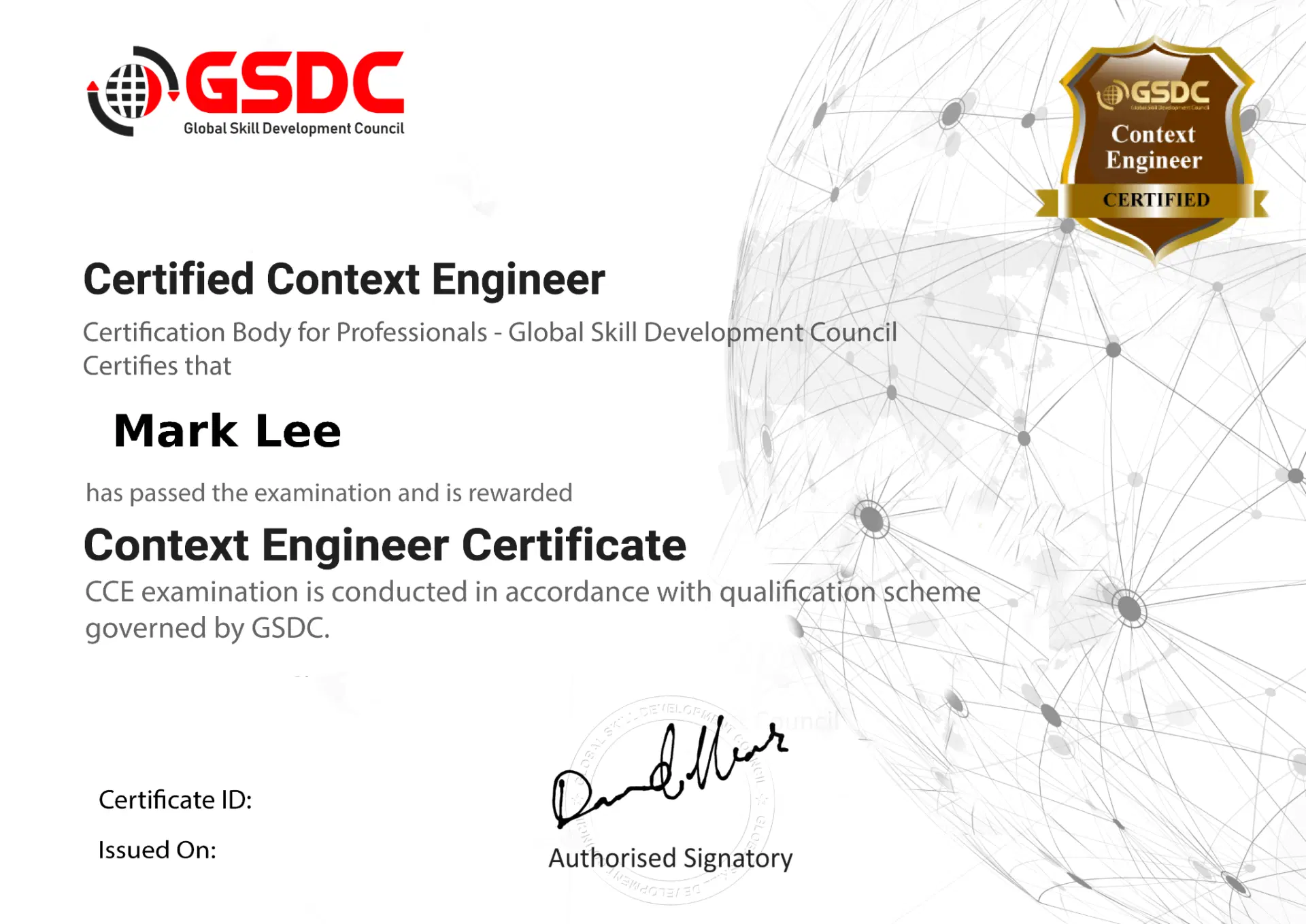
Exam Questions - 42
Exam Format - Multiple choice questions
Exam Language - English
Passing Score - 70%
Exam Duration - 90 Minutes
Proctored Exam - Yes
Certification Validity - 5 Years
Complimentary Retake - Yes
Start Learning For Free
Explore the Learning Hub, our free resource centre with:
- A full LMS to track your progress
- Tutorials and video lessons
- Quizzes to test yourself
- An AI tutor available when you're stuck