
AI Testing Certification & Training Course
NovelVista's Certified AI Testing Course takes you from AI and machine learning fundamentals to production-level model monitoring. It covers model validation, functional testing techniques, API testing, responsible AI testing, and drift detection. With guided hands-on demonstrations, two practice exams and a proctored certification exam, this job-focused AI testing training helps you test, validate and monitor real-world AI systems with confidence.
- In-detailed Learning Materials
- Important IT Service Management Practices.
- Real World Application Via Case Studies
- Global Recognition For IT Services.

Course Overview: Certified Ai Testing
The Certified AI Testing Professional course is built for QA professionals who want to test AI and ML systems, not just talk about them. AI projects rarely fail because nobody wrote test cases. More often, the challenge is that traditional testing was never built to catch how AI models actually fail silently, inconsistently, and only after real-world data shifts. This AI Testing Certification bridges that gap by teaching you to validate a model's behavior before and after it ships.
The AI Testing Training covers the full testing lifecycle. You will learn AI and machine learning foundations, model validation for underfitting and overfitting, reinforcement learning and the questions every tester should ask on an AI project, 22+ functional testing techniques for outputs with no single correct answer, API testing for live model endpoints, responsible AI testing for bias and fairness, and post-deployment testing for drift and production monitoring.
Designed for manual testers, automation engineers, QA leads and test managers, this AI Testing course is equally valuable for professionals whose teams have started shipping AI features without a clear way to test them. No coding or data science background is required every module builds on functional, black-box testing skills you already have.
By completing this certification, you will be able to tell whether a model is ready to ship, apply the right testing techniques to outputs that vary between runs, catch bias before release, and monitor a live model for drift. Unlike theory-heavy programs, this training emphasizes practical application, helping you defend testing decisions to developers and leadership, and strengthening your profile for roles such as AI Tester, AI QA Engineer, ML Test Engineer and Quality Engineering Lead.
What You Will Get?
Learning Outcomes — Certified AI Testing Professional
After the completion of the course, the participants would be able to:
Training Calendar
English
- Self paced videos, assessments, recall quizzes, more
- For more details, reach us at training@novelvista.com
Includes Training, Exam & Certification
Lifetime Access
- Self paced videos, assessments, recall quizzes, more
- For more details, reach us at training@novelvista.com
Includes Training, Exam & Certification
Course Curriculum: Certified AI Testing Course
The Certified AI Testing Professional course provides a complete understanding of AI and ML testing, covering model validation, functional testing, API testing, responsible AI, and production monitoring. Through practitioner-led training, learners gain practical knowledge of how to test, validate and monitor AI systems that hold up in the real world.
Module 1: AI & Machine Learning Foundations for Testers+
- AI and ML Fundamentals: Understand what artificial intelligence and machine learning actually are, and how they differ from rule-based systems.
- The ML Model Lifecycle: Learn the stages a model moves through — data preparation, engineering, evaluation, and deployment — and where testing fits at each one.
- Features, Labels and Training Data: Understand the building blocks every ML model is made of, before you test one.
- Where QA Fits In: Learn why testers get involved earlier in an AI project than they would in traditional software.
Module 2: Testing Supervised Learning Models+
- Underfitting and Overfitting: Learn to recognize when a model is undertrained or overtrained from its validation results.
- Reading Fit Graphs: Understand how to interpret a prediction-vs-actual graph to judge whether a model is ready.
- Validating Clustering Models: Learn to test unsupervised models where there's no single correct output to check against.
- Silhouette Scores: Use a simple, repeatable score to catch a clustering model drifting out of fit.
Module 3: Reinforcement Learning & The Three Questions Every ML Tester Should Ask+
- What Reinforcement Learning Is: Understand how models that learn through rewards and penalties differ from the first two learning types.
- Why It Needs a Different Testing Approach: Learn why reinforcement learning can't be tested the same way as supervised or unsupervised models.
- The Three Questions Framework: Learn to identify a model's learning type, algorithm, and framework before testing any AI project.
- Matching Algorithms to Use Cases: Understand which algorithms and frameworks fit which kind of AI problem.
Module 4: Functional Testing in the Model Evaluation Phase, Part 1+
- Temperature and Token Testing: Learn to test how randomness and output length settings affect a model's answers.
- Prompt and Chain-of-Thought Testing: Verify a model stays within its domain and shows its reasoning, not just a final answer.
- Fantasy Claim Testing: Catch a model fabricating a confident but false answer instead of admitting it doesn't know.
- Accuracy and Repeatability Testing: Measure a model's pass rate and confirm it gives consistent answers across repeated runs.
Module 5: Functional Testing in the Model Evaluation Phase, Part 2+
- Style and Context Testing: Verify a model adapts its tone correctly and remembers conversation history appropriately.
- Invariance and Bidirectional Testing: Confirm a model's output doesn't change when irrelevant data is added or symmetric inputs are reversed.
- API Testing Fundamentals: Understand the request flow behind an AI model, from the UI to the API layer and back.
- Testing a Live Model Endpoint: Learn to generate an API key and test a real model's responses, including tools like ChatGPT's.
Module 6: Responsible AI Testing+
- Fairness Testing: Learn to catch biased outputs across race, gender, age or economic status before release.
- Transparency Testing: Verify a model explains its decisions clearly, especially for high-stakes use cases like loan approvals.
- Privacy and Security Testing: Confirm a model doesn't leak sensitive data, even when a question is reworded to extract it.
- Generalization and Societal Impact: Test whether a model performs fairly across cultures and doesn't cause unintended harm.
Module 7: Post-Deployment Testing & Continuous Monitoring+
- Latency Testing: Measure response time against business SLAs under real-world load.
- Data Drift and Concept Drift: Learn to detect when user questions or correct answers shift after a model goes live.
- Shadow Testing: Run an updated model silently against real traffic before rolling it out.
- A/B Testing and the Monitoring Cycle: Understand how to validate a new model version and keep testing after every update.
Course Details
What Will You Get?+
This AI Testing training provides complete learning support, hands-on practice, assessments and certification preparation to help QA professionals confidently build AI testing expertise.
1. Comprehensive AI Testing Training
- Structured Learning Modules: Progress through 7 carefully sequenced modules that build from AI and ML foundations to production monitoring.
- Videos and Study Materials: Learn through short video lessons, slide decks and downloadable study materials.
Practical Activities: Every module pairs theory with hands-on practice, from fit-validation exercises to live API testing.
2. Access Details
- Lifetime Access: Revisit modules and resources anytime for revision and skill building.
- Multi-Device Learning: Learn from desktop, laptop, tablet or mobile.
Flexible Learning: Study at your own pace, around your work schedule.
3. Course Kit Includes
- Guided Practice: Follow hands-on demonstrations of model validation, fit assessment, and API testing using tools like Postman and the ChatGPT API.
- Practice Exams and Quizzes: Test your readiness with two full practice exams, module quizzes and themed Challenge Zone assessments.
Use Cases and Case Studies: Explore real-world scenarios covering model fit, bias testing, and production drift monitoring.
4. Learning Support
- Practitioner-Led Guidance: Learn from a QA program lead with real-world testing and quality-engineering experience.
- AI Tutor: Ask questions on AI fundamentals, model fit and testing techniques, and deepen your understanding through interactive conversation.
Subject Matter Expert Recordings: Watch recorded sessions covering key AI testing concepts.
5. Certification Value
- Industry-Relevant Credential: Strengthen your profile for AI testing, QA engineering and quality assurance roles.
- Proctored Certification: Earn a certification validated through a proctored exam.
Professional Recognition: Showcase your Certified AI Testing Professional credential on your resume and LinkedIn profile.
6. Bonus Career Resources
- AI Testing Interview Guide: 100 technical questions commonly asked in AI testing interviews.
- Resume & Portfolio Templates: Professional templates to document your testing deliverables and case studies.
- Lifetime Alumni Network: Ongoing access to peer learning, case-study discussion and career opportunities.
Eligibility+
This course is designed for QA professionals who want to test AI systems and build a career in AI quality engineering.
- Manual and functional testers looking to add AI testing skills to their profile.
- Automation and API testers who want to validate AI model behavior and endpoints at scale.
- QA leads and test managers responsible for AI testing initiatives and team upskilling.
- Developers and ML engineers who want to understand testing responsibilities beyond model coding.
- Technical leads overseeing AI delivery who need to align testing with release confidence.
- Working professionals who want practical, hands-on exposure to model validation, functional testing, APIs and responsible AI checks.
- Professionals who want to evaluate when a model is ready to ship, how to catch bias, and how to monitor for drift after deployment.
Pre-requisites+
This course has no mandatory technical prerequisites. It's built so a working tester can start immediately.
- No coding required: AI testing is primarily functional, black-box testing — asking a model a question and evaluating the output. Roughly 75–80% of the course covers this approach.
- No machine learning or data science background needed: Module 1 builds AI and ML concepts from the ground up, including training data, features, and model fit.
- No prior AI testing certification needed: Unlike ISTQB CT-AI, this certification has no Foundation-level prerequisite.
- Recommended, not required: Prior experience in manual or automation software testing will help you move faster through the functional testing modules, but isn't mandatory.
- A computer with internet access: All labs, demos and the practice environment run in the browser; no local setup is needed.
Training Delivery Style+
This AI Testing course is self-paced and fully online, designed to fit around a working QA schedule.
- Self-Paced Video Lessons: Work through all 7 modules on your own schedule, with no fixed class times.
- Guided Demonstrations: Follow real walkthroughs — model fit graphs, a linear regression demo, API testing in Postman — rather than abstract theory alone.
- Module-by-Module Structure: Each module builds on the last, from foundations through production monitoring, so concepts compound logically.
- AI Tutor Support: Get an explanation or a hint inside any module, any time you're blocked, without waiting on a scheduled class.
- Lifetime Access: Revisit any module or demonstration as many times as you need, even after certification.
Key Benefits+
- Test AI, Not Just Software: Learn the testing categories traditional QA training never covered model fit, bias, drift directly applicable to AI features your team is already shipping.
- No Prerequisite, Real Depth: Unlike ISTQB CT-AI, start immediately with no Foundation-level certificate required, while still covering the full testing lifecycle in depth.
- Learn on Real Tools: Practice on an actual model API, including ChatGPT's, not just theoretical examples.
- Career-Ready Evidence: Walk away with real deliverables a test plan, a validation report, an API test collection you can show a hiring manager.
- Stay Relevant as AI Grows: Build the specific skill set responsible AI testing, drift monitoring that's becoming a standard QA expectation, not a niche specialty.
Exam & Certification+
- Format: 42 multiple-choice questions, proctored, completed online.
- Duration: 90 minutes.
- Passing Score: 70%.
- Language: English.
- Validity: The certification is valid for 5 years.
- Retake Policy: One complimentary retake is included if you don't pass on your first attempt.
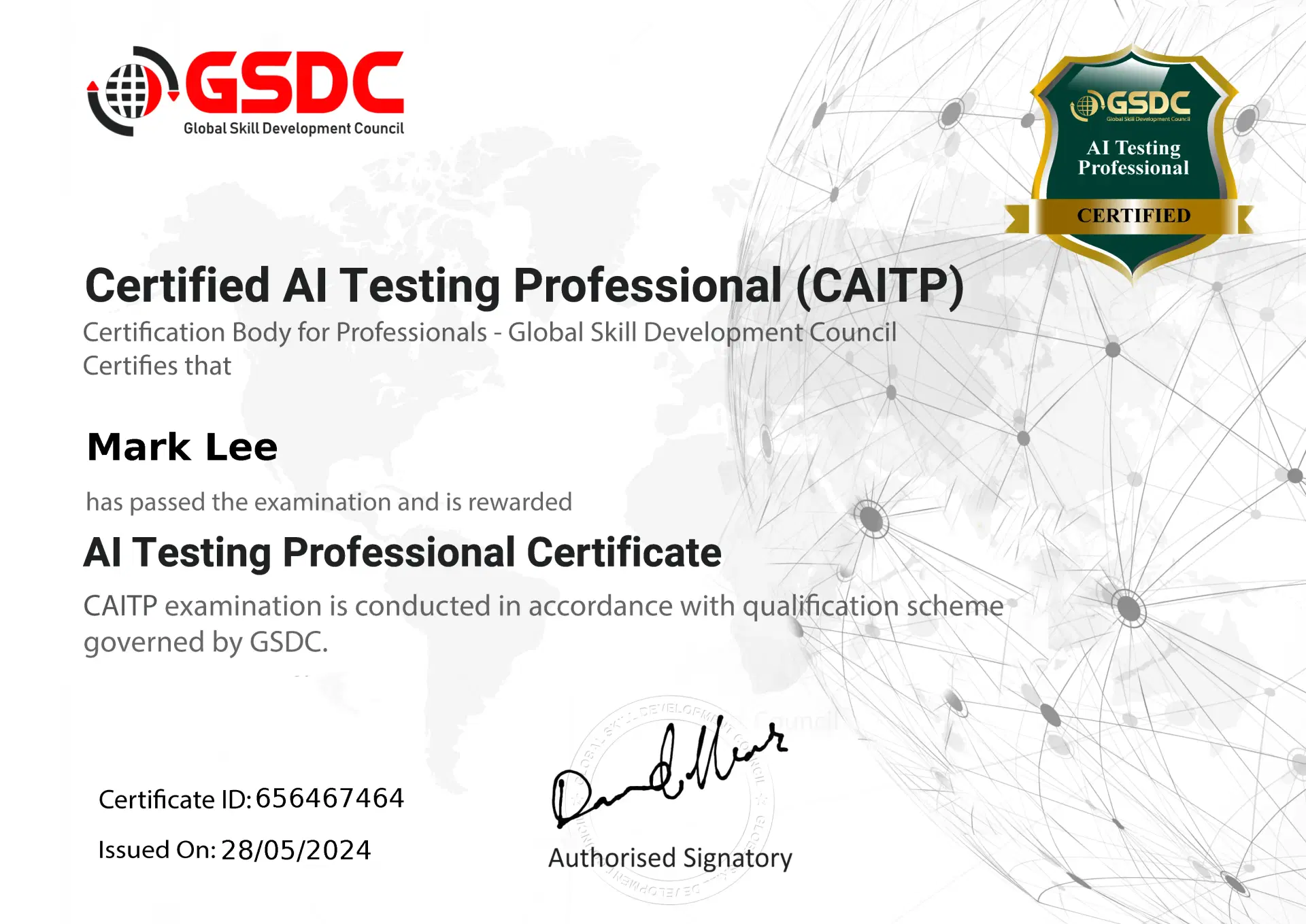
- Issuing Body: Certified by GSDC (Global Skill Development Council), an independent certification body, with the credential verifiable by employers and shareable on LinkedIn.
Support & After-Training Resources+
- AI Tutor, Always Available: Ask questions inside any module and get an explanation or walkthrough any time you're stuck.
- Human Learning Support: If the AI tutor can't resolve it, a learning support team picks up from there.
- Private Alumni Community: Lifetime access to a community of other learners — compare how you assessed a model's fit, discuss case studies, and keep using it when these problems show up on your real projects.
- Interview and Career Prep: A guide to the 100 most-asked AI testing interview questions, plus resume and portfolio templates built around your course deliverables.
- 30-Day Money-Back Guarantee: If the course isn't the right fit, request a refund within 30 days under the enrollment terms.
Certified AI Testing Exam: Key Details
Exam format: Multiple choice
Number of questions: 42
Exam duration: 90 minutes
Language: English
Passing score: 70%
Proctored: Yes
Certification validity: 5 years
Complimentary retake: Yes
Start Learning For Free
Explore the free Introduction to AI testing, which includes:
- Progress tracking as you move through the course
- A slide deck and a 44-minute video lesson
- A hands-on interactive lab (20 minutes)
- A quiz and themed challenges to test yourself