
Category | Generative AI
Last Updated On 30/05/2026
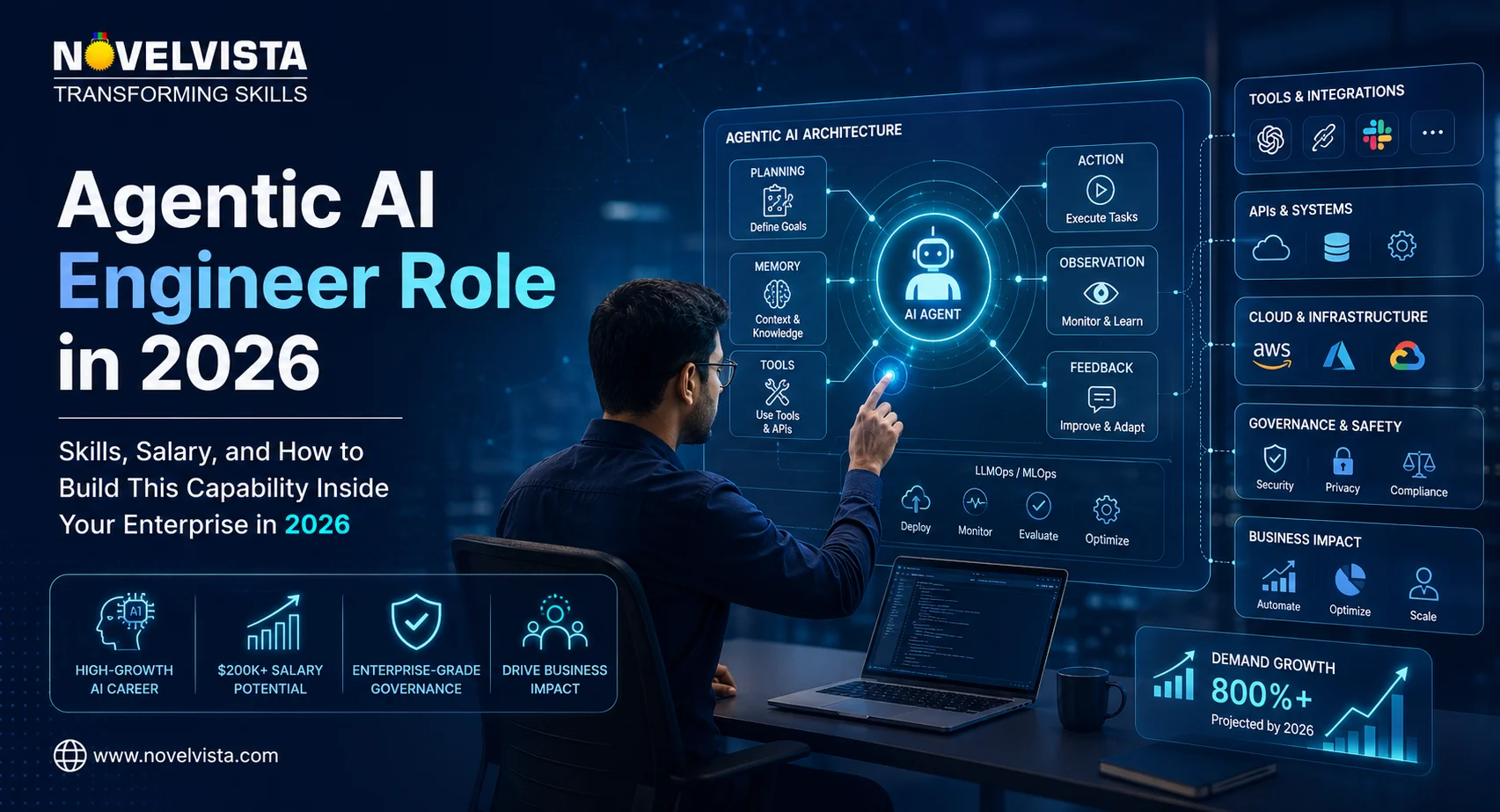
Agentic AI is moving from experimentation to enterprise execution. This blog explains what an agentic AI engineer does, the skills required, salary expectations, practical job responsibilities, useful tools, and a corporate roadmap for building this capability inside your organisation in 2026.
For business leaders, L&D teams, technology heads, and HR decision-makers, the goal is simple: understand the role clearly and create a structured upskilling plan before competitors build the talent moat first.
An agentic AI engineer is a technical professional who designs, builds, tests, and governs AI systems that can plan tasks, use tools, call APIs, retrieve information, remember context, and complete multi-step workflows with controlled autonomy.
Unlike a traditional prompt engineer, this role is not limited to writing better prompts. Unlike a machine learning engineer, the focus is not always model training from scratch. The agentic AI engineer works at the application, workflow, orchestration, integration, and governance layer of AI.
In simple terms, they build AI systems that can “do work,” not just “generate answers.”
For example, a basic chatbot may answer an HR policy question. An agentic AI system can read the policy, ask follow-up questions, check employee eligibility, raise a ticket, update the HRMS, notify the manager, and record an audit trail.
In 2026, many organisations have already tested ChatGPT, Copilot, Gemini, and internal GenAI assistants. The next challenge is scale.
Leaders are asking harder questions:
This is where the agentic AI engineer becomes critical. The role connects AI strategy with operational execution.
Enterprises do not need more isolated AI demos. They need governed AI workflows that reduce manual effort, improve service speed, and support employees without creating compliance risks.
A practical agentic AI engineer job description usually includes responsibilities across design, development, integration, testing, deployment, and governance.
Typical responsibilities include:
A strong agentic AI engineer job description should also include business understanding. The best professionals in this role are not only coders. They understand processes, risks, user journeys, and enterprise adoption realities.
The agentic AI engineer role requires a blended skill set. It sits between software engineering, AI engineering, cloud architecture, automation, and product thinking.
Professionals must understand how large language models work at a practical level. They do not always need to train foundation models, but they must understand tokens, context windows, embeddings, grounding, hallucination, model selection, and prompt behaviour.
This is the heart of the role. The agentic AI engineer must know patterns such as planning, reflection, tool use, routing, memory, evaluator agents, human-in-the-loop approval, and multi-agent orchestration.
Agents become useful when they connect with systems. Engineers should know REST APIs, webhooks, authentication, data contracts, function calling, enterprise connectors, and workflow automation platforms.
Retrieval-augmented generation helps agents access trusted company knowledge. Engineers need skills in vector databases, embeddings, document chunking, metadata filtering, hybrid search, semantic search, and knowledge governance.
Enterprises need scalable deployment, not laptop experiments. Skills in Azure, AWS, Google Cloud, containers, CI/CD, monitoring, secrets management, and secure environments are valuable.
Agentic systems can behave unpredictably. That makes evaluation essential. Engineers must test answer quality, task completion, refusal behaviour, tool selection, latency, cost, and safety outcomes.
The agentic AI engineer must build guardrails. This includes access control, audit logs, data privacy, approval workflows, model risk controls, and fallback mechanisms.
The right stack depends on enterprise maturity, cloud preference, security model, and use case complexity. Common agentic AI tools for AI engineer teams include:
| Tool Category | Examples | Enterprise Use |
|---|---|---|
| LLM platforms | Azure OpenAI, OpenAI API, Anthropic Claude, Google Gemini | Reasoning, generation, tool use, multimodal workflows |
| Agent frameworks | LangChain, LangGraph, CrewAI, Semantic Kernel | Workflow orchestration, state management, agent collaboration |
| Knowledge systems | Azure AI Search, Pinecone, Weaviate, Chroma | RAG, semantic search, knowledge grounding |
| Automation platforms | n8n, Power Automate, Zapier, Make | Business process automation and low-code integration |
| Observability | LangSmith, Arize, Phoenix, custom dashboards | Tracing, evaluation, monitoring, debugging |
| Governance | IAM, DLP, audit logs, approval workflows | Security, compliance, operational control |
When selecting agentic AI tools for AI engineer teams, avoid chasing hype. Choose tools that support security, maintainability, integration, and measurable business outcomes.
The agentic AI engineer salary varies widely because the role is still emerging. Compensation depends on experience, location, cloud skills, product exposure, and whether the person can build production-grade systems.
| Experience Level | India Salary Range | Global/US-Oriented Range | Typical Capability |
|---|---|---|---|
| Entry Level | ₹6 LPA – ₹12 LPA | $70K – $110K | Prompting, basic Python, APIs, simple agents |
| Mid Level | ₹15 LPA – ₹35 LPA | $110K – $160K | RAG, orchestration, cloud deployment, testing |
| Senior Level | ₹35 LPA – ₹70+ LPA | $160K – $220K+ | Enterprise architecture, governance, multi-agent systems |
For hiring teams, the agentic AI engineer salary should be benchmarked against AI engineer, GenAI engineer, platform engineer, and automation architect roles. The highest compensation usually goes to professionals who can move beyond prototypes and deploy secure, measurable, production-ready agent systems.
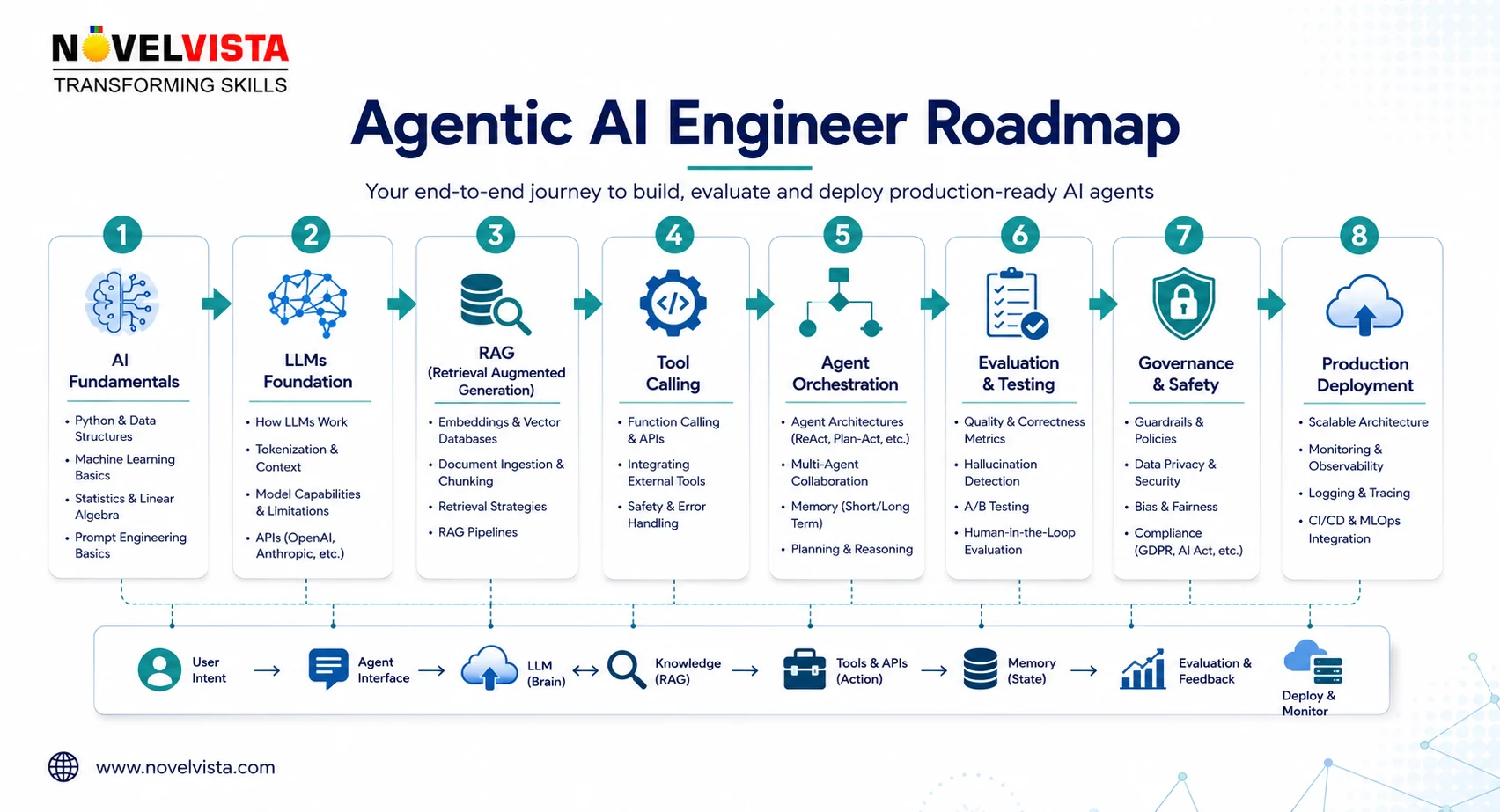
A practical agentic AI engineer roadmap should move from fundamentals to enterprise delivery.
Start with Python, APIs, data formats, cloud basics, and GenAI fundamentals. Learn how LLMs process prompts, context, documents, and structured outputs.
Move from static prompts to dynamic workflows. Build small projects where an AI agent can call tools, search documents, retrieve data, and respond with grounded answers.
Create systems that can plan, execute, validate, and escalate. Practice with sales support, IT ticket triage, HR policy assistants, procurement workflows, and customer service use cases.
A serious agentic AI engineer roadmap must include testing. Build evaluation datasets, define success metrics, monitor failures, and create human approval checkpoints.
Learn CI/CD, containerisation, cloud deployment, access control, monitoring, audit logging, and cost optimisation. Production readiness is where real career value appears.
Hiring one expert is useful. Building internal capability is better.
Start with processes that are repetitive, knowledge-heavy, and measurable. Good examples include IT service desk automation, contract review support, sales proposal generation, onboarding assistance, compliance Q&A, and finance operations.
An enterprise agentic AI team should include AI engineers, software developers, cloud architects, data engineers, security experts, business process owners, and L&D leaders.
This structure prevents AI from becoming a side project owned by one enthusiastic developer.
Many organisations already have strong developers, automation specialists, cloud engineers, and data analysts. With the right training, these professionals can transition into agentic AI engineer roles faster than external hiring cycles.
Enterprises should decide what agents can access, what actions need approval, how logs are stored, how failures are escalated, and who owns risk.
Governance should not arrive after deployment. It should shape the design.
Instead of building one-off agents, create reusable components such as authentication modules, prompt templates, tool connectors, RAG pipelines, evaluation suites, and observability dashboards.
Agentic AI should be measured through business KPIs, not just technical demos.
Useful metrics include:
| Function | Agentic AI Use Case | Business Impact |
|---|---|---|
| IT | Auto-triage incidents and recommend fixes | Faster resolution and lower support load |
| HR | Employee policy assistant with workflow actions | Better employee experience |
| Sales | Proposal and account research agents | Improved sales productivity |
| Finance | Invoice validation and exception routing | Reduced manual review time |
| Legal | Contract clause review and risk flagging | Faster first-level review |
| Customer Support | Case summarisation and next-best action | Improved response quality |
These use cases show why the agentic AI engineer is becoming important for enterprises that want AI to support real business operations, not just isolated experimentation.
Enterprises often struggle when they treat agentic AI as a plug-and-play miracle. Avoid these mistakes:
A good agentic AI engineer understands that autonomy without governance is risk. The winning enterprise formula is controlled autonomy, measurable value, and continuous improvement.
The agentic AI engineer is becoming one of the most important enterprise AI roles in 2026 because companies are moving from AI chat experiments to AI workflow execution. This role blends software engineering, GenAI, cloud, automation, RAG, API integration, evaluation, and governance into one high-impact capability.
For professionals, the opportunity is strong. For enterprises, the urgency is real. Teams that build this capability early will be better positioned to automate complex workflows, improve employee productivity, and create safer AI operating models.
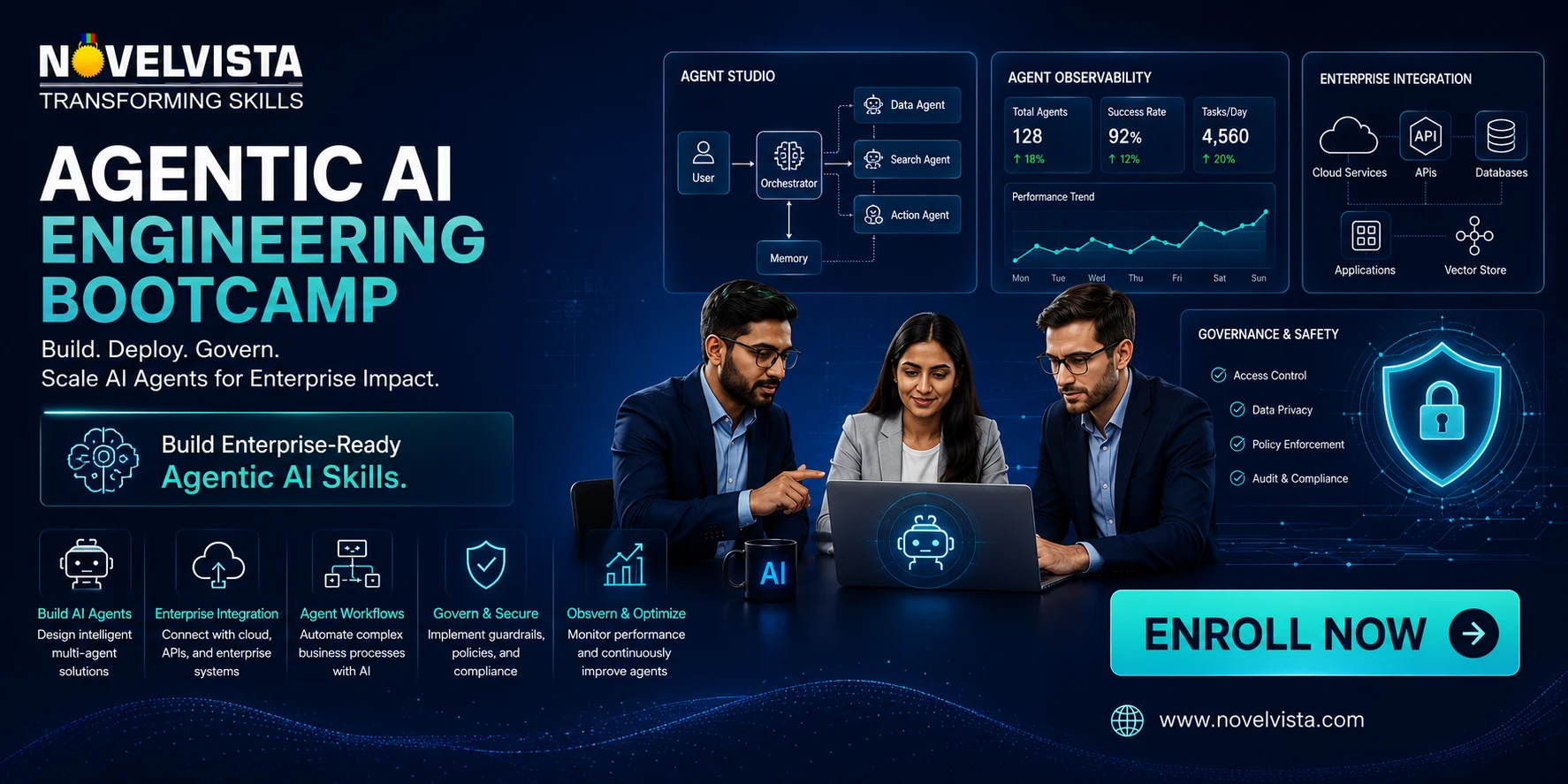
If your organisation wants to develop this capability internally, explore NovelVista’s Agentic AI Engineering Bootcamp. The program is designed to help enterprise teams understand agentic AI concepts, build real-world workflows, apply governance, and move from experimentation to production-ready implementation.
In 2026, the question is no longer whether AI agents will enter the enterprise. The real question is whether your teams will be ready to design, govern, and scale them responsibly.
Author Details

Confused About Certification?
Get Free Consultation Call
Stay ahead of the curve by tapping into the latest emerging trends and transforming your subscription into a powerful resource. Maximize every feature, unlock exclusive benefits, and ensure you're always one step ahead in your journey to success.