
Category | AI And ML
Last Updated On 29/05/2026
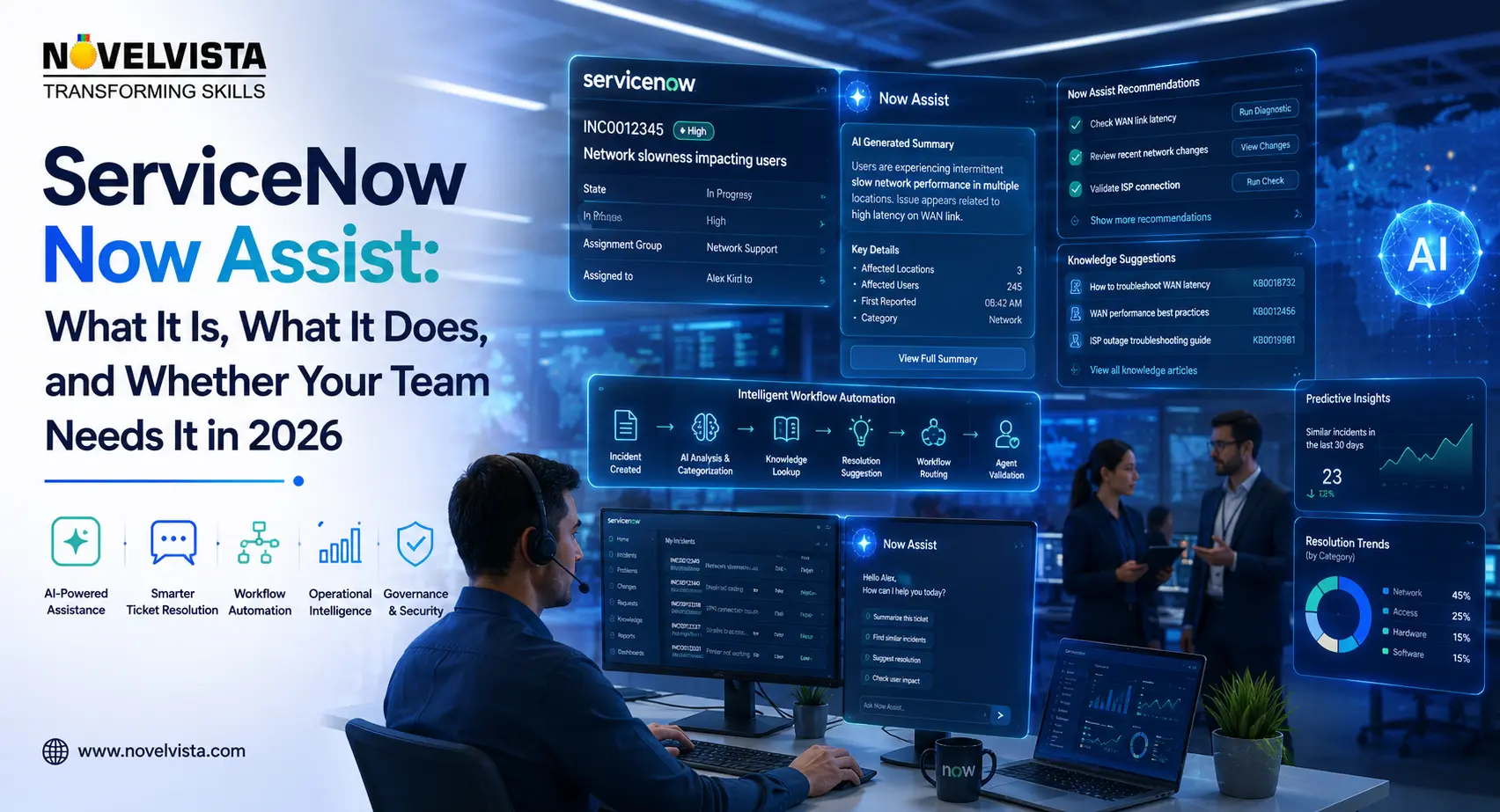
AI is rapidly moving from experimental pilots into operational workflows. In 2026, enterprise IT teams are no longer asking whether AI belongs inside service management platforms. The real question is whether those AI capabilities can improve ticket resolution, reduce manual effort, and support employee productivity without creating governance chaos.
This blog explains what is now assist in servicenow, how generative AI works inside the platform, major servicenow now assist features, practical enterprise use cases, governance implications, adoption challenges, and whether investing in now assist service now capabilities actually makes sense for modern IT teams.
Now Assist is ServiceNow’s generative AI layer designed to enhance workflows across ITSM, customer service, HR, security operations, and enterprise productivity environments.
At a high level, what is now assist in servicenow becomes easier to understand when viewed as an AI productivity engine embedded directly into workflows employees already use daily.
Instead of replacing ITSM platforms, now assist service now enhances them using generative AI, natural language interaction, AI summarization, automated resolution suggestions, conversational search, workflow recommendations, and ticket intelligence.
The platform combines ServiceNow workflow data with large language model capabilities to accelerate operational tasks.
Enterprise service operations generate enormous amounts of repetitive work, including ticket summarization, knowledge searches, incident classification, manual documentation, resolution drafting, chat support, and workflow routing.
Traditional automation handled rule-based activities well, but struggled with context-heavy tasks. That gap created the demand for now assist service now functionality.
| Business Challenge | How Now Assist Responds |
|---|---|
| Slow ticket resolution | AI-generated summaries and recommendations |
| Knowledge overload | Context-aware AI search |
| Agent burnout | Reduced repetitive documentation |
| Support scaling problems | AI-assisted employee support |
| Workflow fragmentation | Integrated conversational AI assistance |
The biggest reason enterprises are evaluating servicenow now assist features is operational productivity.
AI automatically condenses long ticket histories into readable summaries. This reduces context-switching for support engineers.
The platform suggests fixes based on historical incidents and knowledge articles.
Employees can interact with workflows using natural language instead of complex ticket forms.
Knowledge recommendations become more contextual and intelligent.
Support teams spend less time writing repetitive updates.
AI recommends approvals, routing actions, and operational next steps. These servicenow now assist features reduce operational friction rather than replace IT teams entirely.
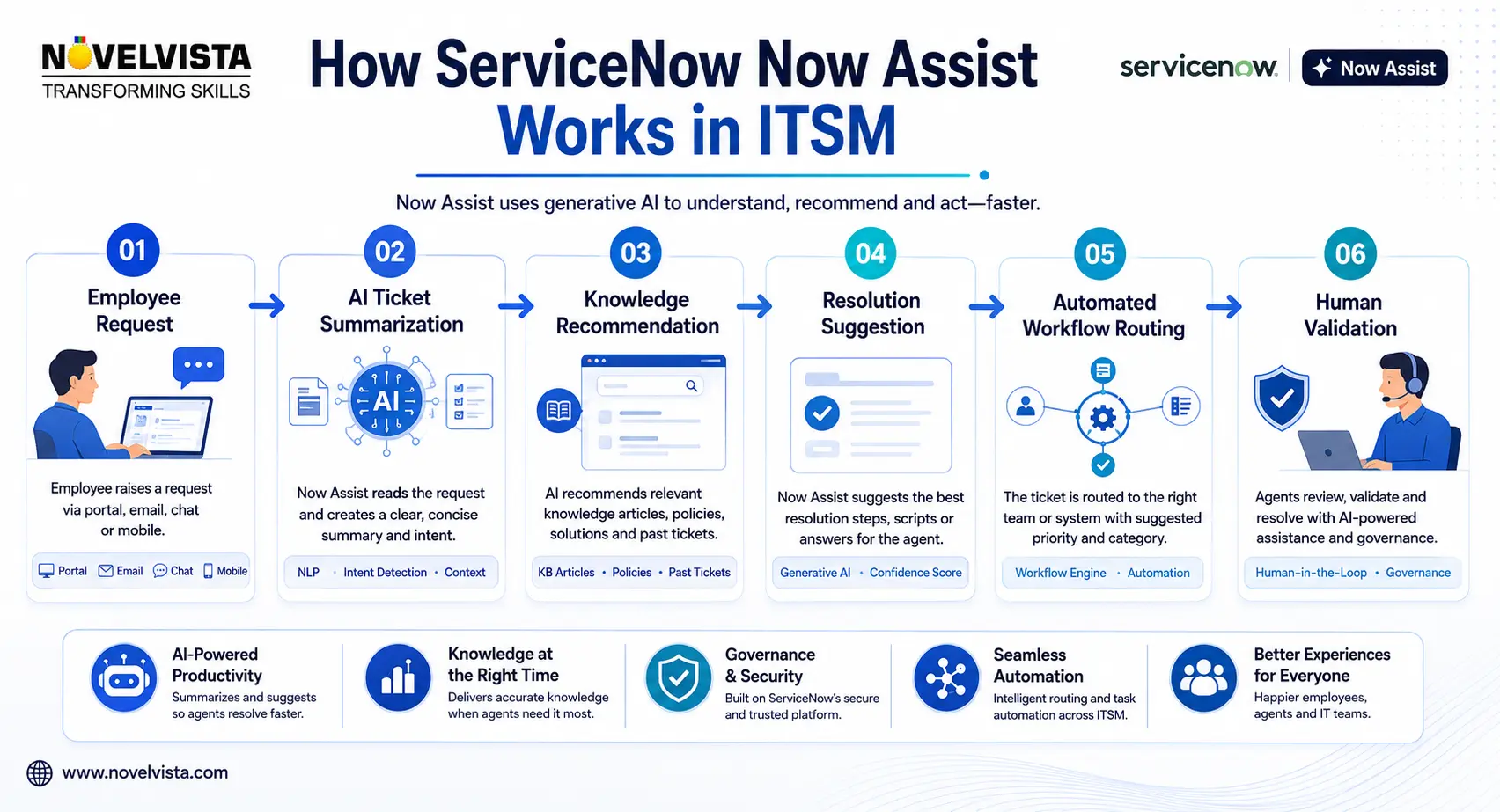
The strongest adoption driver remains servicenow now assist for itsm capabilities. Organizations are deploying AI-enhanced ITSM for incident management, problem management, knowledge management, employee self-service, and change management.
In incident management, AI summarizes incidents, recommends remediation steps, and improves escalation speed. In problem management, patterns across incidents become easier to identify.
| ITSM Area | Now Assist Impact |
|---|---|
| Incident Resolution | Faster triage and summarization |
| Knowledge Articles | Automated content drafting |
| Employee Support | Improved self-service experience |
| Change Reviews | Risk intelligence assistance |
| Major Incidents | Real-time operational summaries |
This is why servicenow now assist for itsm is becoming central to enterprise AI operations discussions.
The intelligence layer behind now assist service now combines enterprise workflow data, knowledge bases, contextual ticket history, LLM-powered text generation, and conversational AI models.
The system does not simply generate random outputs. It works within operational context using enterprise data boundaries and workflow orchestration.
This architecture matters because enterprise AI requires governance, accuracy, auditability, security controls, and context awareness. Without those elements, generative AI creates operational risk instead of productivity.
Although ITSM receives the most attention, servicenow now assist features extend across multiple departments.
The broader the workflow ecosystem, the more valuable now assist service now becomes.
| Capability | Now Assist | Microsoft Copilot | Traditional Automation |
|---|---|---|---|
| Workflow Context | Strong | Moderate | Limited |
| Enterprise ITSM Focus | Very High | Low | Medium |
| Generative AI | Native | Native | No |
| Knowledge Intelligence | Advanced | Moderate | Rule-Based |
| Operational Workflows | Deeply Integrated | Productivity-Focused | Script-Based |
Enterprise buyers increasingly compare ServiceNow AI tools with Microsoft Copilot ecosystems. Some organizations also combine AI workflow platforms with broader productivity enablement through microsoft copilot training to improve enterprise AI readiness.
Organizations evaluating servicenow now assist for itsm usually prioritize faster resolution times, reduced manual documentation, improved employee experience, and better knowledge reuse.
AI reduces investigation overhead, helps support teams spend less time writing repetitive notes, makes self-service interactions more conversational, and improves access to institutional knowledge.
For mature organizations, now assist service now can improve operational scalability significantly.
Generative AI inside IT operations also introduces real risks. AI-generated recommendations may occasionally be inaccurate, sensitive ticket information requires governance controls, and overreliance can weaken human troubleshooting skills.
Enterprises need clear AI usage policies, review checkpoints, data boundaries, and escalation rules. The smartest organizations treat servicenow now assist features as augmentation tools, not autonomous decision-makers.
The answer depends on operational maturity.
AI amplifies existing operational quality. It does not magically fix broken service management processes. That is the most important reality behind what is now assist in servicenow discussions.
Before deploying now assist service now, enterprises should evaluate readiness across data quality, workflow maturity, governance, security, and training.
| Readiness Area | Questions to Ask |
|---|---|
| Data Quality | Are knowledge articles accurate? |
| Workflow Maturity | Are ITSM processes standardized? |
| Governance | Do AI usage policies exist? |
| Security | Is sensitive operational data protected? |
| Training | Can teams effectively use AI tools? |
Technology alone is not enough. Teams adopting servicenow now assist for itsm need skills in AI governance, workflow optimization, prompt engineering, knowledge management, operational analytics, incident intelligence, and AI-assisted automation.
Organizations investing in AI operations often strengthen workforce readiness through structured programs like AI in ITSM & AIOps Training.
The future of enterprise service management will likely include AI-driven operational copilots, predictive service operations, autonomous workflow orchestration, conversational enterprise interfaces, and real-time operational intelligence.
By 2026, the debate is shifting from whether AI belongs in ITSM to how responsibly organizations can operationalize it. That shift is exactly why now assist service now has become strategically important.
The rise of now assist service now reflects a broader transformation happening across enterprise operations. ITSM platforms are evolving from ticket management systems into AI-assisted operational ecosystems capable of accelerating support, improving employee experience, and reducing repetitive manual work.
Understanding what is now assist in servicenow is no longer just relevant for platform administrators. It now matters for IT leaders, operations teams, service desk managers, governance specialists, and enterprise transformation teams evaluating how generative AI fits into operational workflows.
The most successful organizations will not simply deploy AI features. They will combine governance, process maturity, workforce enablement, and AI strategy into a sustainable operational model.
If your organization is preparing for AI-enabled IT operations, explore NovelVista’s AI in ITSM & AIOps Program to build practical capabilities around AI-powered service management, operational intelligence, automation strategy, and enterprise-ready AI adoption.
Author Details

Confused About Certification?
Get Free Consultation Call
Stay ahead of the curve by tapping into the latest emerging trends and transforming your subscription into a powerful resource. Maximize every feature, unlock exclusive benefits, and ensure you're always one step ahead in your journey to success.


