

AI Governance Professional Certification Course
- Industry Expert Trainers
- Online learning session
- Accredited by GSDC
- Global Recognition

AI Governance Course Overview
This AI Governance Course by NovelVista is designed to help professionals understand how organizations can govern AI systems throughout their lifecycle while managing risks, responsibilities, compliance requirements, and business objectives. The program combines AI governance frameworks, risk management, responsible AI, regulatory compliance, data governance, security, controls, and enterprise governance practices.
The AI Governance Training develops a structured understanding of how AI governance operates across business, technical, legal, risk, compliance, security, and executive functions. Participants learn how to establish governance policies, classify AI systems, assess risks and impacts, define accountability, monitor controls, and support responsible AI adoption.
Delivered by NovelVista, this AI Governance Certification program follows a practical, enterprise-focused approach with expert-led sessions, real-world governance scenarios, hands-on exercises, and industry-relevant frameworks. NovelVista's AI Governance Certification Course and Training is trusted by professionals and organizations across the USA, India, Canada, the UK, UAE, Saudi Arabia, Australia, Germany, and beyond, making it a reliable choice for high-quality AI Governance Certification.

What You Will Get?
Learning Outcomes
After the completion of the course, the participants would be able to:
Training Calendar
English
- Self paced videos, assessments, recall quizzes, more
- For more details, reach us at training@novelvista.com
Includes Training, Exam & Certification
Lifetime Access
- Self paced videos, assessments, recall quizzes, more
- For more details, reach us at training@novelvista.com
Includes Training, Exam & Certification
Course Curriculum
Certified AI Governance Professional
Foundations of AI Governance+
This module introduces the fundamental concepts of AI governance and explains how organizations establish structures, principles, roles, and responsibilities for responsible AI adoption.
Introduction to AI Governance
Understand the purpose, scope, and fundamental concepts of AI governance within modern organizations.
What is AI Governance?
Explore the principles, structures, processes, and controls used to govern AI systems and their associated risks.
Why AI Governance Matters
Understand why organizations require structured governance to manage AI opportunities, risks, responsibilities, and business impacts.
AI Governance vs AI Risk Management
Explore the relationship and distinction between AI governance and AI risk management.
AI Governance vs Responsible AI
Understand how responsible AI principles fit within broader AI governance structures and organizational practices.
AI Governance Frameworks & Standards+
This module introduces major AI governance frameworks and standards and develops the ability to understand, compare, and select appropriate governance approaches.
AI Governance Frameworks Overview
Explore the purpose and structure of major AI governance frameworks and their role in enterprise AI programs.
ISO/IEC 42001: AI Management System (AIMS)
Understand the foundations of ISO/IEC 42001 and its approach to establishing an AI Management System.
ISO/IEC 42001 Structure and Key Requirements
Explore the structure, key requirements, and governance considerations associated with ISO/IEC 42001.
NIST AI Risk Management Framework (AI RMF)
Understand the NIST AI RMF and its approach to managing AI risks throughout the AI lifecycle.
Govern, Map, Measure, and Manage
Explore the four core functions of the NIST AI RMF and how they support structured AI risk management.
AI Governance Strategy, Policies & Accountability+
This module focuses on establishing the strategic, policy, organizational, and accountability structures required for an effective AI governance program.
Developing an AI Governance Strategy
Learn how to establish an AI governance strategy aligned with organizational objectives and AI adoption priorities.
AI Governance Policy
Understand the components and purpose of an enterprise AI governance policy.
AI Acceptable Use Policy
Explore approaches for defining acceptable and responsible use of AI systems across organizations.
AI Ethics Policy
Understand how ethical principles can be translated into organizational AI policies and practices.
Generative AI Usage Policy
Learn how organizations can establish policies for responsible and controlled use of Generative AI.
AI Inventory, Classification & AI Lifecycle Governance+
This module focuses on identifying AI systems, classifying them according to risk and business context, and applying governance throughout their lifecycle.
AI System Inventory
Learn how organizations can identify, document, and maintain inventories of AI systems.
AI Asset Management
Understand how AI systems and related assets can be tracked and managed across the organization.
AI Use Case Identification
Explore approaches for identifying AI use cases and understanding their business purpose and context.
AI System Classification
Learn how AI systems can be categorized according to their characteristics, purpose, and governance requirements.
AI Risk Classification
Understand how AI systems can be classified based on their associated risks and potential impacts.
AI Risk Management+
This module develops practical knowledge of identifying, assessing, treating, monitoring, and reporting risks associated with AI systems.
Introduction to AI Risk Management
Understand the foundations and importance of structured AI risk management.
AI Risk Identification
Learn how to identify potential risks across AI systems, processes, data, vendors, and use cases.
AI Risk Assessment
Explore approaches for assessing the likelihood, impact, and significance of AI-related risks.
AI Risk Analysis
Understand how identified AI risks can be analyzed using structured methodologies.
AI Risk Scoring
Learn how organizations can apply risk scoring approaches to prioritize AI risks.
AI Impact Assessment & Trustworthy AI+
This module focuses on evaluating the broader effects of AI systems and applying trustworthy AI principles across governance and decision-making.
AI Impact Assessment
Understand how organizations can assess the potential effects and consequences of AI systems.
Algorithmic Impact Assessment
Explore structured approaches for assessing potential impacts associated with algorithmic systems.
Assessing AI Benefits and Harms
Learn how to evaluate both potential benefits and adverse impacts associated with AI use.
Stakeholder Impact Analysis
Understand how AI systems may affect different stakeholder groups and how these impacts can be assessed.
Human Rights and AI
Explore the relationship between AI governance, human rights, and responsible technology use.
AI Data Governance & Privacy+
This module examines how organizations can govern data used by AI systems while addressing data quality, privacy, security, access, provenance, and lifecycle considerations.
AI Data Governance
Understand the principles and structures required to govern data used throughout AI systems.
Data Quality for AI
Explore how data quality can affect AI system performance, reliability, and risk.
Data Collection and Use
Understand governance considerations for collecting, processing, and using data for AI.
Data Provenance
Learn how to track the origins and history of data used in AI systems.
Data Lineage
Understand how data lineage supports transparency, accountability, traceability, and governance.
Generative AI Governance+
This module focuses on governing Generative AI and Large Language Models while addressing enterprise use, data risks, security, content risks, and responsible adoption.
Generative AI Governance
Understand governance principles and practices for responsible enterprise adoption of Generative AI.
Large Language Model (LLM) Governance
Explore governance considerations associated with the development, procurement, deployment, and use of LLMs.
Generative AI Risk Management
Understand how organizations can identify and manage risks specific to Generative AI systems.
Generative AI Acceptable Use
Learn how organizations can define responsible and controlled use of Generative AI tools.
Generative AI Data Risks
Explore data-related risks associated with Generative AI applications and enterprise use.
AI Security & Third-Party AI Risk+
This module examines AI security governance, AI-specific threats, third-party risks, procurement considerations, and supply chain dependencies.
AI Security Governance
Understand how security governance can be incorporated into AI development, deployment, and operations.
AI Threat and Vulnerability Management
Explore approaches for identifying, assessing, prioritizing, and managing AI-related threats and vulnerabilities.
AI Model Security
Understand security considerations associated with AI models and model-related assets.
AI Application Security
Explore security governance requirements for applications that integrate AI capabilities.
Adversarial Attacks on AI
Understand different forms of adversarial attacks and their implications for AI governance.
AI Governance & Regulatory Compliance+
This module develops an understanding of the regulatory landscape surrounding AI and how organizations can translate regulatory requirements into governance and compliance practices.
AI Regulatory Landscape
Understand the evolving regulatory environment surrounding artificial intelligence.
EU AI Act
Explore the structure and governance implications of the EU AI Act.
Risk-Based Classification under the EU AI Act
Understand how AI systems can be considered according to different levels of regulatory risk.
High-Risk AI Systems
Explore governance and compliance considerations associated with high-risk AI systems.
AI Transparency Requirements
Understand transparency-related governance considerations for AI systems and stakeholders.
AI Governance Controls, Monitoring & Assurance+
This module focuses on establishing controls, monitoring mechanisms, assurance practices, and reporting structures to evaluate AI governance effectiveness.
AI Governance Controls
Understand how governance controls can be designed to address AI-related risks and requirements.
AI Control Frameworks
Explore structured approaches for organizing AI governance controls across enterprise functions.
AI Control Testing
Learn how AI governance controls can be evaluated and tested for effectiveness.
AI Risk and Compliance Monitoring
Understand how organizations can monitor AI risks and compliance requirements on an ongoing basis.
AI Performance Monitoring
Explore governance considerations for monitoring AI system performance and operational outcomes.
Implementing an Enterprise AI Governance Program+
This module focuses on translating AI governance principles and frameworks into a structured enterprise governance program.
AI Governance Implementation Roadmap
Learn how to develop a structured roadmap for implementing an enterprise AI governance program.
AI Governance Maturity Models
Understand maturity models used to evaluate the development and effectiveness of AI governance capabilities.
AI Governance Gap Assessment
Learn how to identify gaps between current AI governance capabilities and desired governance requirements.
AI Governance Prioritization
Explore approaches for prioritizing governance initiatives according to risk, business needs, regulatory requirements, and organizational readiness.
AI Governance Framework Implementation
Understand how governance frameworks can be translated into organizational policies, processes, controls, and responsibilities.
Course Details
What Will You Get?+
This AI Governance Training is designed to provide comprehensive knowledge across AI governance frameworks, AI risk management, responsible AI, regulatory compliance, Generative AI governance, data governance, security, controls, monitoring, and enterprise implementation.
Governance Framework Learning+
- Comprehensive AI Governance Course covering 12 learning modules
- Understanding of major AI governance frameworks and standards
- Practical knowledge of ISO/IEC 42001 and AI Management Systems
- Exposure to NIST AI RMF, ISO/IEC 23894, ISO/IEC 38507, OECD, and UNESCO principles
- Understanding of AI governance operating models and accountability structures
AI Risk & Responsible AI Skills+
- AI risk identification, assessment, analysis, scoring, and treatment
- AI risk registers, ownership, monitoring, acceptance, and reporting
- AI impact assessment and algorithmic impact assessment concepts
- Understanding of fairness, bias, transparency, explainability, privacy, safety, and accountability
- Human oversight and trustworthy AI governance concepts
Regulatory & Compliance Knowledge+
- Understanding of the AI regulatory landscape
- EU AI Act concepts and risk-based classification
- High-risk AI system governance considerations
- AI documentation and record-keeping
- Mapping regulatory requirements to internal controls
- AI compliance monitoring and regulatory change management
Generative AI Governance Skills+
- Enterprise Generative AI governance
- LLM governance and risk management
- Generative AI acceptable-use governance
- AI hallucination and prompt injection risk awareness
- Sensitive data leakage and intellectual property risk considerations
- Generative AI vendor assessment and monitoring
Governance Controls & Assurance+
- AI governance control frameworks
- AI control testing and monitoring
- AI incident management and reporting
- AI audit readiness
- AI governance and compliance assessments
- Governance metrics, KPIs, dashboards, and executive reporting
Enterprise Implementation Skills+
- AI governance implementation roadmaps
- AI governance maturity models
- AI governance gap assessments
- Governance prioritization
- AI Management System implementation concepts
- Governance documentation, tools, templates, training, and continual improvement
Certification Value+
- Builds structured knowledge aligned with modern AI governance responsibilities
- Demonstrates understanding of AI governance frameworks and risk management
- Strengthens knowledge of responsible AI and regulatory compliance
- Supports professional credibility in AI governance, risk, compliance, and responsible AI functions
- Provides a structured foundation for professionals pursuing an AI governance certification online
Career-Oriented Learning+
- Develop capabilities across AI governance, risk, compliance, privacy, security, and responsible AI
- Understand how AI governance operates across business and technical functions
- Build knowledge relevant to enterprise AI governance programs
- Develop capabilities for supporting AI governance implementation and assurance
- Strengthen your foundation for AI governance-focused professional responsibilities
Eligibility+
This AI governance certification course is ideal for professionals who want to develop capabilities across AI governance, risk management, compliance, responsible AI, security, privacy, and enterprise AI implementation.
- AI Governance Professionals
- Risk Management Professionals
- Compliance Professionals
- Internal Auditors
- IT Governance Professionals
- Information Security Professionals
- Privacy Professionals
- Legal and Regulatory Professionals
- AI and ML Professionals
- Data Governance Professionals
- Technology and Digital Transformation Professionals
- IT Managers and Leaders
- Responsible AI Professionals
- AI Consultants
- Professionals transitioning into AI Governance
- Professionals interested in AI Risk and Compliance roles
Pre-requisites+
The AI Governance Training is designed for professionals who want to understand how AI systems can be governed, assessed, monitored, and managed responsibly across organizations.
Recommended Knowledge
- Basic understanding of artificial intelligence and AI applications
- Familiarity with organizational risk or compliance concepts
- General understanding of technology and business processes
- Interest in AI governance, responsible AI, risk, compliance, or regulatory requirements
Prior expertise across every governance framework, technology, regulation, or risk discipline covered in the program is not required, as the curriculum progressively builds knowledge across AI governance, risk management, compliance, responsible AI, security, privacy, and enterprise implementation.
Training Delivery Style+
This AI Governance Training follows a practical, structured, enterprise-focused, and application-oriented learning approach.
- Structured AI governance learning
- Framework and standards-based learning
- AI risk identification and assessment concepts
- Governance strategy and policy development
- AI inventory and classification approaches
- AI lifecycle governance
- Responsible AI and impact assessment
- Data governance and privacy considerations
- Generative AI and LLM governance
- AI security and third-party risk
- Regulatory and compliance concepts
- Governance controls and assurance
- AI governance monitoring and reporting
- Enterprise AI governance implementation
- Governance maturity and continual improvement
Key Benefits+
Comprehensive AI Governance Knowledge
Build structured knowledge across AI governance frameworks, AI risk management, responsible AI, data governance, Generative AI, security, regulatory compliance, controls, monitoring, and enterprise implementation.
Framework & Standards Understanding
Develop knowledge of ISO/IEC 42001, NIST AI RMF, ISO/IEC 23894, ISO/IEC 38507, OECD AI Principles, and UNESCO AI Ethics Principles and become a certified AI governance professional.
AI Risk Management Skills
Learn how to identify, assess, analyze, score, treat, monitor, report, and mitigate risks associated with AI systems.
Responsible & Trustworthy AI
Understand AI impact assessment, fairness, bias management, transparency, explainability, accountability, privacy, safety, reliability, security, and human oversight.
Generative AI Governance
Develop knowledge of LLM governance, Generative AI risk management, acceptable use, hallucinations, prompt injection, sensitive data leakage, intellectual property risks, vendor assessment, and enterprise GenAI governance.
Regulatory & Compliance Readiness
Understand AI regulatory requirements, EU AI Act concepts, risk-based classification, documentation, human oversight, compliance management, and regulatory change management.
Governance Controls & Assurance
Learn how governance controls, monitoring mechanisms, assessments, audit readiness, KPIs, dashboards, risk reporting, and executive reporting support AI governance effectiveness.
Enterprise AI Governance Implementation
Develop knowledge of governance roadmaps, maturity models, gap assessments, prioritization, AI Management Systems, governance documentation, training, change management, and continual improvement.
Career-Oriented AI Governance Skills
Build multidisciplinary capabilities relevant to AI governance, AI risk, compliance, responsible AI, technology governance, privacy, security, audit, and enterprise AI implementation roles.
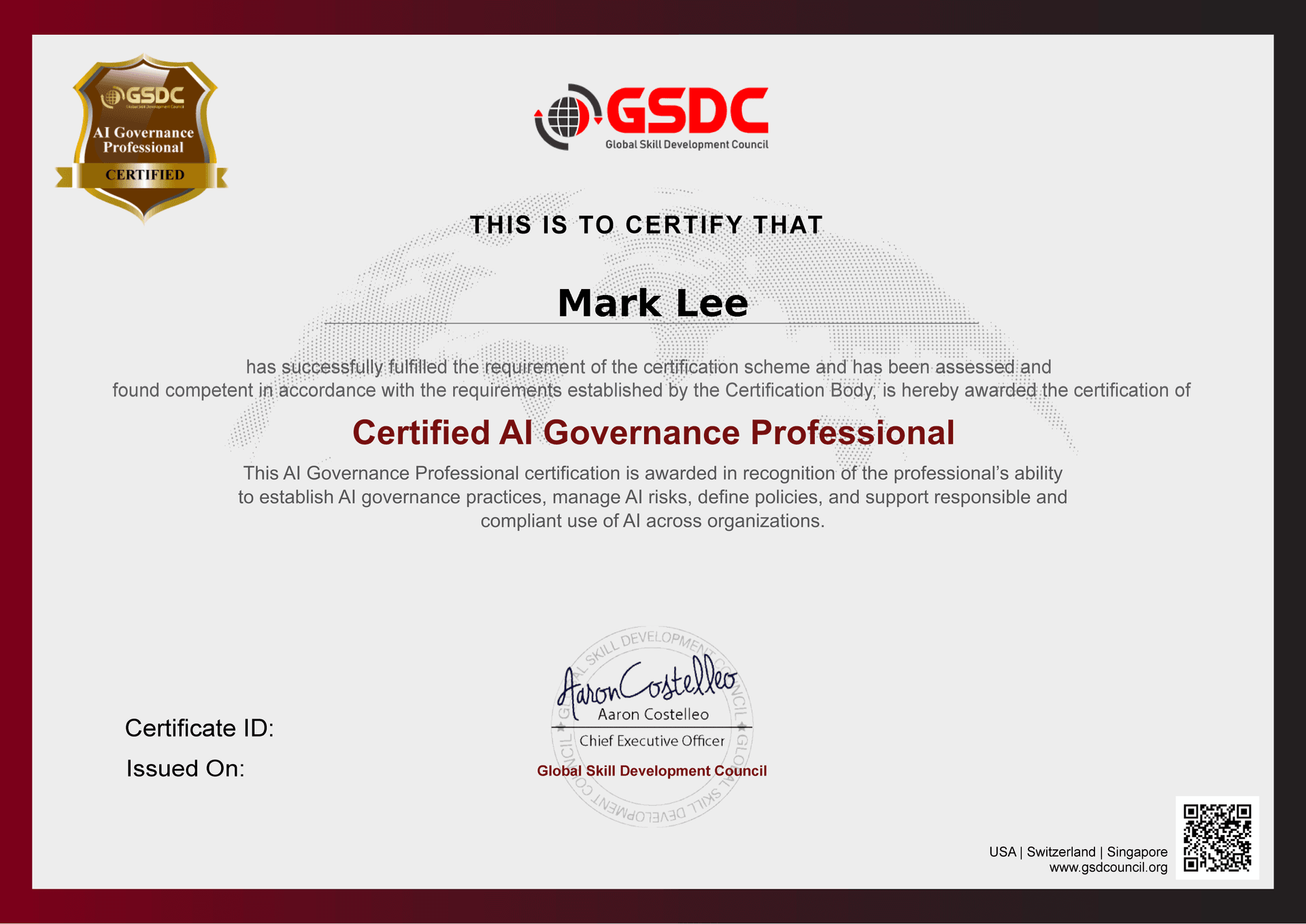
Ai Governance Professional Certification
Exam Questions - 40
Exam Format - Multiple choice
Language - English
Passing Score - 65%
Duration - 90
Open Book - No
Open Book - No
Certification Validity - 5 Years
Complimentary Retake - Yes