

AI Automation Certification | AI Automation Course & Training
NovelVista’s AI automation certification equips professionals with the practical skills required to identify automation opportunities and build intelligent, reliable workflows using LLMs, APIs, webhooks, AI agents, RAG, and modern automation technologies. This AI automation course focuses on turning repetitive business processes into practical AI-powered workflows while developing the technical and problem-solving capabilities required for real-world automation.
- In-detailed Learning Materials
- Important IT Service Management Practices.
- Real World Application Via Case Studies
- Global Recognition For IT Services.

AI Automation Course Overview
The AI automation course by NovelVista is designed to help professionals develop practical capabilities for building intelligent automation systems that connect AI models with business processes, applications, data, and workflows.
Unlike programs that focus only on AI concepts or traditional automation, this AI automation certification brings together Generative AI, LLMs, prompt engineering, APIs, webhooks, workflow orchestration, AI agents, RAG, document automation, RPA, coding, security, testing, observability, deployment, and optimization.
Participants learn how to connect AI capabilities with real business processes and create workflows that are practical, testable, secure, maintainable, and scalable. By completing this AI automation training, professionals develop multidisciplinary capabilities across AI, workflow automation, integration engineering, agentic systems, data processing, security, testing, and production deployment.
What You Will Get?
Learning Outcomes
After the completion of the course, the participants would be able to:
Training Calendar
English
- Self paced videos, assessments, recall quizzes, more
- For more details, reach us at training@novelvista.com
Includes Training, Exam & Certification
Lifetime Access
- Self paced videos, assessments, recall quizzes, more
- For more details, reach us at training@novelvista.com
Includes Training, Exam & Certification
AI Automation Curriculum
This AI automation training is designed to build practical expertise across AI-powered automation, workflow engineering, integrations, agents, RAG, document processing, hybrid automation, coding, security, testing, observability, deployment, and optimization.
Module 1: AI Automation Fundamentals & Opportunity Assessment+
This module establishes the foundation required to understand AI-driven automation and identify opportunities for its application in business processes. Learners explore how AI automation differs from traditional automation and how to evaluate potential use cases.
AI Automation Fundamentals
Understand the core concepts of AI-powered automation and how artificial intelligence can improve repetitive tasks, business workflows, and operational processes.
AI Automation vs Traditional Automation
Explore the differences between rule-based automation and AI-driven approaches. Understand when traditional automation is suitable and when AI can support more complex tasks.
Identifying Automation Opportunities
Learn how to identify repetitive, time-consuming, and process-heavy activities that may benefit from automation.
Evaluating Automation Use Cases
Understand how to assess automation opportunities based on business value, feasibility, complexity, and expected outcomes.
Automation Opportunity Prioritization
Explore how to prioritize potential automation projects based on business requirements, implementation effort, and operational impact.
Module 2: Generative AI & LLM Foundations for Automation+
This module develops the foundational knowledge required to apply Generative AI and Large Language Models within automated workflows. Learners explore how LLMs support intelligent processing, content generation, and decision-support tasks.
Generative AI Fundamentals
Understand the principles of Generative AI and how it can produce text, summaries, classifications, and other outputs for automation workflows.
Large Language Models
Explore how LLMs process inputs and generate responses, and understand their role in modern AI-powered applications.
LLMs in Automation Workflows
Learn how Large Language Models can support tasks such as information extraction, content generation, classification, summarization, and response generation.
Selecting Models for Automation
Understand how to consider model capabilities, task requirements, response quality, latency, and cost when selecting models for automation use cases.
Limitations of Generative AI
Explore common limitations, including inaccurate outputs, inconsistent responses, and context-related challenges, and understand why validation is important in automated systems.
Module 3: Prompt Engineering, Structured Outputs & Function Calling+
This module develops practical skills for controlling AI model behavior and connecting model outputs with automated actions. Learners explore prompt design, structured responses, and function calling to make workflows more consistent and useful.
Prompt Engineering Fundamentals
Learn how to create clear, specific prompts that guide AI models toward relevant outputs for business automation tasks.
Structured Outputs
Understand how to generate consistent, structured responses that can be processed by downstream applications and automation workflows.
Output Validation
Explore how to validate AI-generated outputs against expected formats, required fields, and workflow conditions before using them in subsequent steps.
Function Calling
Understand how AI models can identify and request external functions or tools to complete specific tasks within an automation process.
Connecting AI Decisions with Actions
Learn how model outputs and function calls can trigger defined actions while maintaining appropriate validation and control.
Module 4: Workflow Automation Design & Orchestration+
This module develops the ability to design and coordinate multi-step automation workflows. Learners explore how tasks, conditions, integrations, and AI-generated outputs work together to complete business processes.
Workflow Design Fundamentals
Understand the components of an automation workflow, including triggers, actions, conditions, inputs, outputs, and dependencies.
Multi-Step Workflow Automation
Learn how to connect multiple tasks into a structured workflow that processes information and completes activities in the required sequence.
Workflow Orchestration
Explore how to coordinate different applications, AI models, and automation components within a single process.
Conditional Logic and Branching
Understand how conditions and decision points direct workflows along different paths based on inputs, results, or business rules.
Workflow Error Handling
Learn how to identify and manage failures, unexpected outputs, and incomplete tasks to improve workflow reliability.
Module 5: APIs, Webhooks & Integration Engineering+
This module focuses on connecting AI systems with external applications, tools, and data sources. Learners develop the integration knowledge required to exchange information and coordinate actions across different systems.
API Fundamentals
Understand how APIs enable applications and services to exchange data and functionality within automated workflows.
API Requests and Responses
Learn how requests, response formats, authentication, and error handling support reliable communication between connected systems.
Webhooks
Explore how webhooks notify applications about events and enable workflows to respond automatically when specific conditions are met.
Connecting AI with External Applications
Understand how AI models can interact with business applications, databases, and other services through integrations.
Integration Reliability
Learn how to approach common integration challenges, including failed requests, unexpected responses, and interrupted workflows.
Module 6: AI Agents & Agentic Automation+
This module introduces AI agents and explains how they can plan, reason, use tools, and perform tasks within defined boundaries. Learners explore how agentic automation can support more dynamic and complex business workflows.
AI Agent Fundamentals
Understand the core concepts of AI agents and how they differ from conventional chatbots and predefined automation workflows.
Agent Architecture
Explore the components of AI agents, including models, tools, instructions, context, and execution mechanisms.
Planning and Task Execution
Learn how agents can break complex objectives into smaller tasks and execute actions based on the information available.
Tool Use and External Actions
Understand how AI agents can interact with external tools and applications to retrieve information or perform specific operations.
Agentic Automation Use Cases
Explore how AI agents can support business processes that require multiple steps, contextual decisions, and interactions with connected systems.
Module 7: RAG-Powered Knowledge Automation+
This module introduces Retrieval-Augmented Generation (RAG) and its role in knowledge-based automation. Learners explore how AI systems can retrieve relevant information from organizational knowledge sources to generate more contextually grounded responses.
RAG Fundamentals
Understand how Retrieval-Augmented Generation combines information retrieval with language generation to support knowledge-based applications.
Knowledge Source Integration
Explore how documents, knowledge bases, and other information sources can be connected to AI-powered automation workflows.
Information Retrieval
Learn how relevant information can be retrieved from knowledge sources based on user queries or workflow requirements.
Context-Aware Response Generation
Understand how retrieved information can provide context for AI-generated responses and support tasks requiring organization-specific knowledge.
RAG Automation Use Cases
Explore applications such as knowledge assistance, document-based question answering, internal information retrieval, and automated response generation.
Module 8: Intelligent Document & Data Automation+
This module focuses on using AI to process documents and unstructured data. Learners explore how automation workflows can extract, classify, organize, and transform information into useful outputs for business processes.
Intelligent Document Processing
Understand how AI-powered automation can process business documents and extract relevant information from their contents.
Data Extraction
Learn how to identify and extract important information from documents, text, and other unstructured sources.
Document Classification
Explore how AI can categorize documents and route them to the appropriate workflows based on their content.
Data Transformation and Enrichment
Understand how extracted information can be cleaned, structured, validated, and enriched before being used by downstream systems.
Document and Data Automation Use Cases
Explore practical applications such as invoice processing, form handling, information extraction, document routing, and automated data entry.
Module 9: RPA + AI: Hybrid Automation+
This module examines how Robotic Process Automation (RPA) and AI can work together to automate business processes involving both structured and unstructured information. Learners explore how combining these technologies can support more flexible automation solutions.
RPA Fundamentals
Understand the principles of Robotic Process Automation and how software bots execute repetitive, rule-based tasks.
AI-Enabled RPA
Explore how AI capabilities can extend traditional RPA by supporting information extraction, classification, language processing, and other tasks involving less structured data.
Combining RPA with AI Workflows
Learn how AI models and RPA bots can work together within an end-to-end automation process.
Hybrid Automation Design
Understand how to identify tasks suited to rule-based automation and those that benefit from AI-based processing.
Hybrid Automation Use Cases
Explore business scenarios where RPA and AI can support document processing, data transfer, workflow routing, and repetitive operational tasks.
Module 10: Business Process Automation Blueprints+
This module focuses on translating business requirements into structured automation solutions. Learners explore how to map processes, identify automation components, and develop repeatable blueprints for end-to-end business workflows.
Business Process Mapping
Understand how to document existing processes, identify dependencies, and recognize repetitive activities that may be suitable for automation.
Automation Blueprint Design
Learn how to translate business requirements into a structured automation plan that defines workflow steps, systems, inputs, outputs, and expected outcomes.
End-to-End Process Automation
Explore how multiple automated tasks can be connected to complete a business process from initiation to completion.
Business Rules and Decision Points
Understand how business rules, conditional logic, and decision points can be incorporated into automation blueprints.
Measuring Business Process Outcomes
Learn how to evaluate automation outcomes using relevant measures such as processing time, task completion, error rates, and operational efficiency.
Module 11: Automation Engineering with Code+
This module introduces the engineering practices required to develop customized automation solutions. Learners explore how code can extend workflow capabilities, support integrations, and provide greater flexibility for complex automation requirements.
Coding Fundamentals for Automation
Understand how programming concepts can be applied to automate tasks, process information, and connect different system components.
Custom Automation Logic
Learn how to implement customized logic for data processing, task execution, and workflow requirements that extend beyond standard automation features.
Working with APIs Through Code
Explore how code can be used to send requests, process responses, and integrate external services into automated applications.
Data Processing and Transformation
Understand how to manipulate, validate, and transform data to support reliable execution across automation workflows.
No-Code, Low-Code, and Code-Based Automation
Explore the differences between visual workflow tools and code-driven implementations, and understand how to select an approach based on project requirements.
Module 12: Securing AI Automation & Human-in-the-Loop Control+
This module addresses security considerations associated with AI-powered automation and the importance of human oversight. Learners explore how to reduce risks and establish appropriate controls for automated decisions and actions.
AI Automation Security Fundamentals
Understand the security considerations involved in connecting AI models, external tools, business applications, and sensitive information.
Data Protection and Access Control
Explore how permissions, access restrictions, and data-handling practices can help protect information used in automation workflows.
Risks in AI-Driven Workflows
Understand potential risks associated with unreliable outputs, unintended actions, inappropriate access, and interactions with external systems.
Human-in-the-Loop Control
Learn how human review and approval can be incorporated into workflows for sensitive actions, important decisions, and exception handling.
Secure Automation Design
Explore how validation, controlled tool access, approval steps, and appropriate safeguards contribute to safer automation systems.
Module 13: Testing, Evaluation & Observability+
This module focuses on evaluating AI automation systems for accuracy, consistency, reliability, and performance. Learners explore testing approaches and observability practices that help identify problems and monitor workflows.
Automation Testing Fundamentals
Understand how to test individual workflow components and complete automation processes against expected requirements.
AI Output Evaluation
Learn how to evaluate AI-generated outputs for relevance, correctness, consistency, and suitability for the intended task.
Workflow Validation
Explore how to validate task execution, data transfers, conditional logic, and integration behavior across multi-step workflows.
Monitoring and Observability
Understand how monitoring, logs, execution traces, and performance indicators help track automation behavior and identify issues.
Troubleshooting and Continuous Improvement
Learn how to investigate workflow failures, identify recurring problems, and improve automation reliability through systematic evaluation.
Module 14: Production Deployment, Scaling & Cost Optimization+
This module covers the transition from developing automation workflows to operating them in production environments. Learners explore deployment considerations, scaling strategies, performance monitoring, and cost optimization.
Production Deployment Fundamentals
Understand the considerations involved in preparing and deploying AI automation solutions for operational use.
Reliability and Operational Readiness
Learn how to prepare workflows for real-world execution by considering error handling, recovery, monitoring, and operational requirements.
Scaling Automation Workflows
Explore how automation solutions can be adapted to support increasing workloads, additional use cases, and more connected systems.
AI Automation Cost Optimization
Understand how model usage, workflow execution, processing volume, and system design can influence automation costs.
Production Monitoring and Continuous Optimization
Learn how to monitor deployed automation solutions, identify performance issues, and improve efficiency as business requirements evolve.
AI Automation Course & Certification
The AI automation certification program provides comprehensive learning across AI automation fundamentals, Generative AI, LLMs, prompt engineering, integrations, workflow orchestration, AI agents, RAG, intelligent document processing, RPA, coding, security, testing, observability, deployment, and optimization. Participants develop practical capabilities through a structured learning journey that connects AI technologies with real business processes and automation requirements. The program follows a practical, application-focused approach designed to help learners move from identifying automation opportunities to designing, building, testing, securing, and deploying AI-powered automation solutions.
Eligibility+
This AI automation training is ideal for:
- Software Developers
- Automation Professionals
- AI Professionals
- Business Analysts
- Data Professionals
- IT Professionals
- Consultants
- Project Managers
- Technology Managers
- Business Process Professionals
- Digital Transformation Professionals
- Professionals working with AI tools and workflows
- Professionals transitioning into AI automation roles
- Professionals responsible for identifying or implementing business automation opportunities
The program is particularly relevant for professionals who want to learn AI automation and apply it to practical business processes.
Training Delivery Style+
The AI automation course offers a practical and application-focused learning experience through structured learning resources, hands-on activities, assessments, projects, and AI-supported learning.
The learning experience focuses on:
- Structured AI automation learning
- Generative AI and LLM foundations
- Prompt engineering
- API and webhook integration
- Workflow design and orchestration
- AI agents and agentic automation
- RAG-powered automation
- Intelligent document and data automation
- RPA + AI hybrid automation
- Business process automation
- Coding-based automation
- AI automation security
- Human-in-the-loop controls
- Testing and evaluation
- Observability and monitoring
- Production deployment
- Scaling and cost optimization
Practical projects and assessments
The program emphasizes learning by application, helping participants develop capabilities relevant to an AI automation specialist while understanding how automation systems operate in real business environments.
Pre-Requisites+
The AI automation course is designed for professionals who want to develop practical knowledge of AI-powered automation and workflow engineering.
Recommended Knowledge
- Basic understanding of artificial intelligence concepts
- Familiarity with common business processes and workflows
- Basic understanding of software, applications, or digital tools
- Interest in AI, automation, or digital transformation
Willingness to work with practical automation scenarios
Prior expertise across every AI model, integration technology, automation platform, or coding concept covered in the program is not required. The curriculum progressively develops capabilities from automation fundamentals through advanced implementation, security, testing, and production deployment.
Course Objectives+
Upon completion of this AI automation certification, participants will be able to:
- Understand the foundations of AI-powered automation.
- Identify suitable business processes for automation.
- Evaluate automation opportunities based on business requirements.
- Work with Generative AI and LLMs in automation workflows.
- Create effective prompts and structured outputs.
- Use function calling to connect AI systems with external actions.
- Integrate AI systems using APIs and webhooks.
- Design reliable multi-step workflows.
- Build and apply AI agents for complex automation tasks.
- Use RAG to support knowledge-based automation.
- Automate document and unstructured data processing.
- Combine RPA with AI for hybrid automation.
Key Benefits+
Practical AI Automation Knowledge
Build capabilities across AI automation fundamentals, LLMs, integrations, workflow orchestration, AI agents, RAG, document processing, RPA, coding, security, testing, deployment, and optimization.
Build Intelligent Workflows
Develop the ability to connect AI models, APIs, webhooks, applications, and business processes into practical automation workflows.
AI Agent & Agentic Automation Skills
Understand how AI agents can plan, reason, and take actions to automate more complex tasks beyond traditional scripted workflows.
RAG-Powered Automation
Learn how Retrieval-Augmented Generation can connect automation workflows with relevant organizational knowledge and information.
Intelligent Document Automation
Develop capabilities for extracting, processing, classifying, and enriching information from documents and unstructured data.
Hybrid RPA + AI Automation
Understand how traditional RPA and AI can work together to automate both structured and unstructured business processes.
Secure & Controlled Automation
Learn how to incorporate security, human oversight, and appropriate controls into AI-powered automation systems.
Testing & Observability
Understand how to evaluate automation systems for accuracy and reliability while monitoring performance and troubleshooting issues.
Production-Ready Automation
Build knowledge required to deploy, scale, and optimize automation systems for sustainable production use.
Skills You Will Gain+
- AI Automation Fundamentals
- Automation Opportunity Assessment
- Generative AI
- Large Language Models
- Prompt Engineering
- Structured Outputs
- Function Calling
- APIs & Webhooks
- Workflow Automation
- Workflow Orchestration
- AI Agents
- Agentic Automation
- RAG
- Knowledge Automation
- Intelligent Document Automation
- Data Automation
Why Take This Course+
As organizations move from AI experimentation toward practical implementation, professionals need more than an understanding of AI tools. They need the ability to identify valuable use cases, connect systems, design workflows, manage risks, test outcomes, and deploy automation that works reliably in real environments.
This best AI automation course helps you:
- Build practical AI automation capabilities.
- Identify and evaluate automation opportunities.
- Connect AI models with business applications.
- Design intelligent end-to-end workflows.
- Work with APIs and webhooks.
- Build AI-agent-based automation.
- Apply RAG to knowledge-driven workflows.
- Automate documents and unstructured data.
- Combine RPA with AI.
- Develop custom automation using code.
- Build safer workflows with human oversight.
- Test and monitor automation systems.
- Prepare automation solutions for production deployment.
- Develop skills relevant to AI automation roles.
AI Automation Certification Value+
The AI automation certification demonstrates structured knowledge across the core capabilities required to design, build, evaluate, secure, and deploy AI-powered automation solutions.
Through the program, professionals develop:
- AI automation fundamentals
- Automation opportunity assessment skills
- LLM and Generative AI knowledge
- Prompt engineering capabilities
- API and webhook integration skills
- Workflow orchestration knowledge
- AI agent and agentic automation skills
- RAG implementation knowledge
- Document and data automation capabilities
- RPA + AI knowledge
- Automation engineering skills
- Security and human-in-the-loop awareness
- Testing and observability capabilities
Production deployment and scaling knowledge
The certification supports professional development for individuals pursuing roles such as AI automation specialist, AI automation engineer, automation consultant, AI professional, and digital transformation professional.
What You Will Build+
The program focuses on practical automation scenarios that demonstrate how AI can solve real business problems.
AI Customer Support Router
Build a workflow that classifies customer requests, generates responses, and routes each case to the appropriate team.
Intelligent Document Processor
Create an automation that extracts, validates, and organizes information from invoices, forms, or other business documents.
AI Lead Qualification Agent
Build an AI agent that evaluates incoming leads, assigns priority, and triggers the appropriate CRM workflow.
These projects help learners move beyond theory and develop practical capabilities that can support an AI automation engineer career path.
Why Choose NovelVista?+
- Practical, application-focused AI automation training
- Structured learning across the complete automation lifecycle
- Coverage of Generative AI and LLM foundations
- Hands-on workflow automation concepts
- APIs, webhooks, and integration engineering
- AI agents and agentic automation
- RAG-powered knowledge automation
- Intelligent document and data automation
- RPA + AI hybrid automation
- Business process automation blueprints
- Automation engineering with code
- AI automation security and human-in-the-loop controls
- Testing, evaluation, and observability
NovelVista’s AI automation certification brings together AI, workflow automation, integrations, agents, RAG, document processing, RPA, coding, security, testing, observability, and production deployment in one structured learning journey.
GSDC Accredited Certification - Exam Details
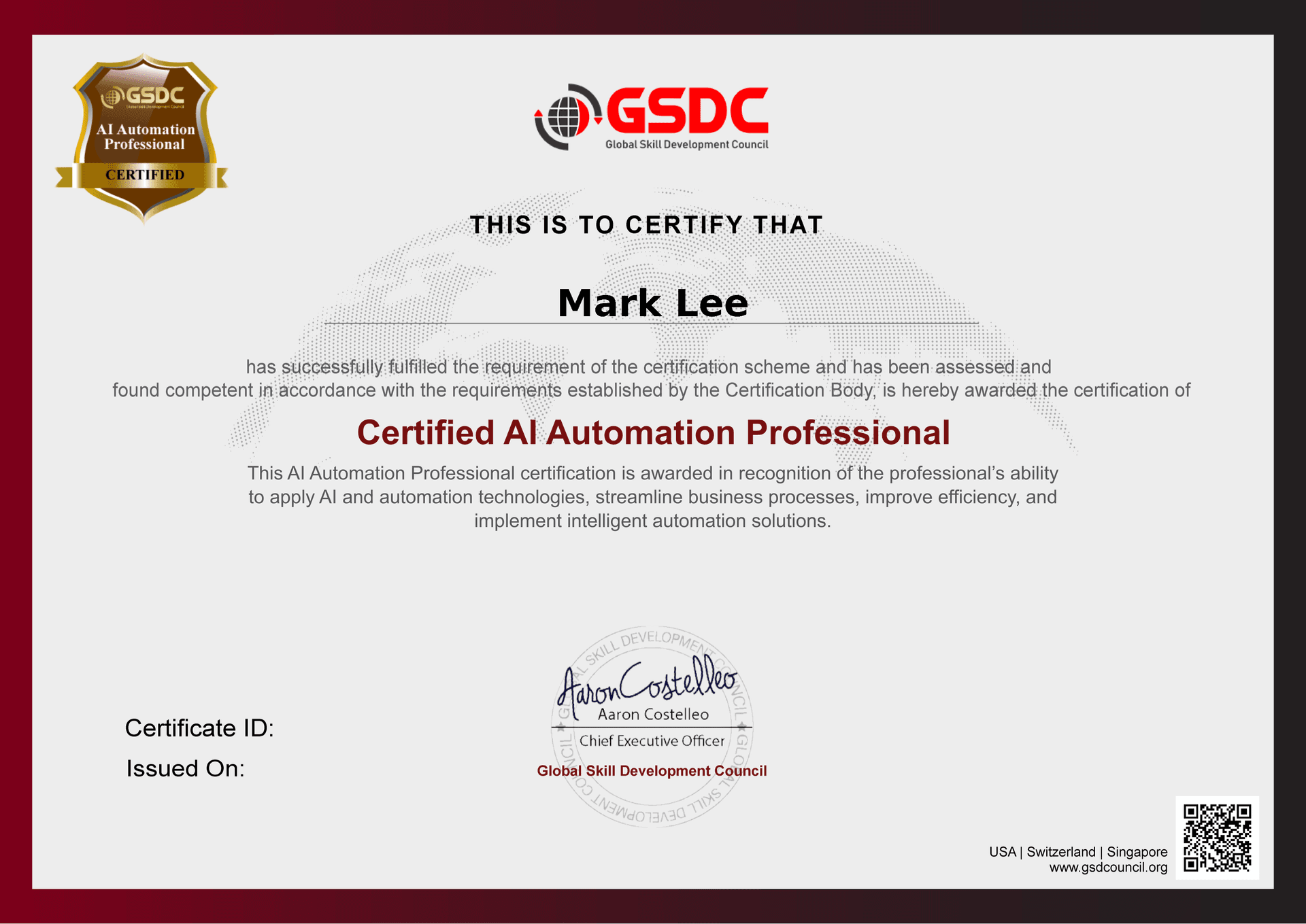
Exam Format - Objective Type, Multiple Choice
Exam Duration - 90 Minutes
No. of Questions - 40 (multiple-choice questions)
Passing Marks- 26 out of 40 (65%)
Certificate - Within 5 business days
Result - Immediately after the exam
Complimentary Retake - Yes
Close Book
Start Learning For Free
Explore the Learning Hub, our free resource center with:
- A full LMS to track your progress
- Tutorials and video lessons
- Quizzes to test yourself
- An AI tutor available when you're stuck